

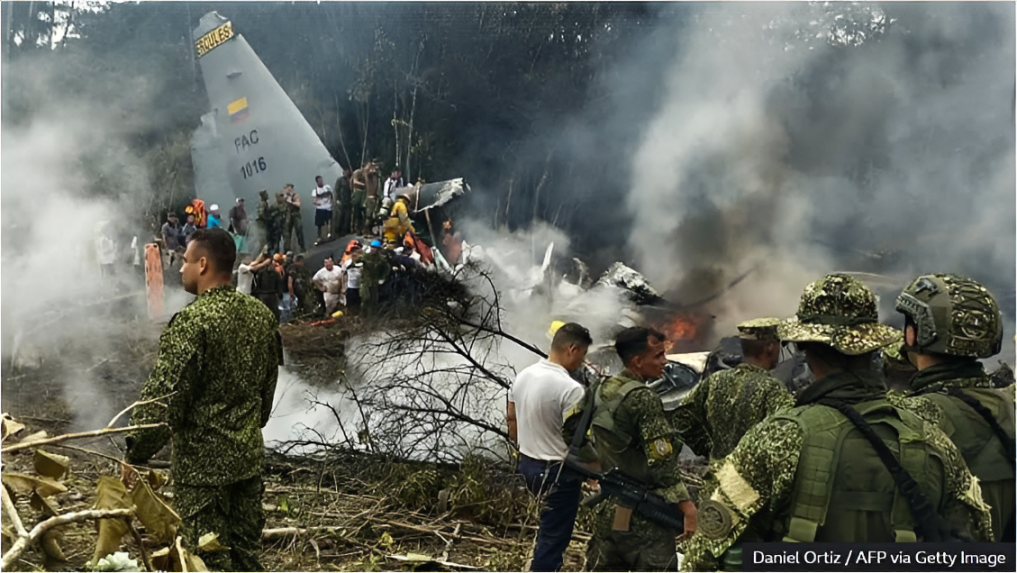
A Colombian Air Force Lockheed C‐30 Hercules transport plane carrying 128 military personnel crashed shortly after take-off from Caucaya Airport in Puerto Leguizamo on Monday 23 March, killing at least 66 people and injuring dozens more in one of the deadliest military aviation disasters in the country’s recent history.
The aircraft, which was transporting soldiers to another location within the Amazonian province of Putumayo, went down approximately 1.5 kilometres from the departure point. Defence Minister Pedro Sanchez confirmed that the impact triggered the detonation of ammunition on board, setting the wreckage ablaze and sending thick columns of black smoke into the sky above the dense jungle canopy.
Of the 128 people on board, including 11 crew members, 66 were confirmed dead: 58 from the National Army, six from the Air Force and two from the National Police. One soldier escaped unharmed, 57 military personnel were rescued and evacuated from the crash site with injuries, and four soldiers remained unaccounted for at the time of reporting. The injured were initially treated at the only two clinics in the small border town before being airlifted to hospitals in Bogota and other major cities. The Air Force dispatched two aircraft equipped with 74 medical beds to facilitate the evacuation.
Authorities have so far ruled out any involvement by illegal armed groups operating in the volatile Putumayo region, which borders both Peru and Ecuador. Air Force Commander General Carlos Fernando Silva stated that the cause of the crash had not yet been determined, noting only that the plane experienced a problem and descended roughly two kilometres from the airport. Video footage geolocated by international media showed the C‐30 lifting off before gradually losing altitude and disappearing behind the treeline.
The aircraft involved was a C‐30H Hercules, an older variant of the workhorse military transport platform that first entered service in 1965. According to Colombian aviation analyst Erich Saumeth, the specific airframe had been donated to the Colombian Air Force by the United States in September 2020 and underwent a comprehensive overhaul in 2023, during which its engines were inspected and key components replaced. Defence Minister Sanchez confirmed the plane was in airworthy condition and the crew was duly qualified.
Colombian President Gustavo Petro used the tragedy to renew longstanding calls for military modernisation, criticising what he described as bureaucratic obstacles that have delayed upgrades to ageing equipment. Writing on social media, Petro said the crash should never have happened and warned that officials who are not up to the challenge must be removed. His critics, however, pointed to reduced flight hours allocated to military aircraft under the current administration due to budget cuts, arguing that the policy has left crews with less operational experience.
The disaster comes just weeks after a Bolivian Air Force C‐30 crashed in the city of El Alto at the end of February, narrowly missing a residential area. It also follows the January crash of an aircraft near Cucuta in northeastern Colombia that killed all on board, including Congressman Diogenes Quintero. The string of incidents has intensified scrutiny of the airworthiness and lifecycle management of ageing military transport fleets across Latin America.
Deputy Mayor Carlos Claros of Puerto Leguizamo said the bodies of the victims had been transported to the town’s morgue, while local residents assisted rescue efforts by ferrying injured soldiers from the crash site on motorcycles. A spokesperson for Lockheed Martin extended condolences and said the company was committed to assisting Colombia with its investigation into the incident. The crash site remains secured as military and civilian investigators work to recover the flight data recorder and determine the sequence of events that led to the disaster. A formal investigation is expected to take several months.