

The skies over the Middle East have once again become a focal point of global aviation, not merely as transit corridors linking continents, but as a reflection of how aviation systems respond under pressure. In 2026, the region finds itself navigating a complex intersection of geopolitical sensitivity and sustained aviation ambition. The immediate picture is shaped by airspace restrictions, rerouted flights, and heightened operational awareness. Yet, beneath these developments lies a deeper and more enduring narrative—one that speaks to resilience, structural strength, and a long-term vision that continues to redefine global connectivity.
Recent weeks have seen significant disruption across parts of the Middle East’s airspace, closely linked to the ongoing U.S.–Iran conflict and its regional implications. Temporary closures and restrictions have been implemented across multiple countries, affecting some of the world’s most critical aviation corridors. Flights that traditionally passed through the Gulf have been forced to reroute either north or south, extending travel times and placing additional operational demands on airlines. Major hubs such as Dubai, Doha, and Abu Dhabi have experienced periods of reduced capacity, with operations managed through controlled airspace corridors to maintain safety and continuity.
For passengers, the experience has been marked by delays and shifting schedules. For airlines, the situation has required rapid recalibration—balancing operational efficiency with safety considerations in an environment where conditions can evolve quickly. Yet, despite these disruptions, the regional aviation system has demonstrated a notable degree of resilience. Air navigation authorities and airport operators have coordinated closely, enabling a gradual normalization of traffic flows and reinforcing confidence in the system’s ability to manage external pressures.
To understand the significance of this response, it is necessary to look beyond the immediate challenges and consider the structural foundations of Middle Eastern aviation. Unlike many other regions, where domestic travel dominates, the Middle East is fundamentally international in character. Its airports are designed as global connectors, facilitating seamless movement between continents. This model has allowed the region to build highly efficient hub-and-spoke networks, turning geographic positioning into a strategic advantage that few regions can replicate.
Airports such as Dubai International and Hamad International in Doha exemplify this approach. They are engineered for both scale and efficiency, enabling millions of passengers to transit between long-haul flights with minimal friction. These hubs are supported by airlines that have become synonymous with global connectivity and service excellence. Their operational models are built around long-haul networks that link secondary cities across continents through centralized hubs, reinforcing the region’s role as a critical نقطة in global aviation.
Carriers such as Emirates, Qatar Airways, and Etihad Airways continue to shape the identity of Middle Eastern aviation. Their fleets, composed of modern wide-body aircraft, are optimized for long-distance travel, while their service offerings remain competitive at the highest levels of the industry. Even amid recent disruptions, these airlines have maintained continuity, adjusting routes and schedules while preserving their global reach. This ability to sustain operations under pressure reflects both operational maturity and strategic foresight.
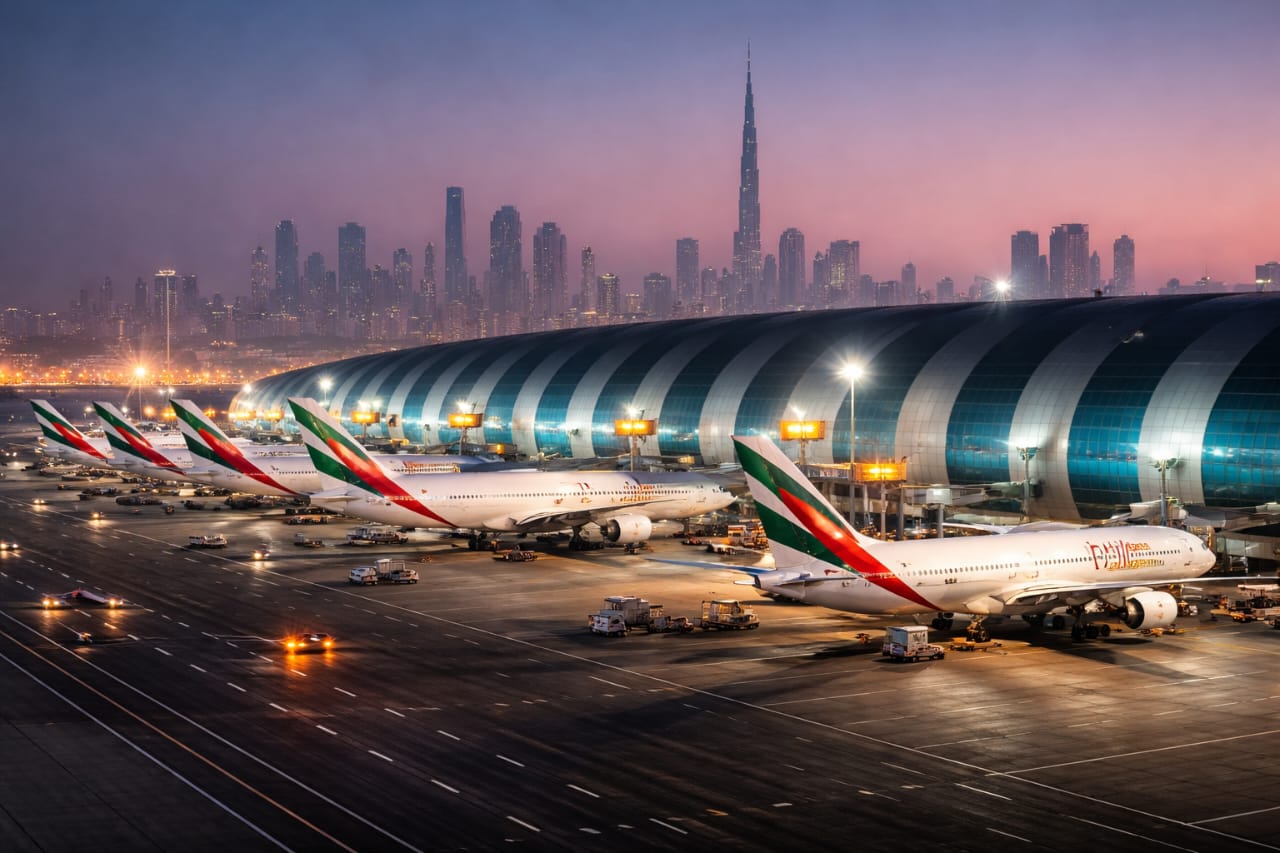
Emirates aircraft representing the scale and reach of Middle Eastern carriers.

At a broader level, aviation remains deeply integrated into the economic strategies of Middle Eastern nations. Governments across the region continue to invest heavily in infrastructure, viewing aviation as a catalyst for diversification and international engagement. Large-scale projects, including new airport developments and terminal expansions, signal a long-term commitment to maintaining and enhancing the region’s global aviation role. These investments are complemented by efforts to integrate advanced technologies, from biometric passenger processing to AI-driven operational systems.
Sustainability has also emerged as an important dimension of the region’s aviation strategy. While the industry globally faces increasing pressure to reduce its environmental impact, Middle Eastern stakeholders are exploring pathways that include sustainable aviation fuels and emerging propulsion technologies. Although these initiatives are still developing, they reflect an awareness that future growth must be aligned with environmental considerations.
Cargo operations further reinforce the region’s strategic importance. Positioned at the crossroads of major trade routes, the Middle East serves as a vital logistics hub connecting Europe, Asia, and Africa. The growth of e-commerce and evolving supply chains have increased demand for air freight, prompting investments in dedicated cargo infrastructure and partnerships. This dual role—supporting both passenger and cargo operations—enhances the resilience and economic contribution of the aviation sector.
Challenges, however, remain an inherent part of the landscape. Geopolitical volatility continues to influence operational conditions and passenger sentiment. Fuel price fluctuations and global supply chain constraints add further complexity, affecting airline costs and fleet expansion plans. These factors require constant adaptation, reinforcing the importance of flexibility within the aviation ecosystem.
What distinguishes the Middle East is its ability to navigate these challenges while maintaining a clear strategic direction. The region’s aviation model is supported by strong institutional frameworks, coordinated policy approaches, and sustained investment. This combination enables it to absorb short-term disruptions without compromising long-term objectives.
Looking ahead, the outlook for Middle Eastern aviation remains cautiously optimistic. Demand for long-haul travel is expected to grow, supported by economic development and increasing global connectivity. The region’s hubs are well positioned to capture this demand, provided that stability is maintained and infrastructure development continues at pace.
In many respects, the current situation highlights the dual nature of aviation—highly sensitive to external events, yet capable of remarkable resilience. The Middle East exemplifies this balance. While its airspace may periodically reflect the tensions of the broader region, its aviation sector continues to demonstrate strength, adaptability, and a forward-looking vision that secures its place at the center of global air travel.