
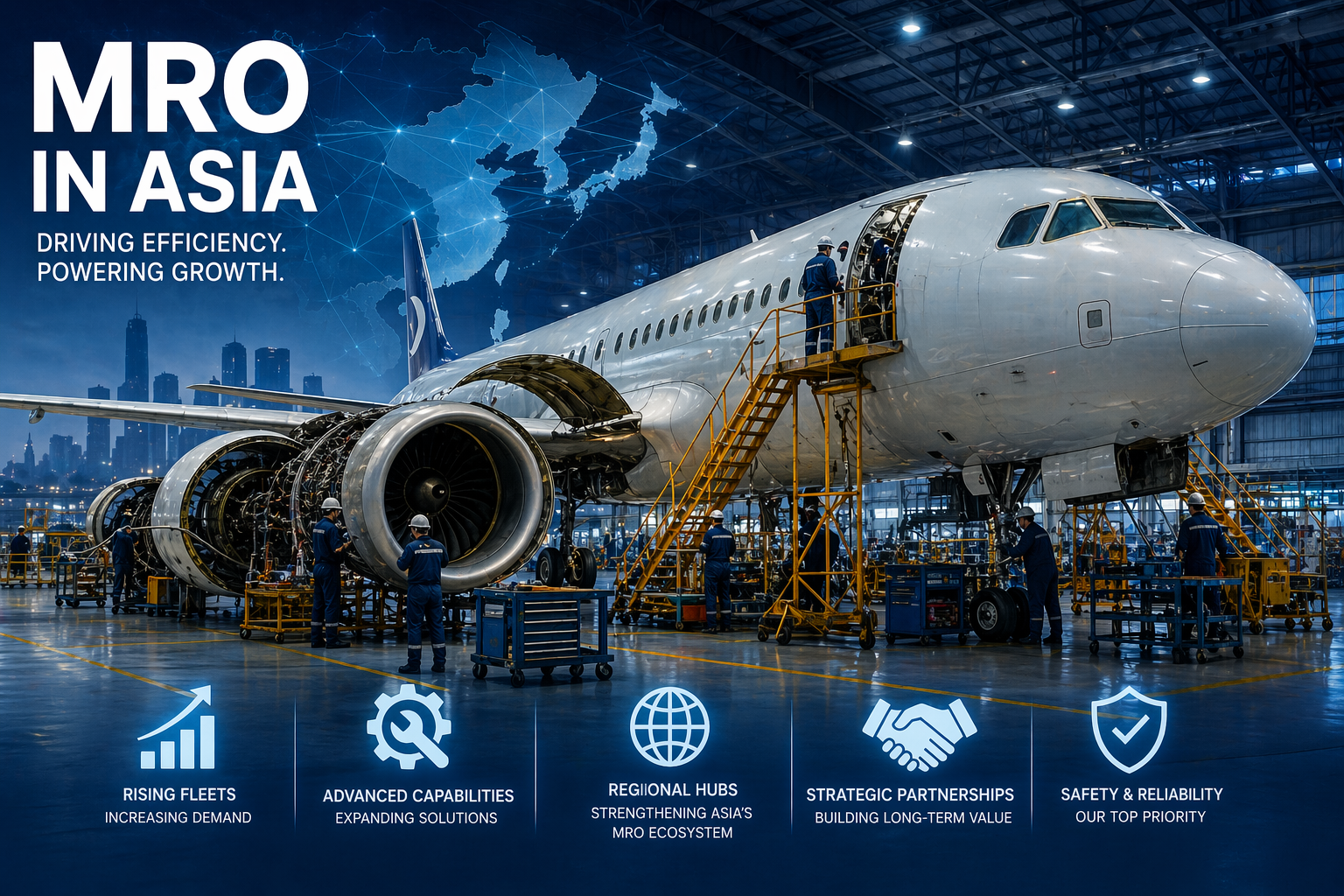
The Maintenance, Repair, and Overhaul (MRO) sector has emerged as one of the most critical pillars of the aviation industry in Asia. As air travel demand continues to expand across the region, the importance of maintaining aircraft safety, operational efficiency, and fleet longevity has intensified. Airlines are no longer viewing MRO as a backend function but as a strategic component of their operational and financial performance.
In recent years, Asia has positioned itself as one of the fastest-growing MRO markets globally. This growth is driven by a combination of expanding airline fleets, increasing passenger demand, and a structural shift toward localized maintenance capabilities. As of 2023, the Asia-Pacific MRO market was valued at approximately USD 16 billion, accounting for over 20% of global market share, with steady growth projected in the coming years
The Asia-Pacific region is widely recognized as the fastest-growing aviation market, and this trajectory directly impacts MRO demand. The continued expansion of low-cost carriers, combined with increasing connectivity between secondary cities, has led to higher aircraft utilization rates. This, in turn, drives the need for more frequent maintenance cycles and advanced overhaul capabilities.
Southeast Asia, in particular, has demonstrated strong growth momentum. The regional MRO market is expected to expand significantly, supported by increasing aircraft fleets and rising safety requirements. Estimates indicate that the Southeast Asian MRO market alone could exceed USD 7 billion by 2030, reflecting strong double-digit growth trends
Beyond Southeast Asia, Northeast Asia, particularly China, Japan, and South Korea is also emerging as a major MRO powerhouse. Governments and industry stakeholders are investing heavily in infrastructure, workforce development, and technological capabilities to strengthen domestic MRO ecosystems.
Key Drivers of MRO Expansion
Several structural factors are shaping the rapid growth of the MRO industry in Asia.
Fleet Expansion and Aircraft Utilization
Asia continues to witness significant fleet growth, with airlines placing large aircraft orders to meet rising demand. Increased utilization of aircraft, especially among low-cost carriers, accelerates wear and tear, driving demand for maintenance services.
Aging Aircraft and Delivery Delays
Global supply chain disruptions and delays in new aircraft deliveries have extended the operational life of existing fleets. Airlines are retaining older aircraft longer, which requires more intensive maintenance and overhaul services. This trend has created a surge in demand for MRO services across the region, with operators increasingly relying on maintenance solutions to sustain operations.
Cost Efficiency and Localization
Historically, many Asian airlines relied on overseas MRO providers, particularly in Europe and North America. However, there is a growing shift toward localized MRO capabilities to reduce costs, improve turnaround time, and enhance operational control. Countries such as Singapore, Malaysia, and India are actively positioning themselves as regional MRO hubs.
The MRO industry in Asia is undergoing a structural transformation, driven by strategic investments and partnerships.
Major global players, including OEMs and independent MRO providers, are expanding their presence in the region through joint ventures and facility development. This includes the establishment of new maintenance hangars, engine repair facilities, and component service centers.
For example, recent developments across Asia highlight increasing investment in MRO infrastructure, with new large-scale facilities being planned to support both domestic and international fleets. These investments are aimed at strengthening regional self-reliance and reducing dependency on external service providers.
At the same time, technology is playing a growing role in MRO operations. The adoption of predictive maintenance, digital platforms, and data analytics is improving efficiency and reducing downtime. These innovations allow operators to anticipate maintenance needs rather than react to failures, enhancing overall fleet reliability.
Operational Challenges
Despite strong growth, the MRO sector in Asia faces several operational challenges that must be addressed to sustain long-term development.
Workforce and Skills Gap
The rapid expansion of the aviation industry has created a shortage of skilled technicians and engineers. Training and retaining qualified personnel remain critical challenges for MRO providers across the region.
Supply Chain Constraints
The availability of spare parts and components continues to impact maintenance timelines. Global disruptions have increased turnaround times, particularly for engine maintenance, which remains one of the most complex and resource-intensive areas of MRO.
Rising Complexity of Aircraft Technology
Modern aircraft are equipped with advanced systems that require specialized expertise and equipment. As technology evolves, MRO providers must continuously invest in training and infrastructure to remain competitive.
A notable trend in Asia’s MRO landscape is the emergence of regional hubs. Countries are actively developing integrated aviation ecosystems that combine maintenance capabilities with logistics, training, and manufacturing.
Singapore remains a leading MRO hub due to its established infrastructure and strong regulatory environment. Malaysia is also gaining momentum, supported by growing investments and expanding service capabilities. Meanwhile, India is positioning itself as a future MRO powerhouse, with significant government support aimed at reducing reliance on foreign maintenance services.
These developments reflect a broader strategic shift toward regional self-sufficiency, where countries aim to capture a larger share of the MRO value chain.
Industry Insight
The future of MRO in Asia is not defined solely by demand, but by the region’s ability to build capability, efficiency, and self-reliance.
The transition from outsourcing to localized MRO services represents a fundamental shift in how airlines approach maintenance strategy. This shift is expected to reshape the competitive landscape, with regional players gaining greater influence.
Looking ahead, the outlook for Asia’s MRO industry remains highly positive. Continued growth in air travel, combined with fleet expansion and technological advancement, will sustain strong demand for maintenance services.
At the same time, the industry is expected to become more integrated and technologically advanced. Digitalization, automation, and predictive maintenance will play increasingly important roles in shaping future MRO operations.
As of 2025–2026, the MRO sector is entering a new phase of development, one that emphasizes efficiency, resilience, and regional capability. The ability to balance these factors will determine the long-term success of both operators and service providers.
Asia’s MRO industry is evolving rapidly, driven by strong demand fundamentals and strategic transformation. From infrastructure expansion to technological adoption, the region is building a more robust and self-sustaining aviation ecosystem.
For airlines, MRO is no longer a support function but a critical enabler of operational performance. For governments and investors, it represents a key opportunity to strengthen national aviation capabilities and capture long-term value. As the aviation industry continues to grow, the role of MRO in Asia will only become more central, supporting not just aircraft, but the entire future of regional air transport.
Editorial Note
This case study is based on publicly available industry developments and is intended for informational purposes only.