
Southeast Asia’s aviation growth story has traditionally been associated with larger fleets, high-density routes and the relentless expansion of low-cost travel. But the next phase of regional growth could look very different.
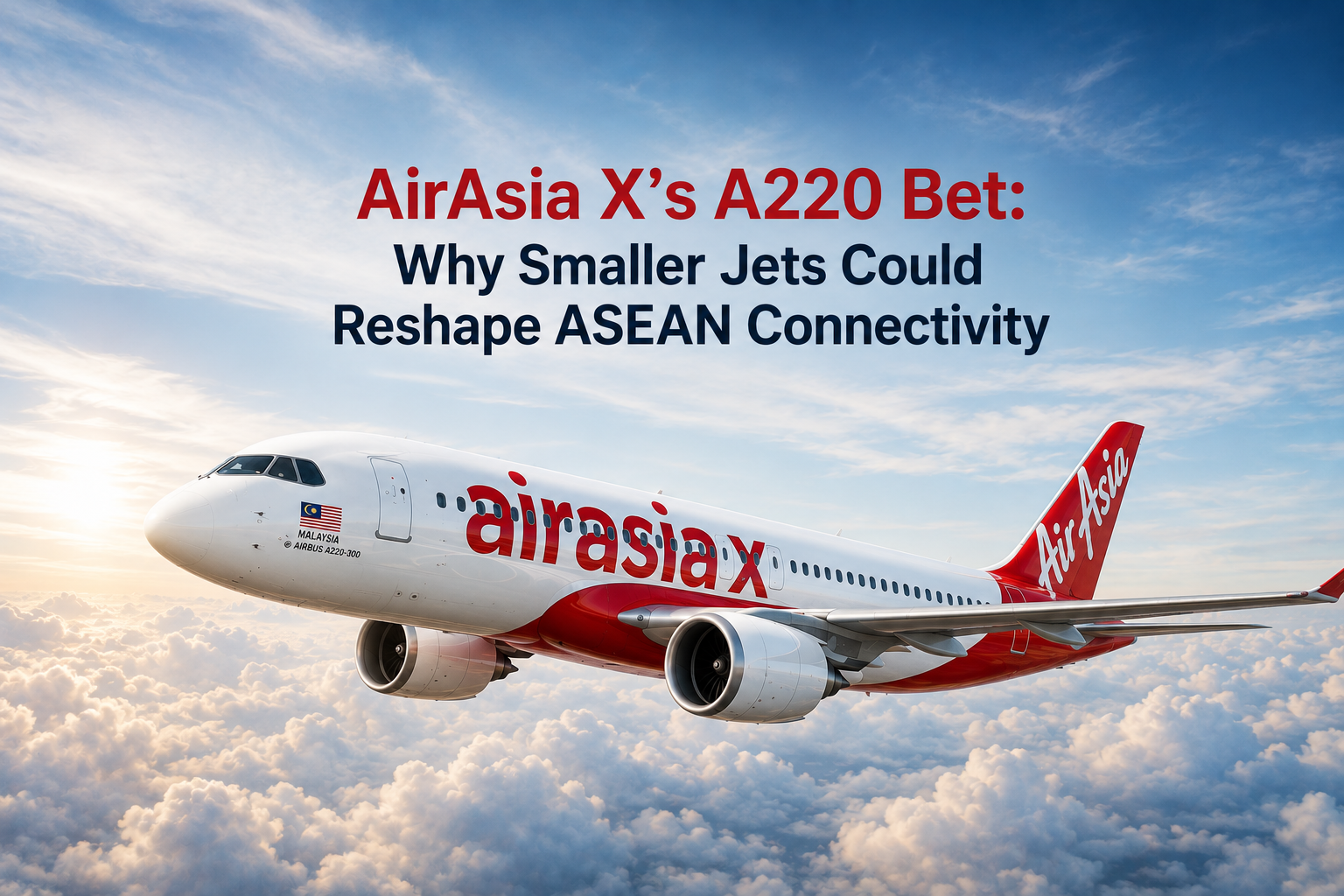
AirAsia X’s move toward the Airbus A220-300 has placed renewed attention on a category of aircraft that could become increasingly important to Asia: smaller, efficient jets capable of connecting markets that may not justify larger narrow-body aircraft.
The significance goes beyond another fleet announcement. For Malaysia and the wider ASEAN aviation sector, it raises a more strategic question: could the next wave of regional connectivity be built not only through major hubs and high-volume routes, but through direct links between secondary cities?
A Different Growth Model for Asia
The Malaysia Aerospace Industry Association has highlighted AirAsia X’s planned acquisition of 150 Airbus A220-300 aircraft, describing the commitment as potentially significant for Malaysia’s aerospace ecosystem and regional connectivity.
The A220 occupies an interesting position in the commercial aircraft market. It is smaller than the aircraft traditionally associated with the AirAsia group’s high-density operating model, but its range and economics can potentially make routes with lower passenger volumes commercially more attractive.
That matters in ASEAN.
The region contains hundreds of cities separated by relatively short and medium distances, yet a considerable proportion of international travel continues to depend on major gateways and connecting flights.
Kuala Lumpur, Singapore, Bangkok, Jakarta, Manila and increasingly Ho Chi Minh City remain critical hubs. But Southeast Asia’s economic development is increasingly extending beyond its largest capitals.
Penang, Johor Bahru, Kota Kinabalu, Kuching, Da Nang, Chiang Mai, Surabaya, Cebu and numerous other secondary markets represent another layer of potential aviation demand.
The challenge has always been matching aircraft capacity with that demand.
The Economics of the Right Aircraft
Putting a large aircraft onto a developing route can create considerable commercial pressure if passenger volumes are insufficient.
Smaller aircraft can change that equation. Rather than waiting until a market can consistently support a larger narrow-body aircraft, airlines potentially gain the ability to establish direct connectivity with fewer seats that need to be filled on each departure. This could allow carriers to experiment with routes that previously appeared commercially marginal. It could also support greater frequency.
For passengers, frequency is often as important as capacity. A destination served several times per week may attract a different passenger profile from one offering convenient daily connectivity. For business travellers in particular, schedule flexibility can determine whether a route becomes genuinely useful. The strategic value of an aircraft such as the A220 therefore lies not simply in carrying fewer passengers. It lies in potentially allowing airlines to deploy the right capacity into the right market at the right frequency.
Malaysia’s Opportunity
For Malaysia, the implications could be particularly significant. The country already possesses one of Southeast Asia’s most developed aviation ecosystems, supported by Kuala Lumpur International Airport, established airlines, aerospace companies, maintenance capabilities and a substantial aviation workforce. Malaysia is also geographically positioned between major Southeast Asian economies. But the country’s future aviation competitiveness will depend on more than the performance of Kuala Lumpur as an international gateway. Greater connectivity from Malaysian cities directly into regional markets could expand tourism, business travel and economic links without requiring every journey to pass through the largest hubs. The concept is not about replacing hub-and-spoke aviation.
Major hubs will remain fundamental to global aviation. Instead, smaller aircraft could complement the hub system by creating another layer of connectivity beneath it.
ASEAN’s Secondary Cities Are Becoming More Important
The economic geography of Southeast Asia is changing. Manufacturing investment, technology industries, tourism and increasingly sophisticated consumer markets are spreading into cities that historically received less international air connectivity. At the same time, ASEAN’s population exceeds 680 million people. As incomes rise and regional economic integration deepens, demand for intra-Asian travel is likely to become increasingly diverse.
The next important aviation market may therefore not necessarily be another Kuala Lumpur–Bangkok or Singapore–Jakarta. It could be a connection between two secondary cities currently requiring passengers to transit through a major hub. Creating enough of these connections could gradually redraw the region’s aviation map.
A220 Strategy Goes Beyond Passenger Numbers
Fleet decisions are among the most consequential investments an airline makes. Aircraft influence network planning, operating costs, airport compatibility, crew requirements, maintenance infrastructure and route economics for decades.
That makes AirAsia X’s A220 strategy worth watching beyond the headline number. If deployed effectively, the aircraft could allow the group to explore markets that sit between traditional regional aviation and longer-range narrow-body operations. But aircraft alone do not guarantee successful routes.
Network planning remains fundamental. Airlines must evaluate passenger demand, yields, airport costs, tourism flows, corporate travel patterns and competitive responses before opening new destinations. The A220 provides another tool. How effectively that tool is used will ultimately determine the commercial outcome.
Wider Implications for Malaysia’s Aerospace Industry
There is another dimension to the story. A fleet of this scale could potentially generate opportunities extending beyond airline operations. Aircraft require maintenance, engineering support, components, training, technical services and skilled aviation professionals throughout their operating lives. Malaysia already has ambitions to strengthen its position within the regional aerospace supply chain.
A significant new aircraft fleet based within the Malaysian aviation ecosystem could therefore have implications for MRO providers, aviation training organisations, engineering talent and supporting industries. The long-term economic value of an aircraft order should consequently not be measured solely by the number of aircraft acquired. The more important question is how much supporting aviation capability develops around those aircraft.
Asia’s Aviation Map Is Changing
Across Asia, airlines are increasingly examining how they can serve markets more precisely. Widebody aircraft remain essential for high-volume long-haul operations. Larger narrow-body aircraft will continue dominating many regional routes. But the enormous diversity of Asian markets means there is unlikely to be a single aircraft solution for every network. The emergence of smaller, longer-range and more efficient aircraft creates additional possibilities.
For ASEAN, where geography, population density and rapidly developing secondary cities intersect, those possibilities are particularly interesting. AirAsia X’s A220 strategy should therefore be viewed as more than a fleet story. It represents an experiment in how one of Asia’s most recognisable aviation groups sees the next generation of regional growth. If that strategy succeeds, the most important result may not simply be additional aircraft in Malaysian skies.
It could be new city pairs, new passenger flows and a more connected ASEAN aviation network.
My Aviation Analysis
The development reflects a broader industry question: as Asia’s aviation market matures, future growth may increasingly depend not on putting more seats onto established routes, but on using the right aircraft to create markets that did not previously exist.