

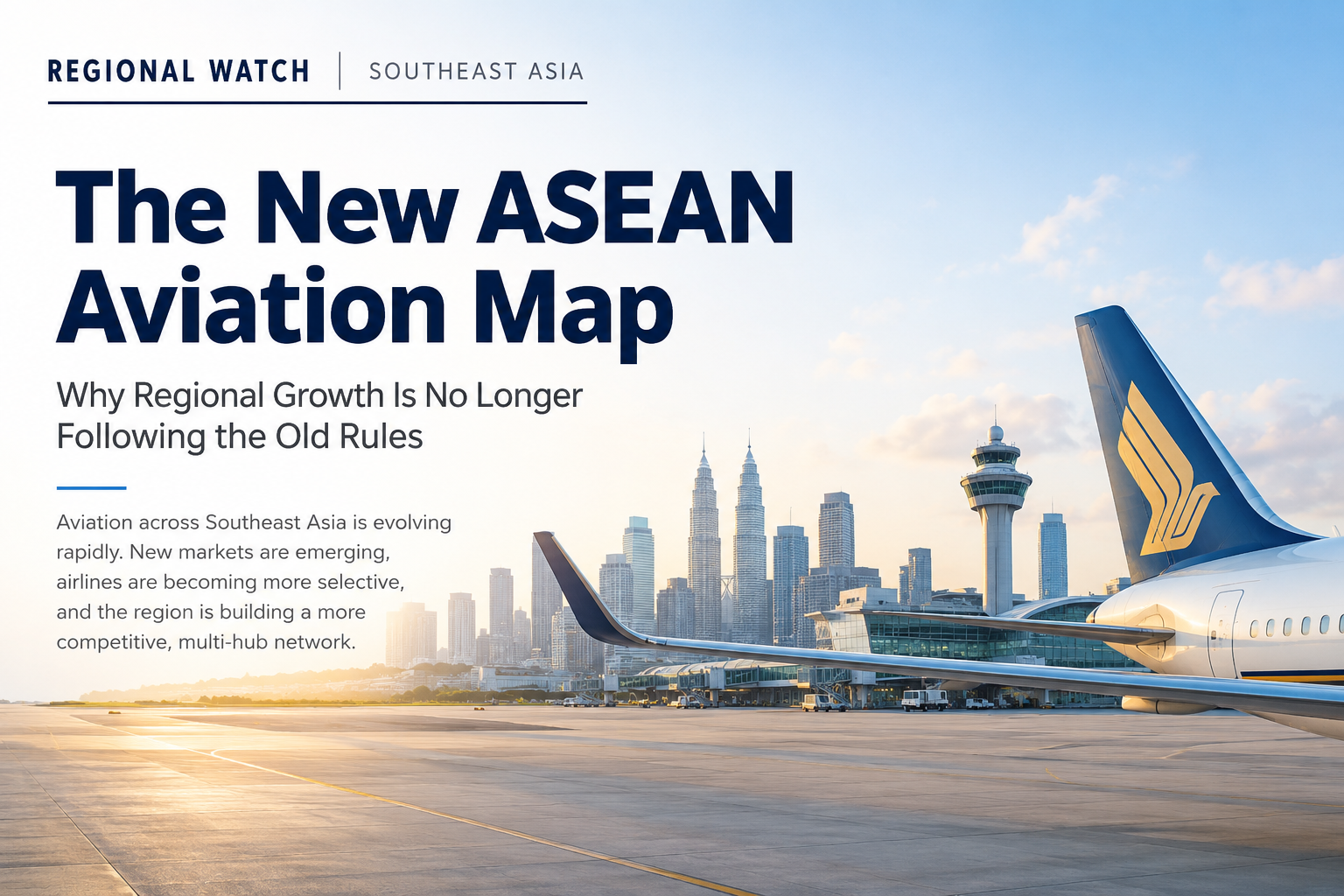
FEATURED ANALYSIS | NETWORK STRATEGY
For decades, Asian aviation growth has been closely associated with its great hubs.
Singapore. Kuala Lumpur. Bangkok. Jakarta. Hong Kong. Seoul. Tokyo.
These cities remain enormously important. Their airports concentrate passengers, airlines, cargo and international connectivity on a scale that smaller markets cannot easily replicate.
But Asia’s next major aviation opportunity may increasingly be found somewhere else.
It may be found in the cities that passengers once had to connect through those hubs to reach.
Across Asia, economic development, rising incomes, tourism and new-generation aircraft are creating conditions in which more secondary cities can support direct air services. The implications extend far beyond simply adding another route to an airline’s network.
A gradual shift toward direct regional connectivity could change how airlines deploy aircraft, how airports compete and even how businesses choose where to invest.
The Hub Model Is Powerful — But Not Perfect
Large hubs work because they consolidate demand.
An airline can bring passengers from many smaller markets into one airport and transfer them onto flights to destinations that might otherwise be unable to support nonstop services.
The model has built some of Asia’s greatest aviation success stories.
But passengers pay a price for that efficiency: time.
A journey between two relatively nearby Asian cities can sometimes require flying to a major hub, waiting several hours and then flying back toward the final destination.
For airlines, that arrangement makes commercial sense when direct demand is insufficient.
But when demand grows, the equation begins to change.
A city pair that once generated 30 passengers a day might eventually generate 80, then 120.
At some point, a direct service becomes possible.
That is where the opportunity begins.
Aircraft Technology Is Changing Route Economics
Aircraft capability has historically shaped airline networks.
Large aircraft require substantial passenger demand. Smaller aircraft require fewer passengers but traditionally came with compromises in range or operating economics.
That distinction is becoming less rigid.
Modern narrowbody and smaller mainline aircraft can operate increasingly long sectors with considerably greater efficiency than previous generations.
For network planners, this creates options.
Instead of asking whether a market can fill a large aircraft every day, airlines can consider whether a smaller aircraft operating at the right frequency can make the route commercially sustainable.
This is particularly relevant in Asia, where enormous populations are distributed across hundreds of economically significant cities.
The opportunity is not simply smaller aircraft.
It is better matching capacity to demand.
Southeast Asia Is Particularly Well Positioned
Few regions demonstrate the potential better than Southeast Asia.
ASEAN’s geography naturally favours air travel.
Indonesia and the Philippines are archipelagic nations. Vietnam stretches more than 1,600 kilometres from north to south. Malaysia is divided between Peninsular Malaysia and East Malaysia. International borders separate cities that may nevertheless have strong commercial, cultural or tourism relationships.
The traditional capitals will remain important.
But Penang, Johor Bahru, Kota Kinabalu, Da Nang, Chiang Mai, Phuket, Surabaya, Cebu and numerous other cities represent substantial aviation markets in their own right.
As these economies develop, passengers may increasingly question why every international journey must pass through a capital-city hub.
Tourism Could Be One of the Biggest Winners
Direct aviation connectivity can transform destinations.
A tourist considering a four-day holiday may tolerate a seven-hour nonstop flight.
They may be considerably less enthusiastic about a five-hour journey that becomes nine hours because of a connection.
Removing that connection changes the attractiveness of the destination.
This is particularly important for secondary tourism markets.
A destination does not necessarily need millions of additional visitors to justify a new route. It needs enough passengers, travelling consistently enough, at fares capable of supporting the operation.
Once direct air service begins, another effect can occur.
Connectivity itself can stimulate demand.
People travel because the flight exists.
Businesses establish relationships because access becomes easier.
Tour operators develop packages.
Hotels receive new markets.
Air connectivity therefore does not simply respond to economic activity.
It can help create it.
Business Travel Could Follow
The same principle applies to investment.
Companies consider transportation when deciding where to locate operations.
An industrial city connected directly to major regional markets becomes easier for executives, suppliers, engineers and customers to reach.
That makes aviation infrastructure part of economic competitiveness.
Secondary airports therefore should not view themselves simply as smaller versions of major hubs.
Their strategy can be different.
Rather than attempting to attract every airline, they can identify specific city pairs where trade, tourism, education or industrial relationships already exist and work with airlines to develop sustainable demand.
But Not Every Direct Route Will Work
There is a danger in becoming too enthusiastic about point-to-point connectivity.
Airline economics remain unforgiving.
A route can look attractive on a map and still lose money.
Passenger numbers alone are insufficient. Airlines must consider fares, seasonality, aircraft utilisation, airport costs, competition and whether passengers travel in both directions.
Frequency matters too.
A route operating twice weekly may appeal to leisure passengers but be unattractive to business travellers who require flexibility.
This is why disciplined network planning matters.
The objective should not be to connect every secondary city directly.
It should be to identify the city pairs where direct connectivity creates genuine economic value.
Major Hubs Are Not Going Away
None of this means Singapore Changi, Kuala Lumpur International Airport, Bangkok Suvarnabhumi or the other great Asian hubs are becoming irrelevant.
Quite the opposite.
Large hubs will remain essential for long-haul connectivity and markets where passenger volumes cannot support direct flights.
The more interesting possibility is that their role evolves.
Asia’s aviation network could increasingly operate through a combination of powerful hubs and expanding point-to-point services.
Passengers travelling between smaller markets may fly directly.
Passengers travelling to thinner international destinations may continue connecting through major hubs.
The two models can coexist.
Malaysia Should Pay Attention
This development has particular relevance for Malaysia.
Kuala Lumpur will remain the country’s principal international gateway.
But Malaysia has several cities capable of playing larger regional aviation roles.
Penang has tourism and industrial demand.
Johor benefits from its position beside Singapore and its growing economy.
Kota Kinabalu is strategically positioned toward Northeast Asia and the wider Borneo region.
Kuching has potential as Sarawak continues developing its tourism and economic ambitions.
The opportunity is not to turn every airport into another KLIA.
It is to identify what each airport can realistically become.
That distinction is important.
Successful aviation strategy should be based on market demand rather than prestige.
Asia’s Aviation Map Could Become Much More Complex
The first great expansion of Asian aviation connected major cities.
The low-cost revolution then made those connections affordable to millions more people.
The next phase could be about density — filling the gaps between those major routes.
More city pairs.
More direct services.
More specialised aircraft deployment.
And more regional airports participating meaningfully in international aviation.
The airlines that succeed will not necessarily be those with the largest fleets.
They may be those with the clearest understanding of where passengers actually want to travel — and the discipline to deploy exactly the right aircraft to take them there.
Asia’s biggest airports will continue to dominate the headlines.
But some of the region’s most interesting aviation growth may happen far away from them.
My Aviation | Featured Analysis | 28 August 2026