
SPECIAL REPORT | MALAYSIA AVIATION
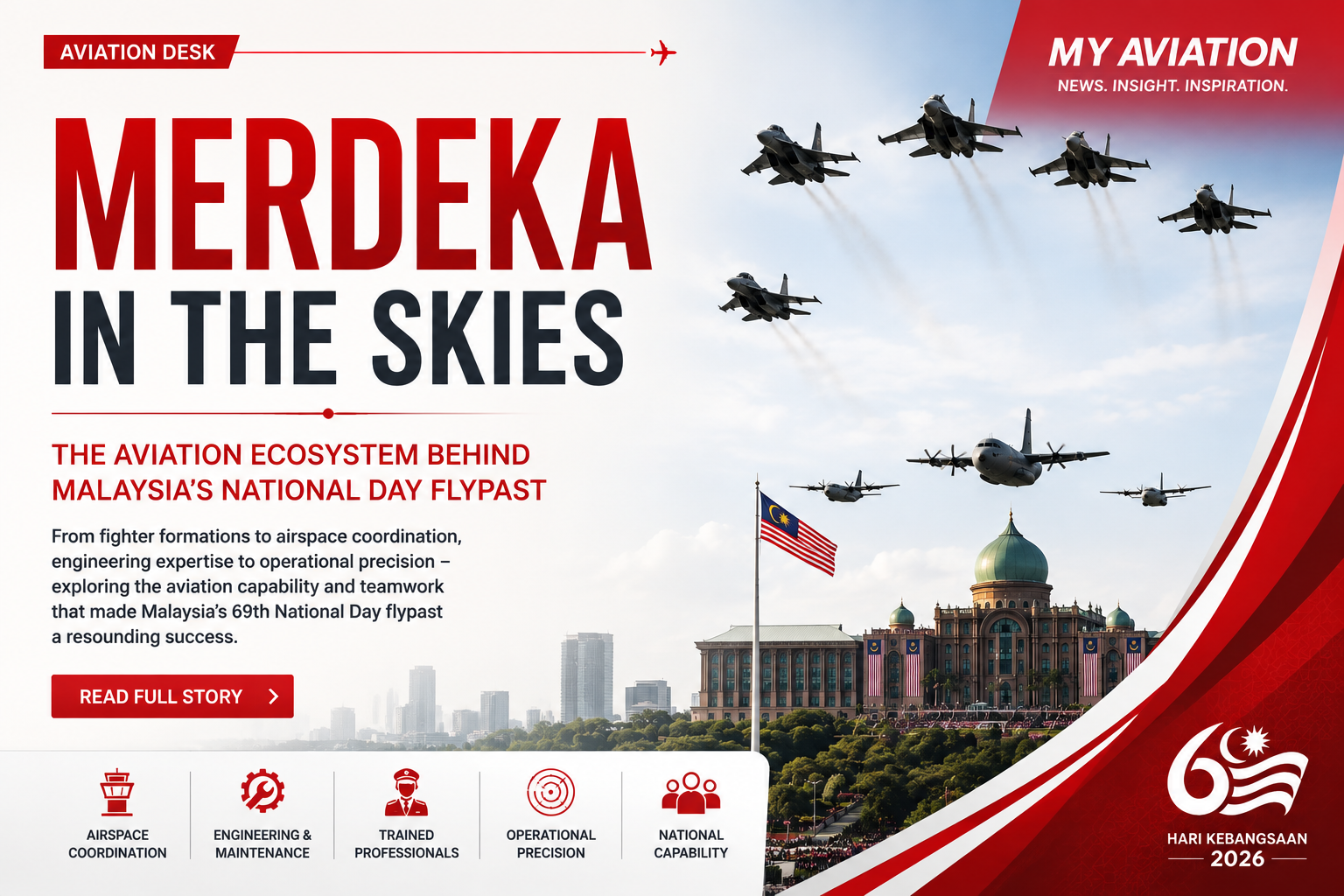
Malaysia’s 69th National Day celebrations brought a powerful display of aviation capability to the skies above Putrajaya, as military aircraft, transport planes and helicopters took part in a carefully coordinated aerial presentation that became one of the highlights of Merdeka 2026.
Led by Royal Malaysian Air Force chief General Tan Sri Muhamad Norazlan Aris from the cockpit of a Sukhoi Su-30MKM, the main fighter display involved four Su-30MKMs, four F/A-18D Hornets and three BAE Hawk 208 aircraft. The fighters performed a series of coordinated formations over the administrative capital, demonstrating the precision and operational discipline required for a large-scale national aviation display.
Beyond the spectacle, however, the flypast provided a glimpse into a much larger aviation ecosystem.
Every aircraft appearing above Putrajaya depended on extensive preparation on the ground. Engineers and technicians were responsible for aircraft serviceability, while pilots underwent detailed planning and rehearsals. Flight operations personnel, air traffic controllers, safety teams and ground crews were required to work within tightly coordinated operational parameters.
The aircraft may have been what Malaysians saw in the sky, but the success of the operation depended equally on the professionals who remained largely unseen.
The display also demonstrated the relationship between military and civil aviation. The Civil Aviation Authority of Malaysia temporarily restricted airspace within the Kuala Lumpur Terminal Control Area to accommodate National Day aviation activities safely. For the official August 31 flypast, scheduled departures and arrivals at Kuala Lumpur International Airport were temporarily affected during the designated operating window.
For an international airport operating within one of Southeast Asia’s busiest aviation environments, such coordination is significant. Commercial traffic, military operations and ceremonial flights cannot function independently when they share the same airspace. Each movement has to be planned within a wider safety framework.
The National Day operation therefore highlighted an aspect of aviation that passengers rarely encounter directly: airspace itself is critical national infrastructure.
As Malaysia’s aviation environment becomes increasingly complex, effective airspace management will become even more important. Commercial aircraft, military operations, helicopters, general aviation and unmanned aircraft systems are increasingly operating within the same national aviation environment. Managing those activities safely requires technology, regulation and highly trained professionals.
The Merdeka display also placed attention on Malaysia’s technical aviation capability.
Modern military aircraft require extensive engineering and maintenance support. Their ability to depart, perform demanding manoeuvres and return safely depends on the work of technicians and engineers long before a pilot enters the cockpit.
The same principle applies across commercial aviation. An aircraft has little operational value unless a country possesses the technical expertise required to keep it airworthy.
This is particularly relevant as Malaysia seeks to strengthen its wider aerospace industry. The country already possesses significant aviation assets, including international airports, airlines, military aviation, maintenance and repair capabilities, aerospace manufacturing and aviation training institutions.
The challenge is increasingly about connecting those capabilities.
Malaysia’s future as an aviation nation will not be determined solely by the number of aircraft operating within the country or the size of its airports. It will also depend on whether Malaysia can continue developing pilots, engineers, technicians, air traffic controllers, safety specialists and aviation leaders capable of supporting a more sophisticated aerospace ecosystem.
The National Day flypast offered a visible demonstration of that human capability.
Transport aircraft including the A400M Atlas, C-130H Hercules and CN235 also participated in the wider aviation presentation, alongside helicopters from different Malaysian government agencies. Their participation demonstrated that aviation capability extends far beyond fighter aircraft.
Transport aviation, rotary-wing operations, emergency response and military aviation each require different operational capabilities, but all depend on common foundations of training, maintenance, coordination and safety.
This is where the significance of the Merdeka flypast extends beyond the celebration itself.
Malaysia has spent decades developing an aviation ecosystem spanning civil and military operations. KLIA has become a major international gateway, Subang remains an important aerospace and aviation centre, Malaysian companies participate in global aerospace supply chains, and the country has established capabilities in aircraft maintenance and technical training.
The opportunity now is to turn these individual strengths into a stronger national aviation proposition.
That will require continued investment not only in infrastructure and aircraft, but also in people.
Aircraft can be purchased. New terminals can be constructed. Technology can be imported.
Experienced aviation professionals take years to develop.
For Malaysia, maintaining a strong pipeline of aviation talent will therefore be as important as acquiring the next generation of aircraft or expanding airport capacity.
The skies above Putrajaya provided an impressive reminder of what the country has already achieved.
But perhaps the more important story was happening behind the scenes.
For every aircraft passing above the National Day celebrations, there were engineers who prepared it, controllers who managed the airspace, crews who supported its departure, planners who coordinated the operation and pilots entrusted to execute the mission.
The aircraft created the spectacle.
The people and aviation system behind them demonstrated Malaysia’s real capability.
As the country celebrates 69 years of independence, the question for Malaysian aviation is no longer simply what it can display in the skies today.
It is how that capability can be developed into an even stronger aviation and aerospace industry for the decades ahead.
My Aviation | Special Report | 31 August 2026