

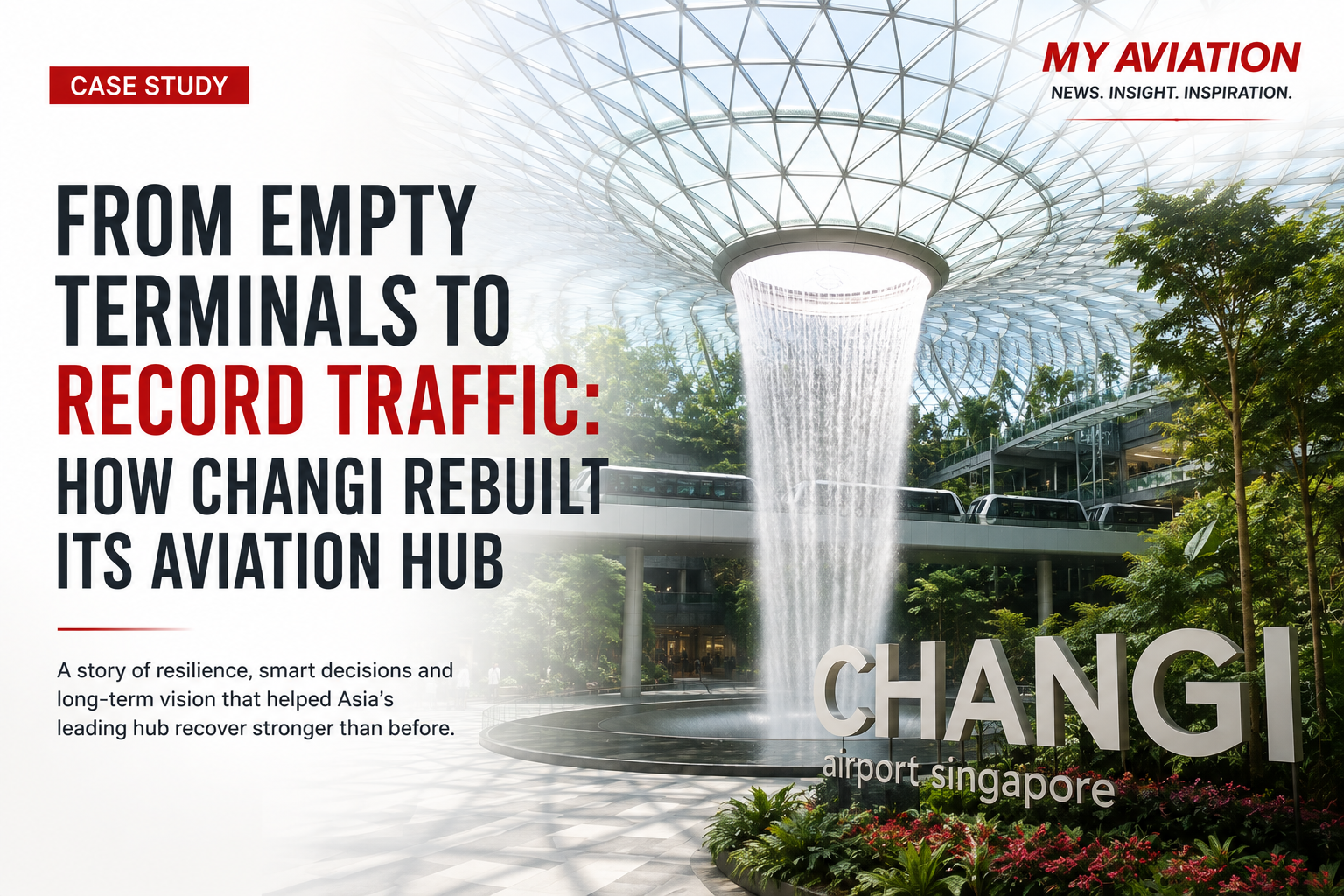
CASE STUDY | AIRPORT STRATEGY
Few images captured the scale of aviation’s COVID-19 crisis as powerfully as an international airport operating far below its normal rhythm.
For Singapore Changi Airport, a hub built around international connectivity, the disruption was particularly severe. Singapore has no domestic aviation market capable of cushioning the collapse in international travel. When borders closed and global passenger movements declined, Changi’s fundamental business model was directly exposed.
The response that followed provides an important aviation case study.
Changi’s recovery was not simply about waiting for passengers to return. It involved reducing operations during the crisis, preserving essential connectivity, progressively restoring terminal capacity, rebuilding airline networks and continuing to invest in the airport’s long-term competitiveness.
By 2024, Changi handled 67.7 million passenger movements, equivalent to 99.1% of its 2019 passenger traffic. During the 2024/25 financial year, passenger traffic moved beyond pre-pandemic levels, reaching 68.4 million movements.
The story provides a useful example of how a major Asian hub navigated one of aviation’s most disruptive periods while continuing to prepare for its future.
When International Connectivity Disappeared
Changi entered the pandemic with one major structural characteristic: its strength was international aviation.
That strength became a vulnerability when international travel collapsed.
With passenger demand severely reduced, keeping every terminal operating normally would have created unnecessary costs and operational complexity. Changi Airport Group therefore consolidated operations.
Terminal 2 operations were suspended from May 2020, allowing airlines to be relocated while reducing expenditure on areas such as utilities and cleaning. The closure also created an opportunity to accelerate some of the terminal’s expansion work.
The decision illustrates an important element of crisis management.
When demand changes dramatically, infrastructure utilisation must change with it.
Instead of maintaining an airport operating model designed for normal passenger volumes, Changi adjusted its physical operation to the reality confronting the industry.
Yet the airport did not stop functioning.
Essential aviation activity continued, including passenger, transit and cargo operations under changing health and operational requirements.
By the 2021/22 financial year, Changi handled 5.2 million passengers — more than four times the previous year’s volume — as international borders gradually reopened and Singapore introduced Vaccinated Travel Lanes.
The recovery had begun, but it remained a long way from normal.
Reopening Capacity Before It Became a Constraint
Singapore relaxed its border restrictions substantially in April 2022.
Passenger demand began returning quickly.
That created a different challenge for Changi.
The airport now had to move from consolidation back towards expansion without allowing returning demand to overwhelm its terminals.
Terminal 2 was progressively reopened. Arrival operations at its southern wing resumed in May 2022, followed by departures in October. Terminal 4 reopened in September that year.
Reopening a terminal after an extended closure is more complicated than switching on the lights.
At Terminal 4, more than 30 trials were conducted with airport partners to test operational readiness across infrastructure, manpower, systems and processes. Orientation flights were also organised to familiarise staff with operational touchpoints before airlines returned.
The process demonstrated that airport recovery is fundamentally an ecosystem exercise.
Airlines cannot restart independently of ground handlers.
Ground handlers cannot operate effectively without sufficient trained staff.
Security, immigration, baggage systems, retail operations, engineering and passenger services all have to recover together.
An airport is therefore only as ready as the wider community operating within it.
Rebuilding the Network
Restoring terminal capacity was only one side of the recovery.
The other was rebuilding connectivity.
For a hub airport, passenger volume alone does not determine competitiveness. The quality and breadth of the network matter enormously.
By April 2023, Changi was served by 102 airlines operating more than 6,000 weekly scheduled flights to approximately 145 cities. Passenger traffic in March that year had recovered to more than 80% of the corresponding pre-pandemic level.
The network continued expanding.
During financial year 2024/25, Changi welcomed seven new passenger airlines and added 20 passenger city links. By March 2025, the airport was connected to 170 cities, served by close to 100 airlines and handling more than 7,200 flights each week.
That connectivity is central to understanding the recovery.
A successful hub creates value by connecting markets.
The more useful connections passengers can make through an airport, the more attractive that airport becomes to airlines and travellers. Strong airline participation can then create additional connectivity, reinforcing the hub.
Changi’s recovery therefore involved rebuilding not merely traffic, but the network effect that supports its role as an international gateway.
Terminal 2 Became More Than a Reopening
Changi also used the recovery period to improve existing infrastructure.
The engineering and expansion programme at Terminal 2 increased the terminal’s handling capacity by five million passengers annually to 28 million.
The project added approximately 15,500 square metres and introduced additional automation, expanded immigration facilities, upgraded baggage systems and more efficient building equipment.
This is an important distinction.
Recovery did not mean recreating Changi exactly as it existed in 2019.
Infrastructure was being modernised for the operating environment ahead.
That approach reflects a broader principle for airports recovering from major disruption: restoring capacity and improving capacity can occur simultaneously.
Passenger Experience Remained Part of the Strategy
Operational efficiency is essential for an airport.
But Changi’s international reputation has also been built around passenger experience.
During the recovery, the airport continued placing emphasis on service standards while restoring traffic and reopening terminals.
This matters commercially.
Major hub airports compete for connecting passengers and airline capacity. Travellers frequently have multiple routing options between regions, particularly across Asia, Europe and Australia.
The transfer experience can therefore become part of an airport’s competitive proposition.
Speed through immigration, reliable baggage handling, terminal comfort, retail, dining and straightforward transfers are not merely cosmetic additions.
Collectively, they influence how passengers experience a hub.
For Changi, maintaining that proposition while passenger numbers returned was an important part of restoring the airport’s wider position.
The Numbers Eventually Told the Story
By 2024, Changi handled 67.7 million passengers, representing 99.1% of 2019 traffic.
The fourth quarter of 2024 achieved full passenger traffic recovery compared with the equivalent period in 2019. December became the first month since December 2019 in which traffic exceeded six million passenger movements.
The recovery subsequently moved beyond simply returning to the old benchmark.
Changi recorded 68.4 million passenger movements during financial year 2024/25, surpassing pre-pandemic levels for the first time since Singapore reopened its borders.
The momentum continued.
In the 12 months ending March 2026, Changi recorded 70.4 million passenger movements — its highest traffic over any 12-month period at that point.
Current figures also demonstrate an important nuance: aviation recovery is rarely a straight line.
Through July 2026, Changi recorded 40.7 million passenger movements. Individual months showed both increases and decreases compared with 2025, while total passenger traffic for the seven-month period remained broadly stable year-on-year.
The airport has therefore moved beyond the simple question of pandemic recovery.
Its challenge is once again long-term competitiveness.
Changi Did Not Allow the Crisis to Define Its Future
Perhaps the most strategically significant decision involved Terminal 5.
The pandemic initially forced Singapore to pause the project for two years.
Instead of treating the original design as fixed, the pause was used to review Terminal 5 with greater emphasis on modularity, resilience and sustainability, incorporating lessons from the pandemic.
Construction subsequently began in 2025.
Terminal 5’s first phase is planned to handle approximately 50 million passenger movements annually and is expected to become operational around the mid-2030s. It will be integrated with Changi’s existing terminals rather than functioning as an isolated airport complex.
This may ultimately be one of the most important lessons from the Changi case.
A severe short-term crisis did not eliminate the long-term rationale for aviation growth.
It changed how that growth needed to be planned.
What the Changi Case Demonstrates
Changi’s experience should not be treated as a formula that every airport can copy.
Singapore has its own geography, economy, airline ecosystem, government structure and strategic position.
Every airport operates under different circumstances.
But the recovery demonstrates several broader principles without requiring comparisons about which airport is “better.”
Airport capacity needs to respond quickly when demand changes. Reopening requires coordination across an entire airport community. Connectivity must be rebuilt alongside infrastructure. Passenger experience remains strategically relevant. And long-term investment cannot stop simply because the industry experiences a temporary crisis.
Perhaps most importantly, resilience does not mean returning to exactly where an organisation started.
It means emerging capable of handling what comes next.
From Recovery to the Next Chapter
Changi’s pandemic story began with terminal consolidation, collapsed international demand and enormous uncertainty.
Six years later, the conversation surrounding the airport is fundamentally different.
Passenger volumes have recovered. International connectivity has been rebuilt. Terminal infrastructure has been modernised. Terminal 5 is under development. And Changi is once again planning around future growth rather than survival.
There will inevitably be new challenges.
Geopolitical disruption, airline economics, workforce constraints, infrastructure costs and competition between Asian hubs will continue shaping the airport’s future.
But that is precisely why the Changi experience is worth studying.
The airport did not recover because one decision transformed its fortunes.
Its recovery came through a sequence of operational, infrastructure and network decisions taken as conditions changed.
The result offers a valuable aviation lesson:
A successful hub is not defined simply by how it performs when traffic is growing. Its resilience is revealed by how effectively it adapts when the aviation environment changes completely.
Changi’s journey from severely reduced activity to record traffic is therefore more than a story about passenger numbers.
It is a case study in airport resilience, network rebuilding and long-term aviation planning.
My Aviation | Case Study | 31 August 2026