

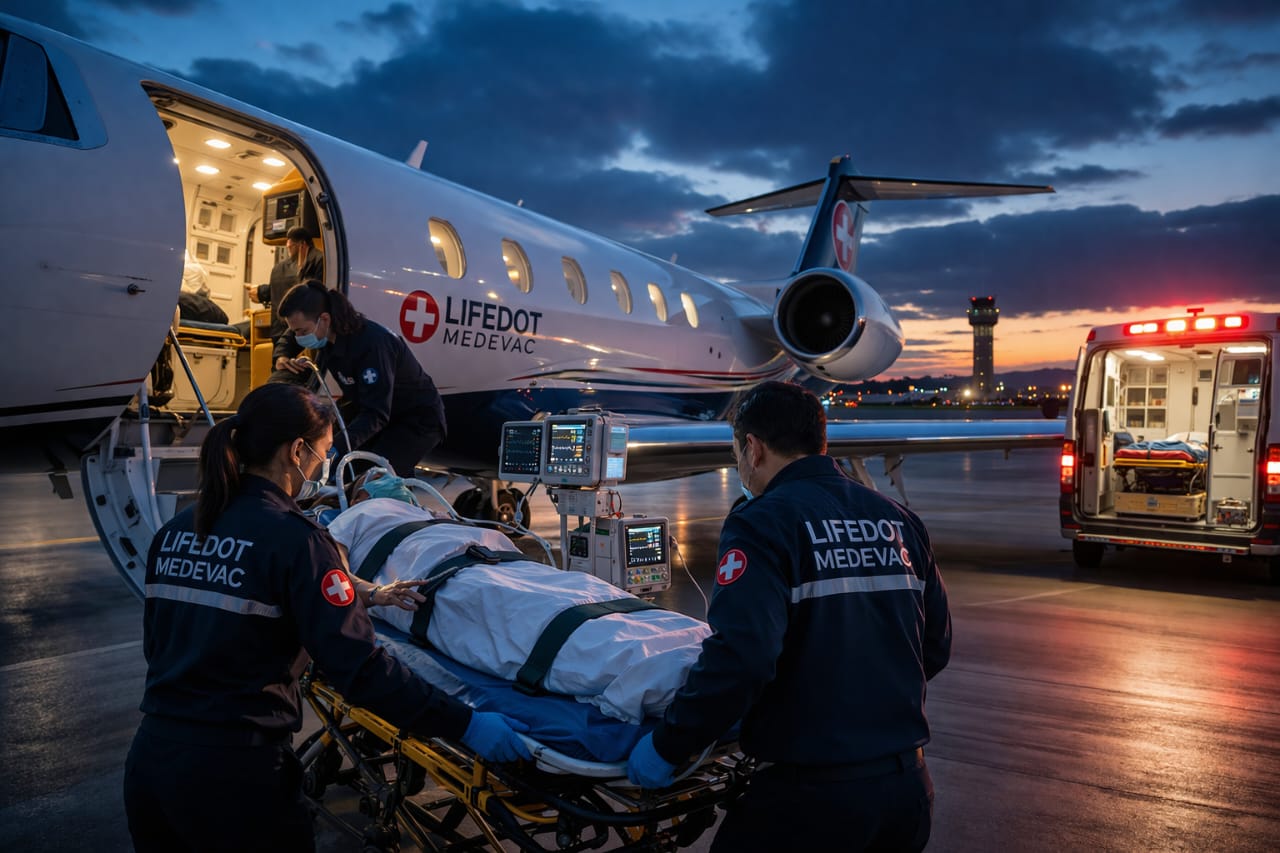
Across Southeast Asia, the demand for cross-border medical evacuation services has grown steadily in recent years, reflecting both increasing regional mobility and the need for timely access to specialised healthcare. Malaysia, in particular, continues to serve as a key destination for patients from neighbouring countries, especially Indonesia, seeking advanced medical treatment. In situations where commercial travel is not feasible due to medical condition or urgency, air ambulance services provide a critical bridge between patients and care.
Within this evolving landscape, the role of structured and compliant medevac coordination has become increasingly important. Lifedot Medevac, based in Malaysia, is contributing to this development by focusing on the integration of aviation, medical, and logistical elements required to support safe and efficient patient transfers across borders. Rather than functioning as an aircraft operator, Lifedot operates as a coordination and facilitation platform, working in collaboration with certified Air Operator Certificate (AOC) holders throughout the region.
All flight operations are conducted by licensed operators in accordance with applicable aviation regulations, including those overseen by the Civil Aviation Authority and corresponding national authorities. This framework ensures that each mission adheres to established safety standards, including proper aircraft certification, regulatory approvals for overflight and landing, and compliance with medical transport protocols. By maintaining this structure, Lifedot Medevac aligns its activities with industry expectations for safety, accountability, and operational integrity.
A defining feature of Lifedot’s approach is its adoption of a multi-operator network model. By collaborating with partners across Malaysia, Thailand, Indonesia, Singapore, and the Philippines, the organisation is able to access a broader range of aircraft capabilities and operational coverage. This model allows each mission to be evaluated individually, taking into account patient condition, urgency, and geographical considerations, before matching it with the most suitable aircraft and crew configuration. In a region characterised by diverse geography and varying levels of infrastructure, such flexibility plays a critical role in ensuring timely and effective patient transfers.
Medevac operations, however, extend beyond aviation logistics. They require careful coordination with medical professionals, referring institutions, and receiving hospitals to ensure continuity of care throughout the journey. This includes considerations such as patient stabilisation prior to departure, the configuration of onboard medical teams, and the availability of specialised equipment required during transport. In this context, medevac is best understood as a clinical operation supported by aviation, rather than aviation alone.
From a practical standpoint, the financial and logistical realities of medevac operations in Southeast Asia also present unique challenges. A significant proportion of cases remain self-funded, requiring timely coordination of payment and deployment. While insurance-supported evacuations do occur, they often involve additional administrative processes and longer approval timelines. As a result, operational readiness must encompass not only aircraft and medical capability, but also efficient coordination mechanisms that support timely activation of services.
Despite ongoing advancements, several challenges continue to shape the regional medevac environment. Variations in permit processing timelines, differences in operator capabilities, and limited awareness among referring institutions can affect the speed and efficiency of deployments. Addressing these challenges requires ongoing collaboration between aviation authorities, healthcare providers, and coordination platforms to improve standardisation and awareness across the region.

Reflecting on this evolving landscape, Lifedot Medevac’s leadership emphasises the importance of integration and adaptability. As the organisation’s Chief Executive Officer Adam SK Naidu notes, “Our focus is on building a reliable and compliant regional coordination framework that connects patients to the care they need without delay. Medevac is not just about aircraft it is about integrating medical, operational, and regulatory elements seamlessly to ensure safe and efficient transfers.” The CEO further highlights that a multi-operator network provides the flexibility required to respond to the unique challenges presented by each mission across Southeast Asia.
Looking ahead, the continued development of regional healthcare connectivity is expected to further increase demand for structured medevac coordination. In this context, organisations that are able to align operational flexibility with regulatory compliance will play an increasingly important role in supporting patient outcomes. Through its network-based approach and emphasis on coordination, Lifedot Medevac aims to contribute to a more connected and responsive medevac ecosystem across Southeast Asia.