

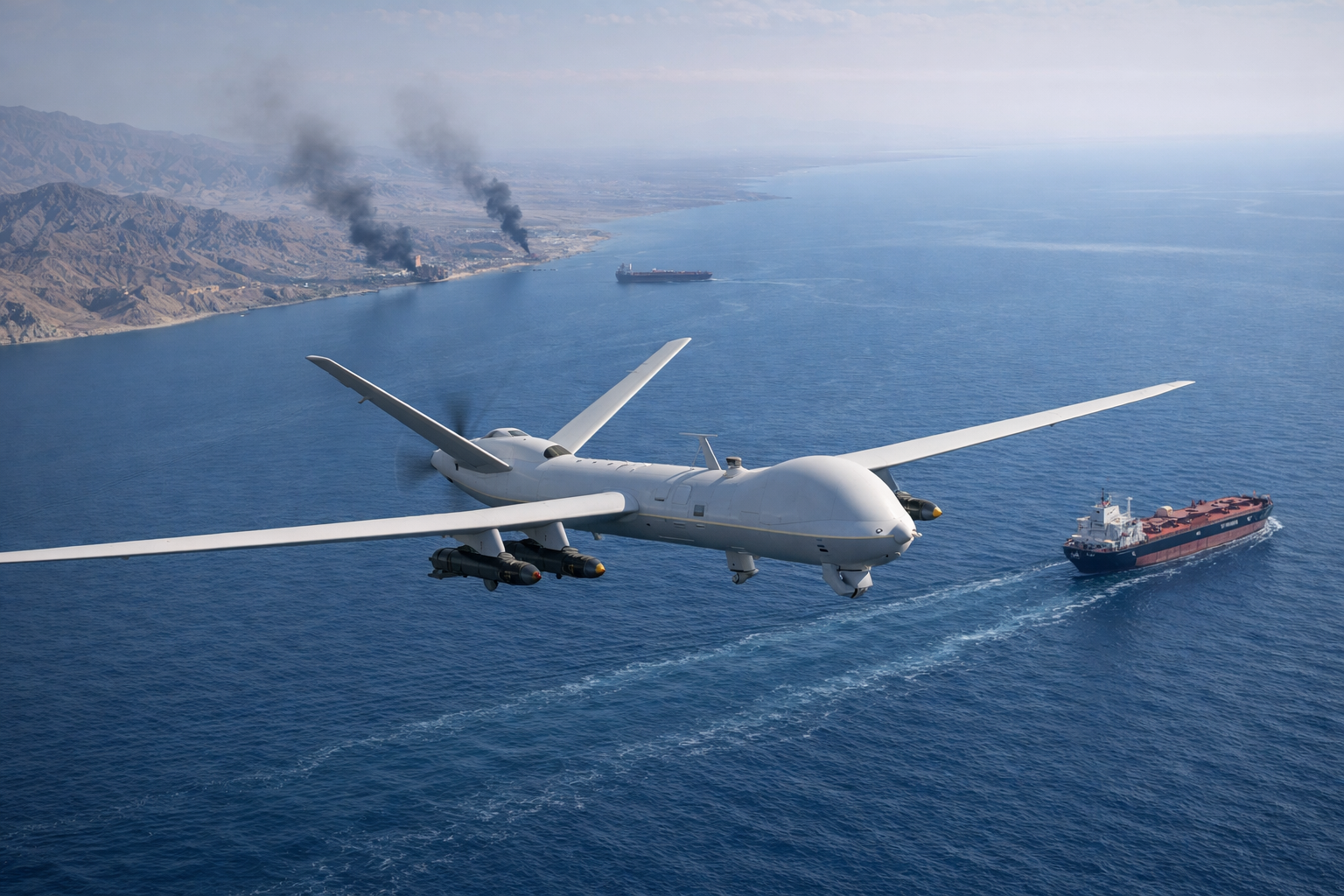
The 2026 Iran War has delivered a masterclass in asymmetric warfare, demonstrating how relatively inexpensive unmanned aerial vehicles can achieve strategic effects that rival the impact of far costlier conventional military assets. Iran’s use of drones to effectively shut down the Strait of Hormuz, the world’s most critical energy chokepoint, has rewritten assumptions about maritime security and the economics of modern conflict.
The strait, just 30 miles wide at its narrowest point, normally carries roughly one fifth of the world’s daily oil supply and a significant share of global liquefied natural gas shipments. Within days of the war’s commencement on 28 February, Iranian drone strikes on vessels in and around the strait brought commercial shipping to a near total halt. Traffic dropped by approximately 90 per cent, with over 150 tankers anchoring outside the waterway rather than risk passage.
What stunned military analysts was how Iran achieved this without deploying the conventional naval blockade that defence planners had long anticipated. Tehran did not need to lay underwater mines, position warships in the shipping lanes or rely on expensive anti ship missiles. Instead, a series of targeted drone strikes on commercial vessels was sufficient to make insurers and shipping companies withdraw from the corridor entirely.
By 11 March, the United Kingdom Maritime Trade Organisation had reported 13 ships hit by projectiles in the strait since hostilities began. The attacks included strikes on a Thai flagged cargo vessel, a Liberian flagged ship and various tankers. The Iranian drone Shahed design, originally developed as a relatively low cost one way attack platform, proved devastatingly effective against undefended commercial vessels.
The insurance industry response amplified the military effect exponentially. War risk insurance premiums, which had already reached a six year high before the conflict, surged to levels that made transit economically unviable for most operators. Policies held by shipowners contained 72 hour cancellation clauses, allowing insurers to withdraw coverage almost immediately when hostilities commenced. The result was an insurance driven shutdown that proved more effective than any conventional blockade.
Major shipping lines including Maersk, MSC, CMA CGM and Hapag Lloyd all suspended transits through the strait. The International Energy Agency coordinated the release of 400 million barrels from emergency reserves to stabilise markets, while oil prices surged above $100 per barrel for the first time in nearly four years.
President Trump responded by offering US naval escorts for commercial vessels and directing the US Development Finance Corporation to provide political risk insurance. However, shipping industry leaders expressed scepticism. Stamatis Tsantanis, chairman of Greece based Seanergy Maritime, stated that normal traffic would not resume until companies were confident the route was “genuinely safe.”
Ukrainian President Volodymyr Zelenskyy revealed that the US military had contacted Ukraine multiple times seeking expertise on countering Iranian designed Shahed drones. Several Middle Eastern nations, including the UAE, Qatar, Saudi Arabia, Jordan and Bahrain, had also approached Kyiv for drone defence assistance. This underscored the reality that even the world’s most powerful military was grappling with the challenge posed by these low cost platforms.
The drone strategy has demonstrated that in modern warfare, the cost equation can be inverted dramatically. Cheap drones costing thousands of dollars have disrupted an energy corridor worth trillions annually.