
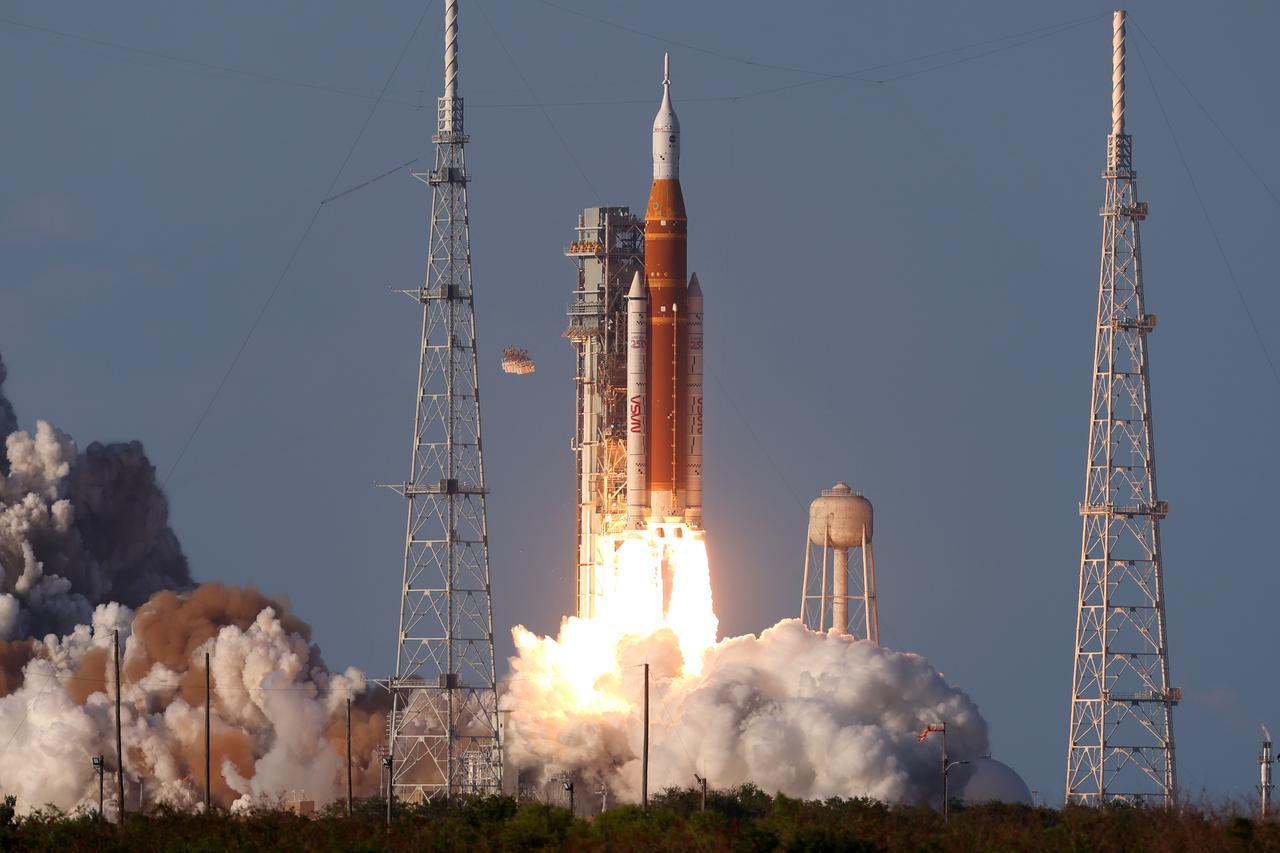
NASA’s Artemis II mission lifted off successfully on 1 April 2026, marking the first time astronauts have been launched towards the Moon since the Apollo 17 mission in December 1972. The Space Launch System rocket departed Launch Complex 39B at Kennedy Space Center in Florida at 18:35 local time, carrying four crew members on what is expected to be a 10-day test flight around the Moon and back to Earth.
The crew comprises NASA astronauts Commander Reid Wiseman, Pilot Victor Glover and Mission Specialist Christina Koch, alongside Canadian Space Agency astronaut and Mission Specialist Jeremy Hansen. The mission is set to achieve several milestones in human spaceflight. Glover will become the first person of colour to travel beyond low Earth orbit, Koch the first woman, and Hansen the first non-American citizen to journey to the Moon’s vicinity.
The countdown proceeded without major disruption, though controllers monitored a temperature warning involving one of Orion’s launch abort system batteries, which was ultimately assessed as a sensor anomaly rather than a hardware fault. A separate Flight Termination System issue briefly placed the mission in a no-go status roughly an hour before launch but was resolved in time for the scheduled departure.
Minutes after liftoff, the twin solid rocket boosters and core stage separated on schedule, and Orion’s solar array wings deployed as planned. NASA confirmed that all four arrays unfolded correctly and began drawing power. The SLS rocket generated approximately 8.8 million pounds of thrust at liftoff, with the solid boosters delivering more than 75 per cent of the total force required to propel the 5.75-million-pound vehicle off the pad.
The mission plan calls for Orion to spend approximately one day in Earth orbit while the crew checks spacecraft systems before a translunar injection burn on flight day two sends them on a trajectory towards the Moon. Orion is expected to enter the Moon’s sphere of influence on flight day five and make its closest approach on flight day six, passing within roughly 4,100 to 6,000 miles of the lunar surface. At its farthest point, the spacecraft will travel approximately 252,800 miles from Earth, surpassing the distance record set by Apollo 13 in 1970.
The astronauts are expected to spend much of the lunar flyby day photographing the Moon and recording observations before beginning the return leg of the journey. Splashdown is planned in the Pacific Ocean off San Diego on flight day 10, where the United States Navy will recover the crew and spacecraft.
The road to launch was not without complications. Originally targeting early February 2026, the mission was delayed by a winter storm that disrupted preparations, followed by a liquid hydrogen leak discovered during a wet dress rehearsal on 2 February. A subsequent helium flow issue in late February forced a rollback to the Vehicle Assembly Building, pushing the launch window to April.
NASA Administrator Jared Isaacman described Artemis II as the opening act and the test mission for the Orion spacecraft, framing the flight as the foundation for what he called a golden age of science and discovery.
Looking ahead, NASA’s revised Artemis schedule, published on 27 February 2026, reconfigures the programme’s trajectory. Artemis III is now planned as a 2027 low Earth orbit demonstration mission to test rendezvous and docking with commercial lunar landers. Artemis IV is targeted for 2028 as the first Artemis mission to land astronauts on the lunar surface. Under that architecture, crew members would travel to lunar orbit aboard Orion, transfer to a commercial lander, descend to the surface, and return to Orion for the journey home. Artemis V is envisaged as a subsequent surface mission as NASA builds towards sustained annual lunar operations and an eventual permanent base on the Moon.
The successful launch represents a significant milestone not only for NASA but for the broader international space community, reaffirming crewed deep space exploration as an active and advancing endeavour more than half a century after the final Apollo mission.