
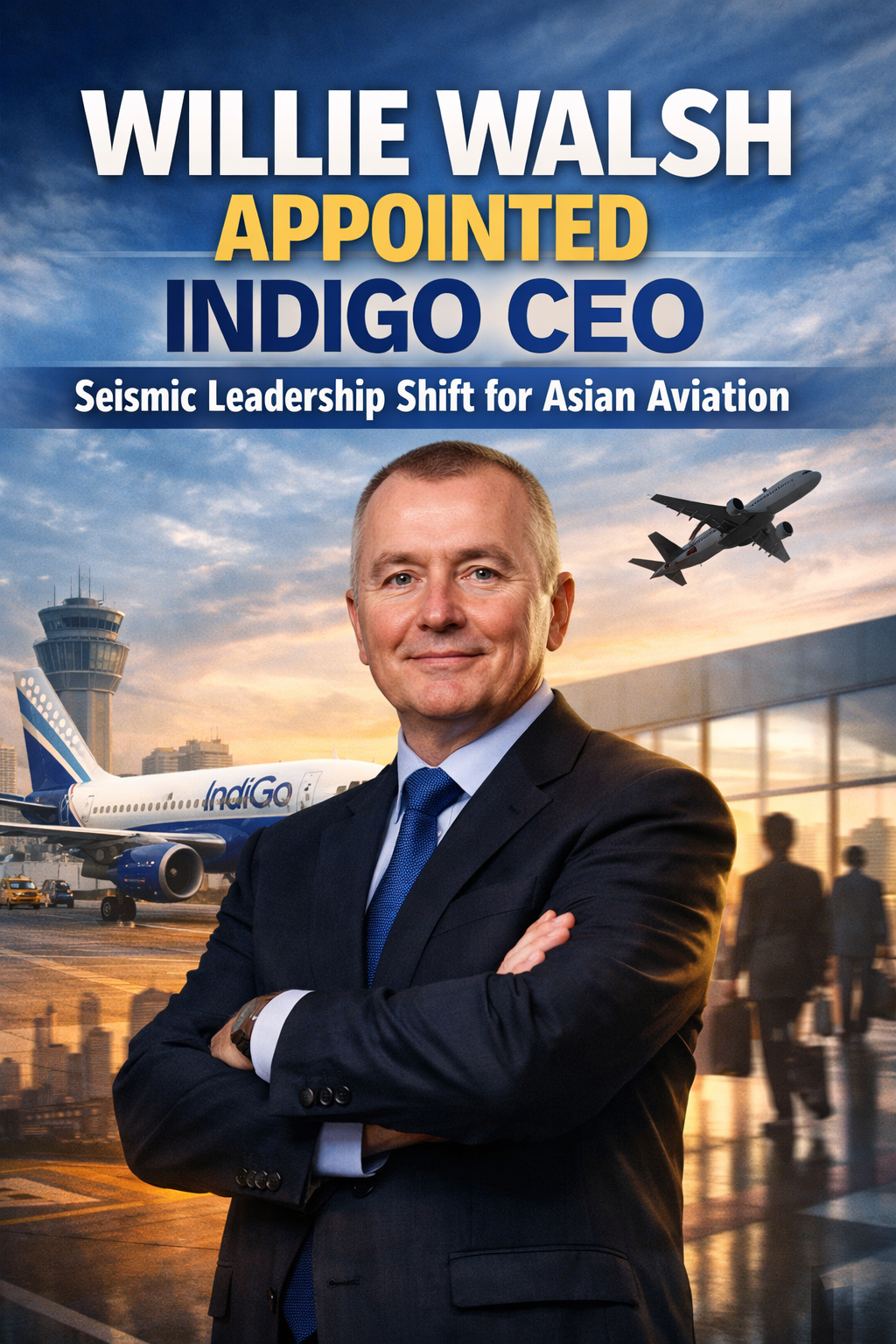
In one of the most significant leadership appointments in Asian aviation history, IndiGo has named Willie Walsh as its new Chief Executive Officer. The announcement, made on 31 March by parent company InterGlobe Aviation, brings one of the most influential figures in global aviation to the helm of India’s dominant carrier at a time when the airline is recovering from a severe operational crisis and navigating an ambitious international expansion.
Walsh, who is currently serving as Director General of the International Air Transport Association (IATA), will conclude his tenure at the global trade body on 31 July 2026 and is expected to take charge at IndiGo no later than 3 August, subject to security clearance from India’s Ministry of Civil Aviation.
The appointment comes less than three weeks after the sudden departure of former CEO Pieter Elbers, who resigned on 10 March citing personal reasons. Elbers’ exit followed a major operational disruption in December 2025, when IndiGo cancelled thousands of flights and delayed thousands more amid difficulties managing pilot schedules after new flight duty time limitation regulations came into force. The crisis triggered regulatory penalties totalling 22.20 crore rupees from the DGCA, widespread public outrage, and raised serious questions about the airline’s operational planning and leadership stability.
IndiGo Managing Director and promoter Rahul Bhatia, who has been serving as interim CEO since Elbers’ departure, described Walsh as an iconic aviation leader whose global perspective, operational expertise, and values driven leadership would position the airline for its next phase of growth. IndiGo Chairman Vikram Singh Mehta expressed confidence that Walsh’s experience would strengthen the carrier in an increasingly competitive international aviation environment.
A career forged in airline leadership. Walsh’s aviation career spans more than four decades, beginning in 1979 as a cadet pilot with Aer Lingus. He rose through the ranks to become the Irish carrier’s Chief Executive in 2001 before moving to British Airways as CEO in 2005. At BA, he navigated the airline through the 2008 to 2009 global financial crisis and orchestrated the landmark merger with Spain’s Iberia to form International Airlines Group (IAG) in 2011. He led IAG, which also encompasses Aer Lingus, Vueling, and LEVEL, until 2020, before taking the helm at IATA in April 2021.
Walsh is widely regarded as one of the most pragmatic and results driven airline executives of his generation, known for complex restructurings, cost discipline, and the ability to manage multi brand airline operations across diverse markets. His track record of turning around carriers and building profitable international networks is precisely the experience IndiGo is seeking as it transitions from a purely domestic low cost model to one with serious international ambitions.
Why this matters for Southeast Asia. IndiGo is not just India’s largest airline. With a 64.2 per cent domestic market share and over 2,700 daily flights to 137 destinations, including 43 international routes, it is a force that directly shapes connectivity and competition across the Asia Pacific region. The airline has been aggressively expanding into Southeast Asian markets, with routes to Bangkok, Singapore, Kuala Lumpur, Jakarta, and Ho Chi Minh City already established or planned.
Under Walsh’s leadership, IndiGo’s international expansion is expected to accelerate further. The airline has placed substantial orders for widebody aircraft, signalling its intention to enter long haul markets that would put it in direct competition with established full service carriers across Asia and beyond. For Southeast Asian airlines, this means a well capitalised, operationally ambitious competitor led by a CEO who built one of Europe’s largest airline groups from scratch.
Walsh’s appointment also leaves a vacuum at IATA, where he has been a prominent voice representing airline interests on the global stage, including championing the industry’s commitment to achieving net zero carbon emissions by 2050 and advocating against what he has described as excessive airport charges imposed on airlines recovering from the pandemic.
For IndiGo, the immediate priorities are clear: stabilise operations after the December crisis, restore passenger and regulatory confidence, and execute on the airline’s long haul ambitions with a leader who has done exactly that at some of the world’s largest carriers. For the wider Asia Pacific aviation industry, Walsh’s arrival at IndiGo signals that the centre of gravity in global aviation continues its decisive shift eastward, and that India’s largest airline intends to be at the forefront of that transformation.