

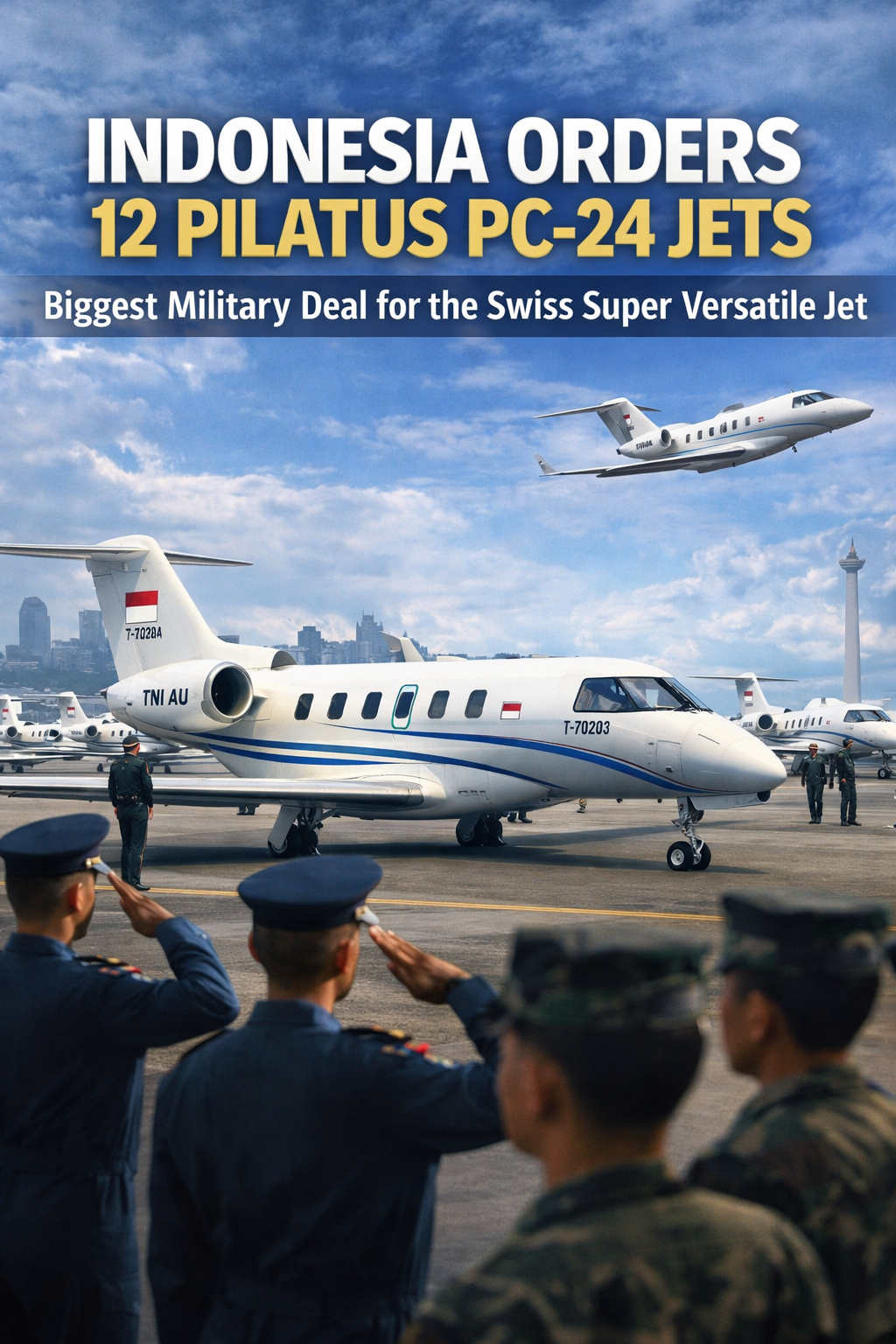
Indonesia’s Ministry of Defence has selected the Pilatus PC-24 as a new asset for the Indonesian Air Force, signing a contract for 12 aircraft in what represents the largest military order to date for the Swiss manufacturer’s light jet. The deal, announced on 30 March, was signed with PT E-System Solutions Indonesia, the authorised defence contractor designated by the Ministry of Defence.
The contract covers 12 PC-24 aircraft along with options for additional units, ground support equipment, tools, spare parts, training, and technical support provided directly from Pilatus headquarters in Stans, Switzerland. The Indonesian Air Force will deploy the jets for transport pilot training, air transport, and liaison missions across the archipelago.
In parallel with the PC-24 purchase, the parties also signed a Letter of Intent for the supply of 24 PC-21 turboprop trainers. That package includes ground-based training equipment, spare parts, ground support equipment, and technical support. If finalised, the PC-21 deal would make Indonesia the third customer for the type in the Asia Pacific region, joining Australia, which operates 45, and Singapore, which has 19.
Why the PC-24 suits Indonesia. The PC-24 was developed for exceptional operational flexibility. It is certified for single pilot operation, equipped with a standard cargo door, and approved for use on unpaved runways. These features make it particularly suited to Indonesia, a nation of more than 17,000 islands where access to remote airfields with limited infrastructure is a constant operational requirement.
Pilatus has emphasised that the aircraft’s ability to take off and land at short airfields and operate from unpaved surfaces was a decisive factor in Indonesia’s selection. For a country where many military and government installations are located on smaller islands with basic runway infrastructure, the PC-24 offers a combination of jet speed and rough field capability that few other aircraft in its class can match.
Pilatus CEO Markus Bucher said the contract marks the beginning of a long-term relationship with Indonesia. He stated that the company’s priority is to support Indonesia in putting the fleet into service smoothly. Ioannis Papachristofilou, Vice President of Government Aviation at Pilatus, noted that the selection by the Indonesian Air Force reflects growing interest among government operators in the PC-24, which the company markets as its Super Versatile Jet.
Pilatus’ growing government aviation business. The Indonesian order is part of a broader expansion of Pilatus’ government and military sales division. The company has recently secured contracts with several countries. France took delivery of its first PC-24 for the French Navy in mid-March 2026, while the Netherlands, Canada, and Belgium have also placed orders in recent years. The PC-21 trainer has established itself as a leading platform in military pilot training programmes worldwide.
The PC-24 entered service in 2018 and has carved out a niche as a versatile light jet capable of operating in environments where larger business jets or military transports cannot. Its cargo door, a feature almost unheard of in the light jet category, allows it to handle a mix of passenger and freight missions. Combined with its unpaved runway certification, this gives military and government operators a single platform that can perform transport, training, medical evacuation, and liaison roles.
Implications for Southeast Asian defence aviation. The Indonesian deal has wider significance for the Southeast Asian defence aviation landscape. Indonesia is the largest country in ASEAN by population and territory, and its military procurement decisions carry weight across the region. The selection of a Western European platform for a training and transport role is notable at a time when geopolitical dynamics are reshaping defence procurement patterns across the Asia Pacific.
For neighbouring countries in the region, including Malaysia, the Philippines, Thailand, and Vietnam, Indonesia’s PC-24 acquisition may prompt fresh assessments of their own light transport and training fleet requirements. Several ASEAN air forces operate ageing trainer and light transport fleets that will require replacement over the coming decade, and the PC-24’s demonstrated suitability for archipelagic and remote area operations could make it an attractive option for countries with similar geographic challenges.
Pilatus will also provide an integrated support programme to ensure maximum fleet availability and efficient maintenance for the Indonesian Air Force. This type of long-term support arrangement is increasingly common in military procurement, where lifecycle costs and operational readiness are weighted as heavily as the initial purchase price.
The deal strengthens Pilatus’ footprint in Southeast Asia, a region where the company already has a well-established presence through its PC-6, PC-9, PC-12, and PC-21 product lines. With Indonesia now committed to both the PC-24 and potentially the PC-21, Pilatus is positioning itself as a comprehensive training and light transport provider for one of the region’s most strategically significant air forces.