

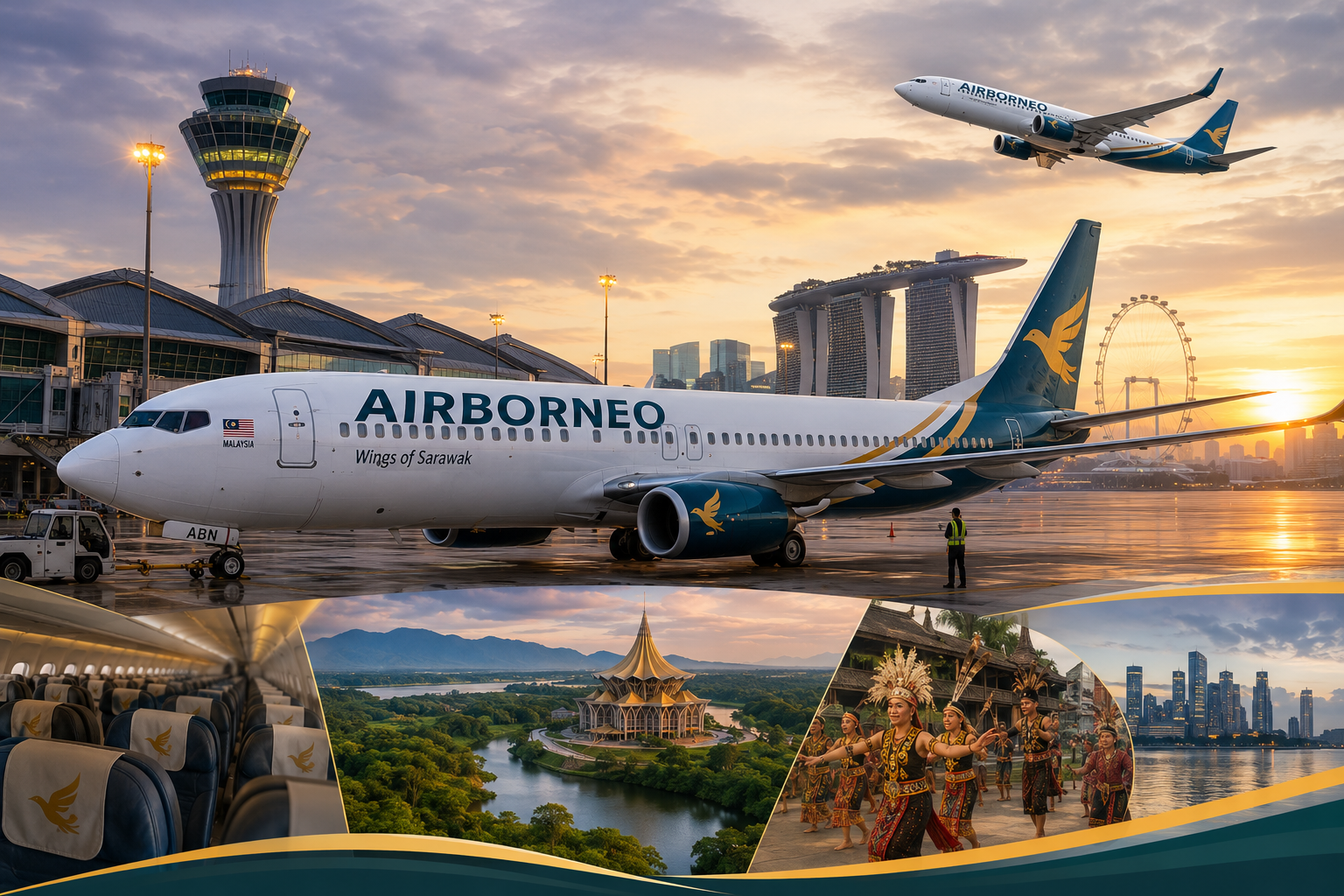
The arrival of AirBorneo’s jet operations marks more than the expansion of a new Malaysian airline. Behind the aircraft is a much larger ambition: to transform aviation into an economic bridge connecting Sarawak with Peninsular Malaysia, ASEAN and the wider world.
A new aviation story is taking shape over Borneo.
On 20 July 2026, AirBorneo entered a significant new chapter with the launch of commercial jet operations. Two Boeing 737-800 aircraft, initially operated under a wet-lease arrangement, are at the centre of an expansion that takes the Sarawak-owned carrier beyond the rural air services from which it emerged and into a much larger regional aviation arena.
The initial jet operation connects Kuching with Kuala Lumpur International Airport Terminal 1, with two daily services planned. Singapore represents the next international step, with the carrier having secured the necessary air traffic rights and airport slots as it prepared for the service. The expansion is particularly significant because AirBorneo began flying only on 1 January 2026 following Sarawak’s acquisition of MASwings. Yet to understand AirBorneo purely as another new airline would be to miss the bigger story.
This is an aviation project closely tied to Sarawak’s economic ambitions, its geographic realities and its desire for greater control over connectivity. AirBorneo’s rise poses an intriguing question for Malaysian and regional aviation: Can a locally anchored airline become an instrument not only for transporting passengers, but also for transforming the economic position of an entire region? For Sarawak, the answer may determine far more than the success of a new carrier.
From Essential Air Links to a Regional Airline
Air transport has always carried particular importance in Borneo. In Peninsular Malaysia, travellers moving between major cities can often choose between highways, railways and aviation. Across parts of Sarawak and Sabah, geography creates a very different reality. Air services can be essential links between communities. AirBorneo inherited this responsibility when it took over the operations associated with MASwings. Its existing fleet includes ATR 72-500 turboprops and DHC-6-400 Twin Otters serving communities across Sarawak, Sabah and Labuan. These aircraft remain crucial to the rural and regional connectivity network.
The introduction of Boeing 737-800 operations changes the scale of the airline’s ambition. AirBorneo is no longer positioned solely around connecting communities within Borneo. It is beginning to establish a second identity: a regional airline capable of linking Sarawak directly with major domestic and international markets.
That distinction matters.
Kuching is intended to serve as the primary hub for jet operations, while turboprop operations continue to support the wider connectivity network. Earlier plans identified Kuala Lumpur, Singapore and Kota Kinabalu among the initial markets being considered as the jet operation developed.
In effect, AirBorneo is attempting to bridge two very different aviation missions. One is about accessibility. The other is about growth. If managed successfully, those two missions could reinforce each other.
The Boeing 737-800 Strategy
AirBorneo’s entry into jet operations has been deliberately structured.
Rather than immediately acquiring and independently operating a large jet fleet, the airline has started with two wet-leased Boeing 737-800 aircraft under an 18-month aircraft, crew, maintenance and insurance arrangement running from July 2026 through December 2027. The strategy allows AirBorneo to enter the jet market while developing its own capabilities and assessing passenger response.
The airline has outlined an ambitious longer-term fleet plan. Three additional jets are targeted for 2027, bringing the fleet to five. From 2028, the carrier plans to transition those aircraft toward dry leases, under which AirBorneo would take greater responsibility for crew and maintenance. Its stated growth trajectory could see nine jets by the end of 2028 and 17 by the end of 2030.
It is an ambitious roadmap. But fleet expansion alone does not build a successful airline. The critical challenge will be developing the operational infrastructure behind those aircraft: pilots, cabin crew, engineering support, maintenance planning, operations control, ground handling, commercial systems and regulatory compliance. Aircraft are the visible face of an airline.
Operational discipline is what keeps an airline flying. For AirBorneo, the transition from a primarily turboprop-focused regional operation into a mixed operation incorporating Boeing 737 services will therefore be one of its most important organisational tests.
Kuala Lumpur: The Essential Commercial Bridge
The Kuching-Kuala Lumpur route is a logical starting point. The connection across the South China Sea is one of the most important aviation links for Sarawak, serving families, students, government travellers and business passengers.
AirBorneo has introduced an all-inclusive one-way economy fare from RM375 on the route for specified travel dates. The airline says the fare was established after analysing historical ticket pricing, fuel fluctuations and competitor fares. The product is positioned as full-service, with the fare including elements such as airport taxes, checked baggage and meals.
That positioning will be closely watched. Malaysia already has an intensely competitive airline market. AirBorneo must establish a clear reason for passengers to choose it while maintaining fares capable of supporting sustainable operations.
Its greatest advantage may be emotional as well as commercial. As a Sarawak-owned airline, AirBorneo carries an identity deeply connected to the market it serves.But identity alone cannot guarantee passenger loyalty. Reliability, punctuality, customer experience and value will ultimately determine whether travellers return.
The airline’s leadership appears aware of the need to stabilise operations before accelerating expansion. Its initial two-aircraft strategy has been described as a way to enter the market, gather customer feedback and assess demand before further growth. That measured approach may prove important. Aviation history is filled with airlines that expanded faster than their operational foundations could support. AirBorneo has an opportunity to grow differently.
Singapore Changes the Conversation
If Kuala Lumpur establishes AirBorneo’s commercial relevance within Malaysia, Singapore has the potential to redefine its regional profile. Direct connectivity between Kuching and Singapore links Sarawak with one of Asia’s most important aviation and business centres. The implications extend well beyond tourism.
Singapore is a major financial hub, an international aviation gateway and a centre for corporate activity. Easier connectivity can support investment, business travel, conferences, tourism and professional mobility. For Sarawak, this aligns with a wider economic ambition.
Aviation can act as an economic bridge. When connectivity improves, a destination becomes easier to visit, easier to invest in and easier to integrate into regional business networks.
This is where AirBorneo’s strategic value could extend beyond conventional airline economics. The success of the carrier should certainly be judged by commercial fundamentals. But if its network also contributes to tourism receipts, investment flows and business development, the economic impact of the airline could be felt far beyond its own financial statements. Singapore is therefore not simply another destination. It is potentially a gateway through which Sarawak can strengthen its visibility within ASEAN and beyond.
–Connecting Borneo to ASEAN
AirBorneo’s medium-term strategy is focused on destinations within approximately three to five hours of Sarawak, placing a significant part of ASEAN and nearby Asian markets within its potential network.
The airline has discussed further regional expansion, although future routes remain dependent on regulatory approvals, airport slots, aircraft availability and operational readiness. Recent reporting indicates that Kota Kinabalu and Jakarta are planned for a later stage rather than being part of the immediate July jet launch. The geographic logic is compelling. Borneo sits at the heart of Southeast Asia, shared between Malaysia, Indonesia and Brunei.
Yet connectivity within and around the island has historically not always reflected its geographic importance. A carrier built around Sarawak could potentially create a more focused network linking Borneo with ASEAN cities.
That gives AirBorneo an opportunity to develop a distinctive strategic identity: Connecting Borneo to ASEAN and bringing ASEAN closer to Borneo. Such positioning could be more powerful than attempting to replicate the network models of Malaysia’s larger established airlines. AirBorneo does not need to become the largest carrier in Southeast Asia to become strategically important. It needs to become highly relevant to the markets it chooses to serve.
Aviation and Sarawak’s Medical Tourism Opportunity
One particularly interesting dimension of AirBorneo’s potential network is healthcare. Sarawak has been developing its position in medical tourism, particularly among Indonesian patients.
Recent figures reported by The Star indicate that the number of foreign patients receiving treatment in Sarawak increased from 64,393 in 2023 to 76,796 in 2024 and 104,106 in 2025. Sarawak’s leadership has previously discussed the potential of Kuching-Jakarta connectivity as a way to support further medical tourism growth. This demonstrates how aviation connectivity can influence industries far removed from the airport terminal.
A patient considering treatment abroad must consider more than the quality of a hospital. They must consider how easily they can reach it. Direct flights reduce travel complexity. For accompanying family members, healthcare professionals and patients requiring follow-up appointments, connectivity can influence the attractiveness of a destination. If AirBorneo eventually strengthens direct links between Sarawak and key Indonesian cities, the impact could extend into hospitals, hotels, ground transport and the wider healthcare economy. This is aviation functioning as infrastructure for another industry.
The Challenge: Reliability Must Define the Brand
Ambition creates opportunity, but aviation ultimately rewards execution. AirBorneo’s transition has already demonstrated some of the operational challenges inherent in running an airline. Earlier disruptions to its services were linked to scheduled maintenance, aircraft rectification and replacement-component delivery issues. These are genuine operational realities, but passengers judge an airline largely through reliability and communication.
As the jet operation expands, expectations will increase. A passenger flying between remote communities may view essential connectivity differently from a business traveller purchasing a full-service ticket between Kuching and Singapore.
The competitive environment changes. AirBorneo will therefore need to ensure that operational reliability grows alongside its network. Aircraft availability must be protected. Engineering capability must mature. Crew resources must keep pace. Contingency planning must strengthen. And when disruptions occur as they inevitably do across every airline communication must be fast and transparent. A new airline can generate excitement. A trusted airline must earn confidence repeatedly.
Could Kuching Become a Stronger Regional Gateway?
AirBorneo’s emergence inevitably raises a bigger question about Kuching itself. Could the city develop into a stronger regional aviation gateway? The ingredients are beginning to appear. Sarawak has tourism potential, a growing business environment, increasing interest in healthcare travel and a strategic location within Borneo. A home carrier adds another component. But hubs are not created by branding alone. Successful aviation hubs require connectivity, frequency, airport infrastructure, attractive schedules and enough passenger demand to sustain routes.
AirBorneo could become a catalyst, particularly if it builds a network designed to connect regional traffic through Kuching rather than simply operating isolated point-to-point services. That possibility will take years to develop. But every aviation hub begins with connectivity. AirBorneo gives Sarawak a tool through which it can influence that connectivity more directly.
A New Model for Malaysian Aviation?
AirBorneo represents something unusual in Malaysia’s aviation landscape. It combines public-service roots with commercial ambitions. It is expected to maintain vital rural connectivity while simultaneously developing a jet network. It must balance affordability with sustainability. And it carries expectations extending beyond airline profitability into regional economic development. That makes the AirBorneo experiment important. If successful, it could demonstrate how a locally anchored carrier can support tourism, investment, healthcare, business and community connectivity while operating within a competitive commercial aviation environment.
Success, however, is not guaranteed. The airline industry is unforgiving. Fuel costs change. Currencies fluctuate. Aircraft develop technical issues. Competition intensifies. Consumer expectations rise. AirBorneo’s future will depend on disciplined leadership, careful network selection and operational excellence. The greatest danger would be allowing ambition to outrun capability. The greatest opportunity is building an airline that grows deliberately around the genuine needs of Sarawak and Borneo.
More Than an Airline
AirBorneo’s Boeing 737s represent something larger than new aircraft wearing a new livery. They represent Sarawak’s decision to take a more active role in shaping its aviation future. The airline begins its jet era by strengthening the bridge between Kuching and Kuala Lumpur. Singapore opens the door to greater international relevance. Future ASEAN expansion could extend that bridge further. And behind every route lies the possibility of something more: another tourist arriving, another business considering investment, another patient accessing healthcare, another family reconnecting. That is the real power of aviation. Airlines do not simply connect airports.
They connect economies, communities and opportunities. AirBorneo is still at the beginning of its journey. Its long-term success will ultimately be determined by safety, reliability, commercial discipline and its ability to turn ambitious plans into sustainable operations. But its arrival already represents an important moment for Malaysian aviation. The question is no longer whether Sarawak can operate its own airline. The question now is how far that airline can take Sarawak. As AirBorneo’s network begins to extend beyond the island, one thing is becoming increasingly clear:
Borneo is no longer simply a destination on someone else’s aviation network. Through AirBorneo, Sarawak is beginning to build a network of its own.