
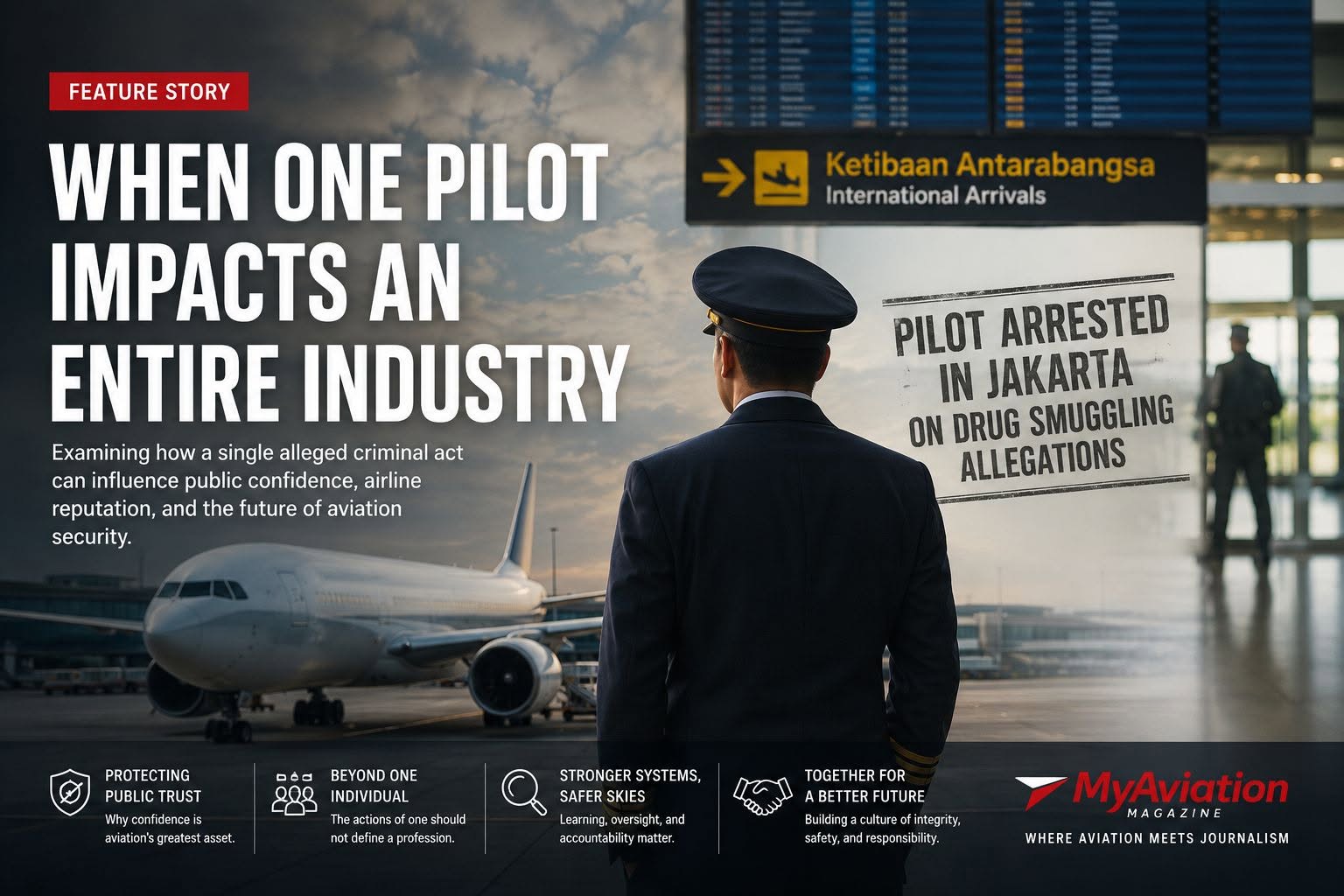
The recent arrest of a Malaysian pilot in Jakarta on allegations of drug smuggling has sent shockwaves through the aviation community and attracted widespread public attention across the region. While the matter remains under investigation by the Indonesian authorities and the individual is entitled to due legal process, the incident has reignited an important discussion about one of aviation’s most valuable assets, public trust.
For an industry that transports millions of passengers safely every day, confidence is not built overnight. It is earned over decades through professionalism, rigorous training, operational discipline, regulatory oversight, and an unwavering commitment to safety. Yet, history has shown that the actions of a single individual can quickly place an entire profession under public scrutiny.
The aviation industry is unique. Unlike many other professions, pilots are entrusted with the lives of hundreds of passengers on every flight. This responsibility extends beyond technical competence. It encompasses integrity, discipline, sound judgement, and adherence to the highest ethical standards. When a pilot becomes the subject of serious criminal allegations, the impact often reaches far beyond the individual concerned.
A Profession Built on Trust
Every passenger who boards an aircraft does so with a silent expectation. They expect the aircraft to be airworthy, the engineers to have completed their work diligently, the cabin crew to be prepared for emergencies, and above all, the pilots to operate with professionalism and integrity.
Unlike many industries where consumers can directly observe the quality of service, aviation relies heavily on trust. Passengers cannot inspect aircraft maintenance records or evaluate flight crew competence before departure. Instead, they rely on a comprehensive system of oversight involving airlines, aviation authorities, training organisations, airports, maintenance providers, and international regulatory frameworks.
This confidence has enabled commercial aviation to become one of the safest modes of transport in the world.
However, public trust is fragile. Incidents involving flight crew, whether related to safety, misconduct, or alleged criminal activity, often receive significant media attention because they involve individuals occupying positions of extraordinary responsibility.
One Individual Does Not Represent an Entire Profession
It is important to distinguish between an allegation against one individual and the professionalism of thousands of pilots who perform their duties with dedication every day.Across Malaysia and the wider Asia-Pacific region, pilots undergo years of demanding education, simulator assessments, recurrent training, medical examinations, and regulatory evaluations before they are permitted to command commercial aircraft. Their careers are built upon continuous learning and strict compliance with national and international aviation standards.The overwhelming majority of aviation professionals maintain exemplary standards throughout their careers. They operate in highly regulated environments where safety remains the overriding priority. Therefore, while incidents involving individual pilots naturally attract public attention, they should never be viewed as representative of the aviation profession as a whole.
Reputation Extends Beyond One Airline
Modern aviation operates within an interconnected global ecosystem. When news involving a pilot emerges, public perception often extends beyond the individual concerned. Questions may arise regarding airline recruitment practices, crew monitoring, security procedures, airport controls, and regulatory oversight. Even organisations with no direct connection to the incident may find themselves responding to increased public concern. In today’s digital environment, news travels instantly across multiple platforms. Public perception is often formed before official investigations are completed.
This places additional responsibility upon airlines and aviation authorities to communicate transparently while respecting ongoing legal proceedings. Timely communication, factual updates, and clear explanations help maintain public confidence during periods of uncertainty.
Security Beyond the Flight Deck
The aviation industry has invested billions of dollars in protecting aircraft against external threats. Airports employ sophisticated screening technologies, behavioural detection programmes, customs enforcement, intelligence sharing, and international security cooperation. However, incidents involving aviation personnel remind the industry that security extends beyond infrastructure and technology. A comprehensive security culture must also encompass personnel integrity, ethical behaviour, organisational reporting systems, and effective compliance programmes. Strong internal governance encourages employees to report concerns without fear of retaliation while ensuring that organisations respond promptly to identified risks. A mature safety culture and a mature security culture are closely connected.
The Importance of Professional Ethics
Aviation has always demanded more than technical excellence. Professional pilots are expected to demonstrate discipline both inside and outside the cockpit. Their conduct influences public confidence in airlines and reflects the values of the wider aviation profession. Ethics, accountability, and personal responsibility remain essential characteristics of aviation leadership. Training institutions increasingly recognise that technical competence alone is insufficient. Modern aviation education also focuses on decision-making, human factors, leadership, fatigue management, threat and error management, and professional conduct.
These subjects contribute to developing pilots who are prepared not only to operate aircraft safely but also to uphold the integrity of the profession.
Supporting Crew Wellbeing
While individual accountability is fundamental, airlines also have a responsibility to support the wellbeing of their employees. Commercial pilots operate under demanding conditions that include irregular schedules, international travel, time zone changes, operational pressure, and significant responsibility. Many airlines now invest in confidential employee assistance programmes, mental health support, peer assistance initiatives, and wellness programmes designed to encourage early intervention before personal issues develop into operational concerns. A proactive approach to wellbeing strengthens both safety and organisational resilience.
Learning Rather Than Reacting
The aviation industry has long embraced a culture of learning from incidents. Every occurrence, whether operational, technical, or security-related, provides an opportunity to review procedures, identify vulnerabilities, and improve systems. Rather than focusing solely on individual wrongdoing, organisations benefit most when they examine whether existing processes remain effective and whether further safeguards could enhance resilience. Continuous improvement has always been one of aviation’s defining strengths.
The Role of Regulators
Civil aviation authorities play an essential role in maintaining confidence through oversight, certification, inspections, and enforcement. Strong regulatory frameworks reassure passengers that aviation safety does not depend solely upon individual organisations but is supported by independent supervision and internationally recognised standards. Collaboration between regulators, airlines, airports, customs agencies, and law enforcement strengthens the aviation ecosystem as a whole. International cooperation has become increasingly important as aviation continues to connect people, businesses, and healthcare across borders.
Responsible Media Matters
Events involving aviation professionals inevitably attract significant media attention. However, responsible journalism requires careful distinction between allegations, confirmed facts, and speculation. Balanced reporting protects the integrity of ongoing investigations while avoiding unnecessary damage to organisations and professionals who are not connected to the incident. For specialist aviation publications, the objective should not be sensationalism but thoughtful analysis that contributes to industry understanding.
Looking Ahead
The recent allegations involving a Malaysian pilot serve as a reminder that public trust remains aviation’s most valuable asset. The industry’s response should not be driven by fear but by professionalism, transparency, and continuous improvement. Airlines, regulators, training organisations, airports, and aviation professionals all share responsibility for preserving the confidence that millions of passengers place in aviation every day. One individual’s alleged actions should never define an entire profession. Instead, they should reinforce the importance of strong governance, ethical leadership, effective oversight, and a culture where safety, security, and integrity remain inseparable. Ultimately, aviation has earned its reputation through decades of learning, adapting, and improving. That commitment must continue.
As the industry navigates future challenges, maintaining public trust will remain just as important as maintaining operational excellence. Because in aviation, safety is not only measured by technology and procedures, it is measured by the confidence people place in those entrusted to fly them safely.
MyAviationMagazine believes that the aviation community grows stronger when difficult issues are examined objectively, responsibly, and with a commitment to learning rather than assigning blame. By preserving professionalism and strengthening public trust, the industry can continue moving forward while upholding the standards that have made aviation one of the world’s safest and most respected sectors.