
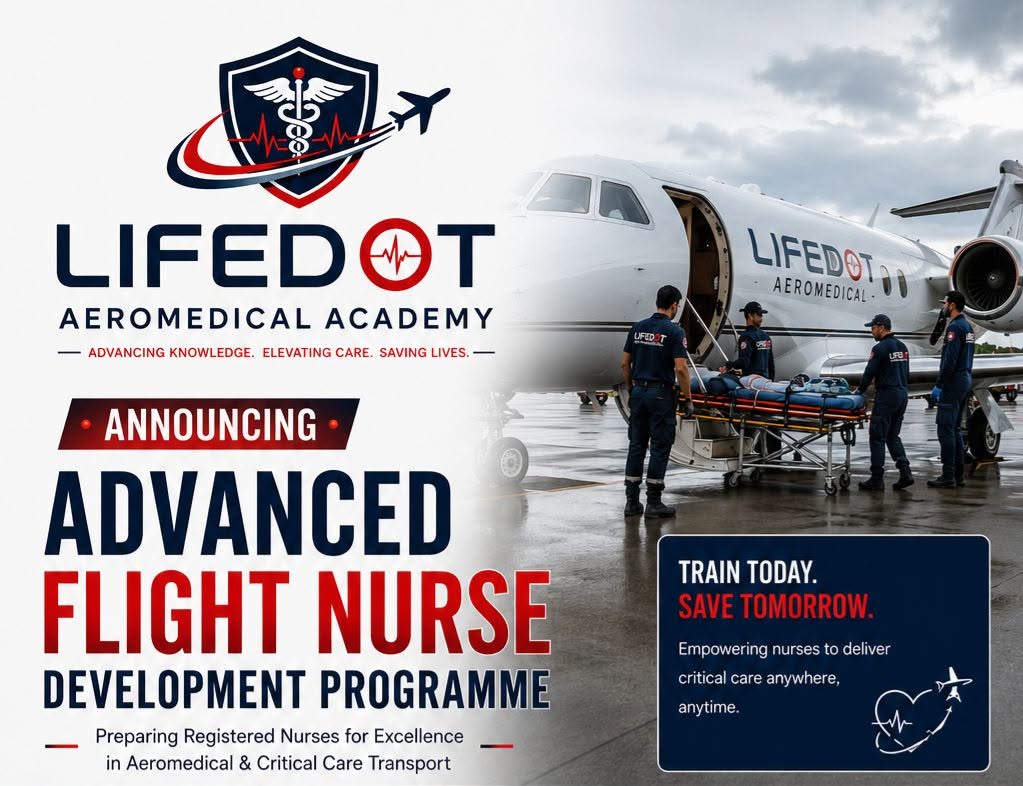
Lifedot Aeromedical Academy launches a new five-day Advanced Flight Nurse programme as Efinair MyJets International strengthens its commitment to professional development within the region’s evolving aeromedical ecosystem.
When Critical Care Leaves the Hospital
There is a moment in every critical care transport when the familiar environment of the hospital disappears.
The patient leaves the ward. The monitors move with them. Oxygen becomes a finite resource. Equipment must travel. The clinical team becomes smaller. The ambulance doors close, and eventually the aircraft door does too.
From that point forward, there is no ICU down the corridor.
For the medical professionals entrusted with that patient, preparation, anticipation and clinical judgement become critical.
This is the world of aeromedical nursing.
As medical repatriation, cross-border healthcare and critical care transport continue to develop across Asia, nurses are increasingly encountering patients whose care must continue beyond the conventional hospital environment.
Against this backdrop, Lifedot Aeromedical Academy has launched its Advanced Flight Nurse (AFN) programme, a five-day professional development initiative designed to strengthen nursing knowledge and competency within aeromedical and critical care transport.
The inaugural programme is scheduled for 19–23 October 2026.
For Adam S. Kumar, CEO of Efinair MyJets International Sdn Bhd and Lifedot Medevac, Lifedot Aeromedical Academy, the programme represents something larger than the launch of another training course.
It represents an effort to strengthen the people behind an aeromedical mission.
«“An aircraft can transport the patient, but it is the medical team that must continue the care. Aeromedical capability is ultimately built around people, preparation, clinical judgement and teamwork.”»
A Different Kind of Nursing Environment
Critical care nursing is already demanding.
Move that care into an ambulance or aircraft, however, and the clinical environment changes.
The patient may still require mechanical ventilation, continuous monitoring, medication infusions, haemodynamic support or complex nursing interventions, but the resources surrounding the clinician are no longer those of a conventional ICU.
Space may be restricted.
Noise and vibration can complicate assessment and communication.
Medical equipment must be selected and secured before departure.
Battery endurance matters.
Oxygen consumption must be anticipated.
Access to the patient may become limited.
And once an aircraft is airborne, simply obtaining additional equipment or personnel is no longer an immediate option.
Aeromedical transport therefore demands a mindset that extends beyond reacting to a patient’s current condition.
The medical team must ask:
What could happen next?
That principle sits at the heart of the Advanced Flight Nurse programme.
Understanding What Flight Does to the Patient
A critically ill patient does not necessarily respond to the flight environment in the same way as a healthy passenger.
Changes associated with altitude and cabin pressure can influence physiology, oxygenation and the behaviour of trapped gases.
For certain patients, including those with respiratory compromise, trauma, recent surgical procedures or other complex conditions, these considerations may become clinically significant.
Understanding aeromedical physiology is therefore one of the foundations of flight nursing.
AFN introduces participants to the relationship between atmospheric pressure, cabin altitude, hypoxia, gas expansion and patient physiology, before progressing into the practical implications for patient assessment and transport planning.
The purpose is not to turn nurses into pilots.
It is to ensure that nurses caring for patients within an aviation environment understand how that environment can influence clinical care.
As Adam explains:
«“A highly experienced ICU nurse already possesses valuable clinical skills. Aeromedical education adds another layer, understanding what changes when that same patient has to be moved, transported and potentially cared for at altitude.”»
From “Can This Patient Fly?” to “How Do We Move This Patient Safely?”
One of the most important decisions surrounding an aeromedical mission occurs before the aircraft departs.
A patient’s diagnosis alone does not tell the complete story.
The medical team must consider current physiological stability, recent deterioration, oxygen requirements, ventilation, medications, invasive devices, anticipated complications, duration of transport and the resources required throughout the journey.
The question is therefore broader than simply:
Can this patient fly?
It becomes:
What needs to happen for this patient to be transported as safely as reasonably possible?
AFN introduces nurses to structured pre-transport assessment, stabilisation priorities, transport-risk identification and multidisciplinary fit-to-fly considerations.
The programme deliberately places these concepts within a multidisciplinary framework.
Flight nurses form an important part of the clinical team, but decisions surrounding transport suitability may involve physicians, medical directors, operational teams and other healthcare professionals depending on the patient’s condition and organisational protocols.
That distinction is important in building a professional programme that develops judgement without overstating professional authority.
Five Days, One Continuous Patient Journey
Rather than presenting aeromedical nursing as a collection of isolated subjects, the AFN curriculum follows the progression of a patient-transfer mission.
Day One — Foundations & Aeromedical Physiology
Participants begin with the principles of aeromedical nursing and the physiological implications of the flight environment.
Altitude, cabin pressure, hypoxia, gas expansion and transport-related physiological stress establish the scientific foundation for the programme.
Day Two — Advanced Assessment & Critical Care
The focus moves to patient assessment and stabilisation.
Participants examine airway and respiratory management, mechanical ventilation during transport, cardiovascular assessment, haemodynamic considerations and recognition of deterioration.
Day Three — Complex Critical Care Transport
The programme progresses into complex patient management, including critical care pharmacology, neurological emergencies, trauma, surgical patients and special or high-risk populations.
Day Four — Aeromedical Environment & Operational Awareness
Participants then examine the environment surrounding the clinical mission.
Aeromedical equipment, oxygen planning, resource management, aircraft-environment awareness, Human Factors, Crew Resource Management and mission coordination become central themes.
Day Five — Emergencies, Simulation & Assessment
The final day brings the programme together through clinical emergencies, case-based decision-making, simulation and competency assessment.
Participants must move beyond knowing the theory and demonstrate their ability to apply it.
The Mission Does Not Begin at Take-Off
One misconception surrounding air ambulance operations is that the aeromedical mission begins when the aircraft leaves the runway.
In reality, the journey often begins at the patient’s bedside.
A typical international transfer may involve:
Sending Hospital → Ground Ambulance → Airport → Aircraft → Destination Airport → Ground Ambulance → Receiving Hospital
Every transition introduces potential risk.
A communication failure at the referring hospital can affect the flight.
An equipment problem discovered during loading can delay departure.
Insufficient oxygen planning can become a serious operational and clinical concern.
A poor handover at destination can undermine hours of otherwise excellent care.
For this reason, Lifedot’s programme emphasises the bed-to-bed philosophy of aeromedical transport.
The nurse is encouraged to understand the complete journey rather than viewing the aircraft as an isolated clinical environment.
«“The patient does not experience the mission as separate pieces,” Adam says. “For the patient, it is one continuous journey. Our clinical thinking should reflect that.”»
Human Factors: Where Medicine Meets Aviation
Some of aviation’s most important safety lessons have little to do with flying an aircraft.
They concern people.
Communication.
Leadership.
Fatigue.
Workload.
Situational awareness.
Decision-making.
The ability to recognise when something is going wrong and the willingness to speak up before it becomes worse.
These principles have particular relevance to aeromedical operations, where healthcare and aviation professionals must work around the same mission while carrying very different responsibilities.
A deteriorating patient may demand the medical team’s full attention at precisely the same moment that weather, turbulence or another operational issue demands the flight crew’s attention.
Communication must remain disciplined.
Responsibilities must remain clear.
AFN therefore incorporates Human Factors and Crew Resource Management principles relevant to aeromedical healthcare professionals.
It does not train nurses to perform flight-crew functions.
Instead, it develops awareness of how effective multidisciplinary teamwork contributes to patient and operational safety.
Training for the Unexpected
A flight nurse cannot control when a patient deteriorates.
But training can influence how effectively that deterioration is managed.
What happens if oxygen saturation suddenly falls?
What if a ventilator alarms?
What if haemodynamic stability deteriorates?
What if an infusion fails?
What if access to the patient is restricted?
What if clinical deterioration occurs alongside an operational challenge?
These are precisely the situations where knowledge must become action.
Simulation therefore forms an important component of AFN.
Rather than assessing participants solely through written knowledge, the programme incorporates practical learning, clinical scenarios and an integrated mission assessment.
The intention is to develop a cycle of:
Assess. Anticipate. Stabilise. Transport. Lead.
For Adam, anticipation is particularly important.
«“The strongest transport clinicians are not only asking what is happening now. They are continuously thinking about what could happen ten minutes from now, thirty minutes from now or at the next stage of the journey.”»
Professional Development Without Blurring Regulatory Boundaries
The growth of specialist healthcare education brings an equally important responsibility: qualifications must be described accurately.
Lifedot Aeromedical Academy has deliberately positioned AFN as a professional development programme in aeromedical and critical care nursing.
Participants who successfully complete the programme requirements will receive a:
Professional Certificate of Completion in Advanced Flight Nursing.
The programme does not confer Advanced Practice Nurse status and does not constitute a CAAM aviation licence, rating, approval or flight-crew qualification.
This distinction is intentional.
The aviation operational content is focused on aircraft-environment and operational awareness relevant to aeromedical healthcare personnel, rather than training nurses to undertake regulated flight-crew responsibilities.
Likewise, professional employment as a flight nurse remains subject to the credentialing, experience, occupational requirements and clinical governance arrangements of individual employers and aeromedical organisations.
«“Credibility requires clarity,” Adam says. “We should never make a professional programme appear to grant an authority or regulatory qualification that it does not. AFN is about developing aeromedical nursing knowledge, judgement and competency.”»
From Efinair to Lifedot Aeromedical Academy
The launch of the academy represents another stage in the development of the aeromedical activities associated with Efinair MyJets International Sdn Bhd and Lifedot Medevac.
For the organisation, professional education provides an opportunity to complement aeromedical services with capability development.
Lifedot Aeromedical Academy is intended to provide a dedicated platform for professional learning, industry engagement and future regional educational collaboration.
Kumar believes developing human capability is fundamental to the wider evolution of the sector.
«“Aircraft change. Medical technology changes. Equipment becomes more sophisticated. But the quality of an aeromedical mission will always depend heavily on the professionals making decisions around the patient.”»
The longer-term ambition is therefore not limited to one intake or one profession.
The academy sees opportunities for interaction between nurses, doctors, paramedics, ambulance providers, hospitals, assistance companies and aviation stakeholders while maintaining the professional boundaries of each discipline.
Why Asia Needs the Conversation
Asia presents one of the world’s most complex environments for patient movement.
Its geography includes densely populated international cities, remote communities, vast land areas, island nations and major tourism corridors.
At the same time, patients increasingly move across borders for work, travel, treatment and repatriation.
A patient who becomes critically ill overseas may require a chain of coordination involving multiple hospitals, ambulance providers, airports, aviation operators and medical teams across different jurisdictions.
Within that chain, clinical continuity matters.
Malaysia’s position within Southeast Asia provides an opportunity to contribute to the development of aeromedical capability and professional education within the region.
Singapore has a sophisticated healthcare environment. India has a large and developing critical care and aeromedical ecosystem. Indonesia’s geography creates its own transport challenges. Other Asian markets are similarly developing specialised patient-movement capabilities.
For Lifedot Aeromedical Academy, regional development creates an opportunity for professional collaboration rather than competition alone.
«“There is tremendous knowledge across Asia,” Adam says. “The future should involve greater collaboration, shared learning and stronger professional networks around aeromedical medicine.”»
The academy is already looking at the potential for future regional programmes where appropriate partnerships and participant demand exist.
The Flight Nurse of the Future
The future flight nurse will likely need to be more than technically competent.
The role increasingly demands a combination of critical care capability, transport knowledge, communication, situational awareness, adaptability and leadership.
Technology may provide better monitoring.
Aircraft may become more capable.
Medical equipment may become lighter and more sophisticated.
But technology cannot entirely replace clinical judgement.
A monitor can identify that a parameter has changed.
A trained clinician must understand why it changed, what it means in the context of the patient and transport environment, and what should happen next.
That is where professional development matters.
More Than a Destination
Every aeromedical mission has a departure point and a destination.
For the patient, however, the most important issue is what happens between them.
The aircraft is only one component.
The real mission is continuity of care.
With the launch of the Advanced Flight Nurse programme, Lifedot Aeromedical Academy is placing greater emphasis on preparing nurses to understand that complete journey, clinically, operationally and professionally.
For Adam S. Kumar, the philosophy behind the initiative can ultimately be expressed simply:
«“When a critically ill patient leaves the hospital, the responsibility for quality care does not remain behind. It travels with the patient.”»
And that may be the defining principle of modern aeromedical nursing.
Critical care does not end at the hospital door. Sometimes, it takes flight.
ADVANCED FLIGHT NURSE (AFN)
Inaugural Programme
19–23 October 2026
Subang SkyPark RAC, Subang, Selangor, Malaysia
Five-Day Professional Development Programme
Professional Certificate of Completion in Advanced Flight Nursing
Lifedot Aeromedical Academy
Associated with Lifedot Medevac | Efinair MyJets International Sdn Bhd
Office: 03 2116 5949
Programme Hotline: 016 267 3998
Email: ops@lifedotmedevac.com
The Advanced Flight Nurse programme is professional development training in aeromedical and critical care nursing. It does not confer Advanced Practice Nurse status or constitute a CAAM aviation licence, rating, approval or flight-crew qualification.