
OPINION | MY AVIATION
Asia is becoming one of the most important aviation regions in the world.
Airlines are expanding fleets. Airports are adding capacity. New routes are appearing across Southeast Asia. Emerging markets are growing, and millions of people who once regarded air travel as a luxury now consider it an essential part of everyday mobility.
Growth is exciting.
But growth alone should not become the measure of success.
The question Asia’s aviation industry should increasingly ask is not simply how many more passengers can we carry?
It should be: how intelligently can we grow?
Bigger Is Not Always Better
For years, aviation growth has often been communicated through impressive numbers: aircraft orders, passenger records, new destinations, additional frequencies and airport expansion.
These numbers matter.
But an airline operating more aircraft is not automatically a stronger airline. An airport processing more passengers is not necessarily a better airport. And opening another route does not guarantee that the route will remain commercially sustainable.
Aviation is an ecosystem.
Aircraft utilisation, profitability, airport infrastructure, engineering capability, workforce development, safety culture and passenger experience must grow together.
When one component expands significantly faster than the others, pressure begins appearing elsewhere.
Asia therefore needs to move beyond celebrating expansion simply because it is expansion.
The Right Aircraft for the Right Market
One of the most interesting developments in modern aviation is the increasing ability of airlines to match aircraft more precisely with individual markets.
Not every route requires hundreds of seats.
There are potentially valuable connections between secondary Asian cities that may struggle to support larger aircraft but could work with appropriately sized capacity.
This matters enormously for ASEAN.
The region contains major aviation centres such as Singapore, Kuala Lumpur, Bangkok, Jakarta, Manila, Hanoi and Ho Chi Minh City.
But beyond these gateways are dozens of growing cities.
The next chapter of Asian aviation could increasingly involve connecting those cities directly rather than forcing passengers through traditional hubs for every journey.
That is smarter connectivity.
Airports Must Grow Differently Too
The same principle applies to airports.
Building larger terminals is visible. Improving operational efficiency is less visible.
Yet passengers experience aviation through much more than architecture.
They experience immigration queues, baggage delivery, security processes, ground transportation, flight connections, digital systems and how effectively disruption is managed.
An impressive terminal loses some of its value when passengers spend excessive time waiting for baggage.
A beautiful airport becomes less competitive when aircraft repeatedly experience operational delays.
Asia’s airports should certainly invest in infrastructure.
But infrastructure investment should increasingly be accompanied by investment in efficiency, technology and people.
The Workforce Cannot Be an Afterthought
Perhaps the most underestimated challenge facing aviation growth is human capital.
Aircraft can be ordered.
Terminals can be constructed.
Technology can be purchased.
Experienced aviation professionals take years to develop.
Pilots, engineers, air traffic controllers, ground personnel, safety professionals, dispatchers and specialised aviation managers all require training and experience.
If Asian aviation expands significantly without developing sufficient human capability, the industry’s growth ambitions could eventually collide with workforce limitations.
Training should therefore not be treated as something that follows expansion.
It must be part of the expansion strategy itself.
Safety Must Remain Boring
There is another principle Asia should never sacrifice in pursuit of growth.
Safety.
The best aviation safety system is often the one passengers never notice.
Checks are performed. Procedures are followed. Aircraft are maintained. Crews are trained. Risks are identified. Decisions are challenged when necessary.
None of this generates glamorous headlines.
But it is the foundation upon which every successful aviation market is built.
As competition increases, airlines will naturally pursue efficiency.
Efficiency is necessary.
But there is an important difference between removing unnecessary processes and removing necessary safeguards.
The industry’s responsibility is to understand that difference.
ASEAN Should Think Beyond National Competition
There is understandable pride when a country’s airport moves up an international ranking or its airlines expand.
But Southeast Asian aviation should also be viewed collectively.
A stronger Vietnamese aviation market does not automatically make Malaysia weaker.
A stronger Kuala Lumpur does not require Singapore to decline.
Bangkok’s success does not prevent Jakarta or Manila from developing.
ASEAN contains more than 680 million people and sits strategically between some of the world’s largest economies.
Its greatest aviation opportunity may ultimately come from greater connectivity between its own markets.
Competition will remain.
But competition and regional cooperation are not mutually exclusive.
Better air connectivity can increase tourism, trade, investment and mobility throughout the region.
Malaysia Has an Opportunity
Malaysia is particularly well positioned within this transformation.
Its geographic location, established aviation infrastructure, international connectivity, airline ecosystem and aerospace capabilities provide considerable advantages.
But past achievements cannot guarantee future relevance.
Other Asian aviation markets are moving quickly.
Malaysia’s challenge is therefore not simply to become bigger.
It is to become more valuable within the Asian aviation ecosystem.
That means strengthening connectivity, developing aviation talent, supporting aerospace capability, improving passenger experience and creating an environment where aviation businesses can compete internationally.
Malaysia should not chase every aviation trend.
It should decide where it can genuinely lead.
The Next Aviation Race
The coming decade will produce plenty of impressive numbers.
Asia will carry more passengers.
Airlines will acquire more aircraft.
Airports will expand.
New routes will connect cities that previously had no direct air service.
But perhaps the most successful aviation markets will not necessarily be those that grow fastest.
They will be those that understand why they are growing and build the ecosystem required to sustain it.
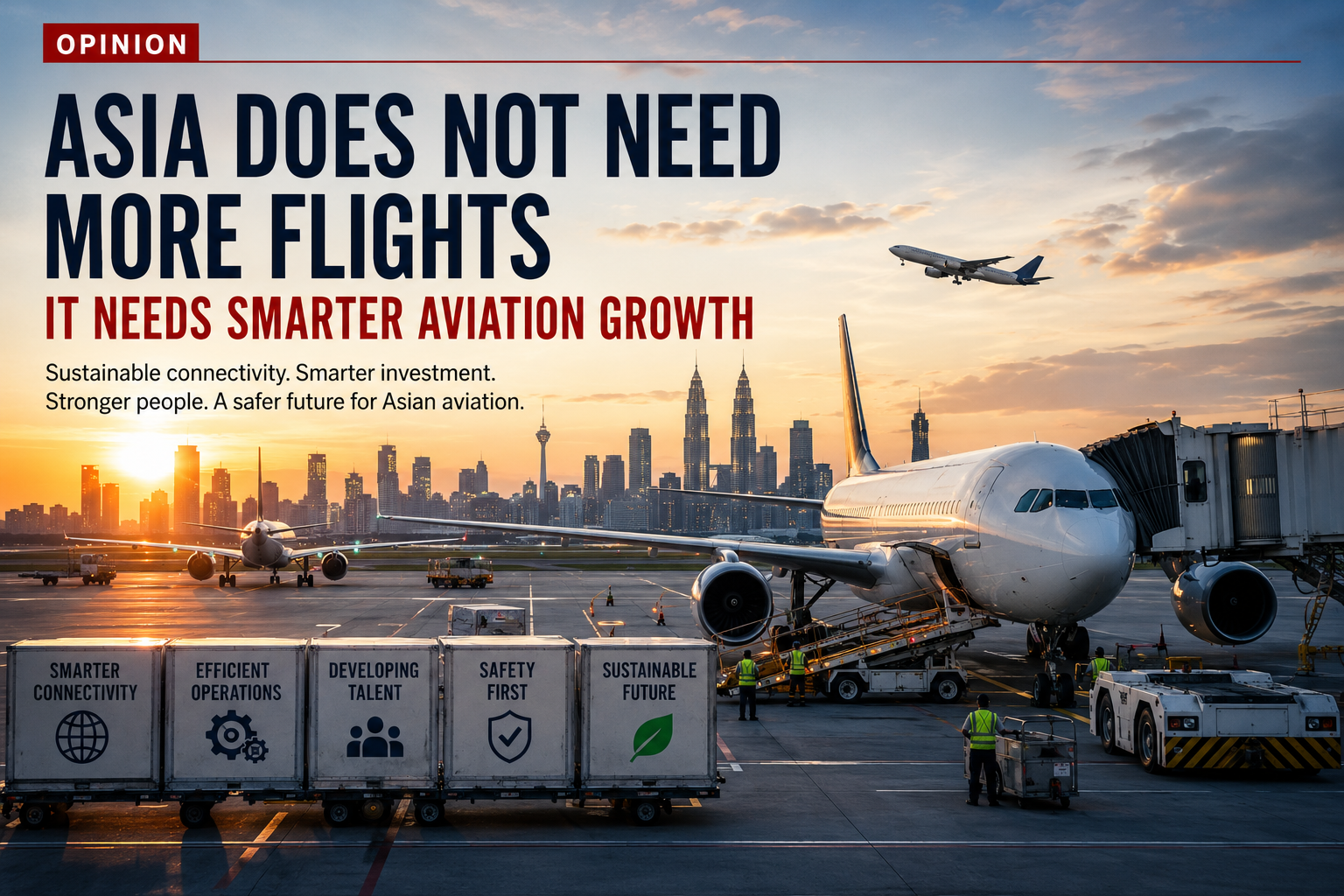
Asia does not need growth at any cost.
It needs airlines that are commercially resilient, airports that work efficiently, professionals who are properly developed and safety cultures that remain uncompromised.
The aviation race of the future should therefore not simply be about becoming the biggest.
It should be about becoming better connected, more efficient, more resilient and more sustainable.
That is the kind of aviation growth Asia should pursue.
My Aviation | Opinion | 28 August 2026