

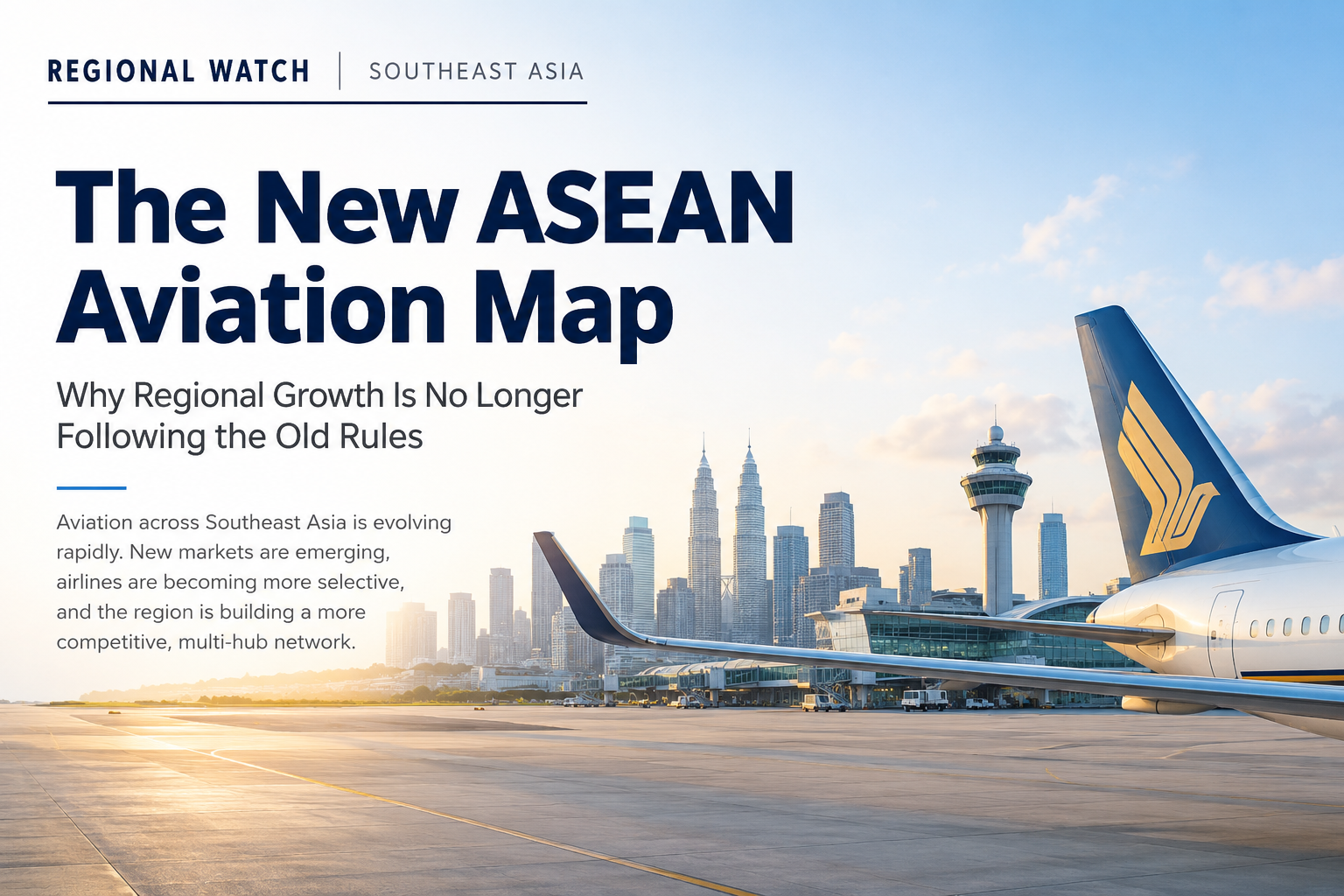
REGIONAL WATCH | SOUTHEAST ASIA
For years, Southeast Asia’s aviation landscape was relatively easy to understand. Singapore, Bangkok and Kuala Lumpur dominated regional connectivity, Indonesia supplied enormous domestic scale, and low-cost carriers transformed the way millions travelled across ASEAN.
That map is changing.
Vietnam is expanding rapidly. Indonesia continues to benefit from the sheer size of its domestic market. Malaysia remains strategically positioned between major ASEAN markets. Singapore continues to command premium international connectivity, while Thailand is working to maintain its position as one of the region’s most important tourism gateways.
At the same time, airlines are becoming more selective about where they deploy aircraft.
What is emerging is not one dominant Southeast Asian aviation centre, but a more competitive, multi-hub regional network.
Vietnam Is Changing the Balance
One of the clearest shifts is taking place in Vietnam.
In August 2026, Vietnam moved ahead of Thailand in scheduled airline capacity, reaching approximately 7.3 million seats compared with Thailand’s roughly 7.2 million. Vietnam’s capacity was around 10% higher year-on-year, with domestic capacity expanding even faster.
That is significant.
Thailand remains an aviation heavyweight with globally recognised tourism destinations and two major Bangkok airports. Vietnam overtaking it for a month does not suddenly reverse decades of aviation development.
But it demonstrates how quickly the competitive balance can move.
Hanoi and Ho Chi Minh City are becoming increasingly important aviation gateways, while Vietnam’s expanding economy, tourism sector and domestic travel market provide airlines with several sources of demand.
The lesson is not that Vietnam has “beaten” Thailand.
It is that ASEAN aviation leadership is becoming more widely distributed.
Indonesia Remains the Giant
Indonesia presents a completely different aviation proposition.
With thousands of islands and one of the world’s largest populations, aviation plays a fundamental role in connecting the country.
Indonesia remained Southeast Asia’s largest aviation market by scheduled capacity in August, with approximately 11 million seats.
Its importance therefore extends beyond Jakarta.
Domestic routes connecting cities across Java, Sumatra, Kalimantan, Sulawesi and other parts of the archipelago create a scale that few ASEAN markets can replicate.
As Indonesia’s economy develops, this enormous domestic aviation base could increasingly support international connectivity as well.
For regional airlines, Indonesia is simply too important to ignore.
Thailand Still Has Powerful Advantages
Thailand’s slight capacity contraction should also be kept in perspective.
Bangkok remains one of Asia’s best-known international gateways, while Phuket continues to attract substantial leisure traffic.
Thailand possesses something that cannot be created overnight: a globally established tourism brand supported by decades of international air connectivity.
Its challenge is therefore not building an aviation market from the beginning.
It is ensuring that infrastructure, airline capacity and passenger experience evolve quickly enough as neighbouring markets become stronger.
Competition within ASEAN is becoming less forgiving.
Singapore Competes Differently
Singapore demonstrates why passenger volume alone does not tell the entire story.
The city-state cannot compete with Indonesia or Vietnam on domestic aviation because it has effectively no domestic airline market.
Instead, Singapore’s strength comes from international connectivity.
Changi Airport functions as a transfer gateway linking Southeast Asia with Australia, Europe, India, Northeast Asia and other global markets.
Its aviation ecosystem also extends beyond passengers into cargo, maintenance, aerospace, airline operations and premium connectivity.
Singapore therefore illustrates an important point about the emerging ASEAN aviation landscape:
There is more than one way to become an aviation hub.
Malaysia Sits in a Critical Position
Malaysia’s position deserves particular attention.
Kuala Lumpur sits geographically close to several of Southeast Asia’s largest aviation markets. Malaysia has established airline brands, significant airport infrastructure, aerospace and maintenance capabilities and decades of experience supporting regional aviation.
But geography alone does not guarantee leadership.
Malaysia is competing in a region where Vietnam is accelerating, Indonesia has enormous scale, Thailand has global tourism strength and Singapore has built one of the world’s most recognised aviation ecosystems.
The opportunity for Malaysia is not necessarily to imitate any of them.
It is to determine where Malaysia can provide something distinctive.
That could include stronger regional connectivity, aerospace development, MRO, aviation training, cargo, specialised aviation services and better connections between secondary ASEAN cities.
Secondary Cities Could Be the Next Battleground
Perhaps the most interesting development will occur outside the traditional capitals.
For decades, much of Southeast Asian aviation revolved around major gateways.
But economic development is creating stronger demand in secondary cities.
Airlines with appropriately sized aircraft can increasingly consider routes that might once have been commercially difficult.
Instead of every passenger travelling through Singapore, Bangkok or Kuala Lumpur, more direct city-to-city connections could emerge.
That would gradually change how ASEAN’s aviation network functions.
The next important route may not necessarily connect two capital cities.
It could connect two growing regional economies that previously required passengers to make an unnecessary connection.
Low-Cost Carriers Are Entering a More Mature Phase
Low-cost aviation remains one of Southeast Asia’s greatest transport success stories.
It opened air travel to millions of people and helped transform weekend tourism, business mobility and cross-border travel.
But the operating environment is becoming more complicated.
Fuel costs, currency movements, aircraft availability and increasingly competitive markets mean airlines must become more disciplined about capacity.
That does not mean the low-cost model is weakening.
It means the model is maturing.
The next generation of successful Southeast Asian carriers may be those that understand not simply how to grow, but where growth actually creates sustainable value.
ASEAN Is Becoming a Network of Hubs
The traditional question has often been: Which city will become Southeast Asia’s leading aviation hub?
Perhaps that is increasingly the wrong question.
ASEAN is too large, diverse and geographically complex to revolve around a single airport.
Singapore can remain an international transfer powerhouse.
Bangkok can remain a major tourism gateway.
Jakarta can anchor Indonesia’s enormous market.
Vietnam can continue its rapid expansion.
Kuala Lumpur can strengthen its role as a strategically located regional connector.
Manila can develop alongside the Philippines’ growing domestic and international demand.
These markets do not need to develop identically.
Their differences may actually strengthen the regional aviation system.
The Regional Race Has Changed
Southeast Asian aviation is entering a period where yesterday’s rankings cannot be assumed to remain tomorrow’s rankings.
Passenger flows are changing.
Airlines are reassessing networks.
New aircraft are creating different route possibilities.
Secondary cities are becoming more important.
Governments are investing in airport infrastructure, while travellers have more choices than ever before.
The winners will not necessarily be the countries with the biggest airport or the airline with the largest fleet.
They will be the markets that understand how aviation fits into their wider economy — tourism, trade, investment, aerospace, logistics and regional mobility.
Southeast Asia’s aviation map is not simply expanding.
It is being redrawn.
And the most important development may be that ASEAN is no longer evolving around a handful of established aviation centres.
It is becoming a region of multiple gateways, multiple competitors and increasingly interconnected aviation markets.
That makes the next decade of Southeast Asian aviation considerably more interesting than the last.
My Aviation | Regional Watch | 28 August 2026