
BEHIND THE SCENES | GROUND OPERATIONS
To most passengers, an aircraft turnaround looks deceptively simple.
An aircraft arrives at the gate. Passengers disembark. Bags disappear onto conveyor belts. A new group of travellers gathers at the departure gate. Before long, the doors close and the aircraft pushes back for another flight.
But between arrival and departure, an intense operation is unfolding around the aircraft.
In some airline operations, teams may have only 30 to 60 minutes to prepare an aircraft for its next sector. During that window, multiple activities must be completed safely, accurately and in the correct sequence.
Every minute matters.
This is the hidden world of the aircraft turnaround.
The Clock Starts at the Stand
The operation begins before the aircraft has completely settled into its parking position.
Ground personnel are already preparing for its arrival. Equipment must be positioned correctly, staff briefed and the stand kept clear of hazards.
Once the aircraft stops and its engines are shut down, ground power may be connected and passenger stairs or an aerobridge positioned.
Only when the aircraft is confirmed safe to approach can the wider turnaround operation accelerate.
Passengers see the door opening.
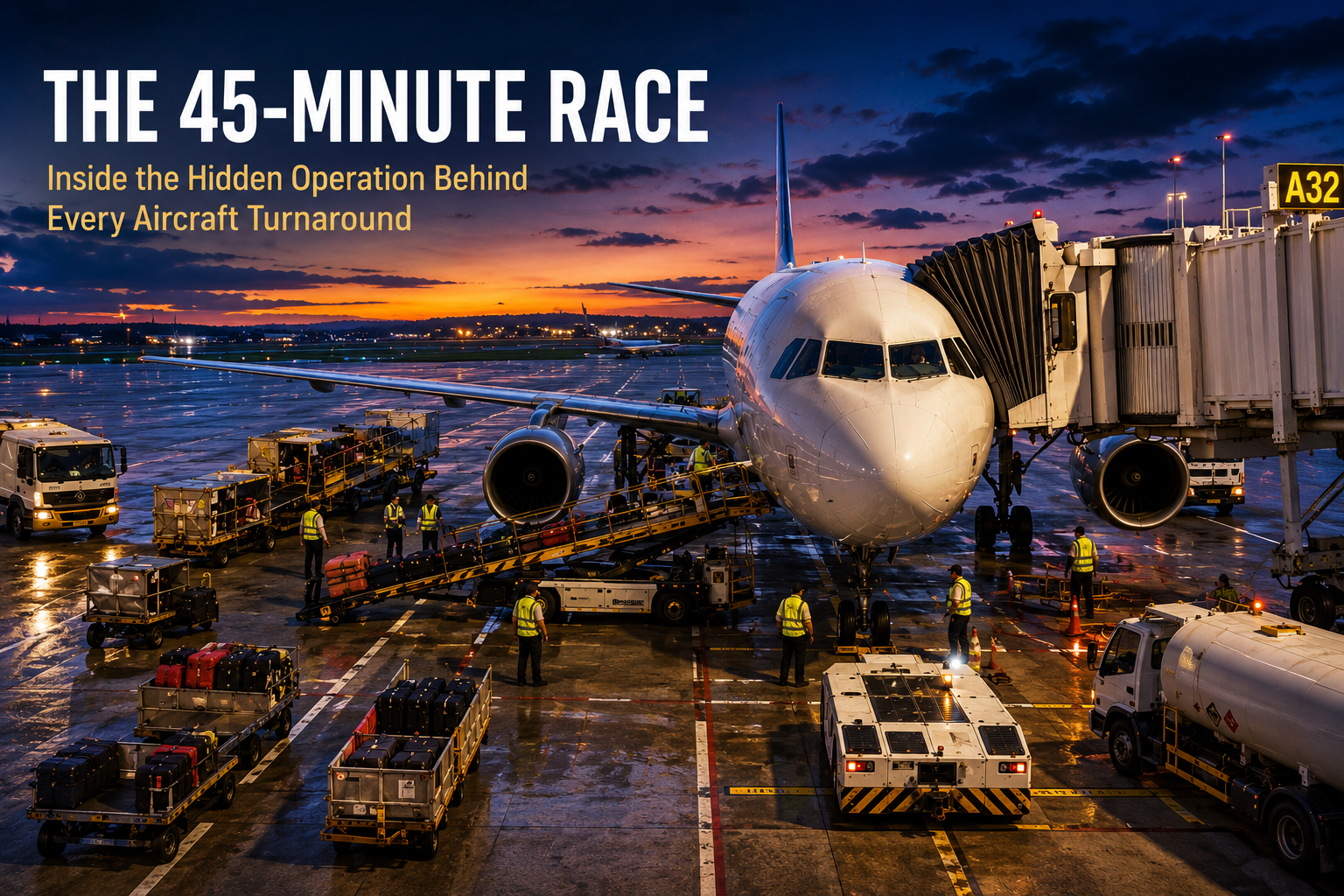
On the ramp, dozens of other tasks are beginning.
Baggage: A Race Against Time and Error
Below the passenger cabin, baggage teams begin unloading the aircraft.
Transfer baggage may need to reach another departing flight quickly. Local baggage must be transported to the terminal. At the same time, baggage for the next flight is being sorted and prepared for loading.
Speed matters, but accuracy matters more.
A bag loaded onto the wrong aircraft can create operational disruption and inconvenience for passengers thousands of kilometres away.
There is also another consideration: weight and balance.
Baggage and cargo cannot simply be placed wherever space is available. Their distribution contributes to the aircraft’s overall loading condition and must remain within approved limits.
What looks like people moving suitcases is therefore part of a much larger aircraft loading process.
Inside the Cabin, Another Team Takes Over
While activity intensifies outside, another turnaround is happening inside.
Cleaning teams enter the cabin as soon as operationally possible.
Seat areas are checked. Waste is removed. Galleys and lavatories are serviced according to the operator’s procedures, and the cabin is prepared for another group of passengers.
On aircraft operating several sectors per day, efficiency becomes critical.
A few unnecessary minutes spent on one turnaround can affect the next departure. That delay can then follow the aircraft throughout the day.
This is why airline punctuality is rarely determined by one department alone.
It is a collective performance.
Catering Has Its Own Deadline
For flights requiring catering, service vehicles approach designated aircraft doors and replenish the aircraft.
Meals, beverages and other catering supplies must correspond with the requirements of the next sector.
It is another operation passengers rarely think about.
Yet catering teams work within the same limited turnaround window as baggage handlers, cleaners, engineers and other ground personnel.
All these activities must coexist around one aircraft without compromising safety.
That coordination is what makes a successful turnaround remarkable.
Fuel: Essential, Controlled and Carefully Coordinated
Refuelling is one of the most important ground activities.
The amount required is determined through operational planning that considers the flight, reserves, weather, routing and other applicable requirements.
Fuel operations are performed under strict procedures.
At the same time, other turnaround activities may be taking place around the aircraft, making ramp discipline particularly important.
Vehicles, personnel and equipment all operate within a relatively confined environment.
A busy airport ramp can look chaotic from a terminal window.
It isn’t supposed to be.
Behind the movement are procedures defining where equipment can travel, where vehicles can park and how personnel approach the aircraft.
Engineers Are Watching Too
Not every technical inspection requires passengers to leave the aircraft for hours.
Engineering personnel may conduct transit or line-maintenance activities during the turnaround, depending on aircraft requirements and operator procedures.
Flight crews can also report technical observations from the previous sector.
If an issue is identified, engineers must determine the appropriate action in accordance with approved maintenance procedures and operational requirements.
This creates one of aviation’s most important principles:
Schedule pressure never overrides airworthiness.
A delayed aircraft may inconvenience passengers.
An aircraft that is not fit for operation does not depart merely to protect the schedule.
That distinction is fundamental to aviation safety.
Upstairs, the Next Flight Is Already Being Built
While the aircraft is being physically prepared, another operation is happening away from public view.
Dispatchers, operations personnel and flight crews are preparing for the next flight.
Weather conditions are reviewed.
Routing and operational information are considered.
Fuel requirements are determined.
Relevant notices and airport conditions are assessed.
The pilots prepare the cockpit and review the information required for the sector.
Cabin crew conduct their own preparations and safety checks.
The aircraft may still appear to be sitting quietly at the gate.
Operationally, however, the next flight has already begun.
Load Control: The Numbers Behind Departure
One of the least visible but most important parts of the turnaround is load control.
Passengers, baggage, cargo and fuel all contribute to aircraft weight.
Where that weight is positioned also matters.
Before departure, the aircraft must remain within its approved weight and balance limitations.
Passenger numbers can change. Bags can be removed. Cargo may be added. Fuel figures can be adjusted.
Those changes must be reflected accurately.
It is an excellent example of how aviation safety often depends on professionals passengers may never meet.
Then Comes the Final Coordination
As departure approaches, the separate pieces of the turnaround begin coming together.
Baggage loading is completed.
Cargo compartments are secured.
Cabin preparation finishes.
Required servicing is completed.
Operational documentation is finalised.
Passengers board.
Aircraft doors eventually close.
Around the aircraft, ground equipment begins moving away.
The ramp is checked.
The flight crew receives clearance for the next stage of departure, and the pushback operation begins where required.
An aircraft that arrived less than an hour earlier is ready to fly again.
What Happens When One Piece Is Late?
Turnarounds demonstrate why airline operations are so interconnected.
A late inbound aircraft can shorten the available preparation time.
A baggage issue can delay loading.
A technical defect can require engineering attention.
Weather can disrupt flight planning.
Passenger boarding can take longer than expected.
Air traffic restrictions can change the departure sequence.
Any one of these factors can affect the entire operation.
And because commercial aircraft frequently operate several flights in a single day, a delay early in the schedule can potentially influence later sectors.
This is why airlines devote enormous attention to operational reliability and turnaround performance.
The People Passengers Rarely See
When passengers compliment a smooth flight, attention naturally goes to pilots and cabin crew.
They are the airline professionals passengers interact with directly.
But every successful departure also depends on a much larger community.
Ground handlers. Baggage teams. Ramp personnel. Aircraft cleaners. Catering teams. Fuel operators. Engineers. Load controllers. Dispatchers. Operations controllers. Gate personnel and many others.
Some work in intense heat.
Others work through rain, darkness and overnight shifts.
Many perform highly time-sensitive jobs only metres away from operating aircraft and heavy ground equipment.
Their names will never appear on a passenger’s boarding pass.
Yet without them, the aircraft does not leave.
More Than 45 Minutes
The aircraft turnaround represents aviation in miniature.
Safety, teamwork, communication, engineering, logistics and human performance all converge around a single aircraft with one objective:
prepare it safely and efficiently for its next flight.
The next time passengers look through an airport window and see an aircraft surrounded by vehicles and ground personnel, they are witnessing far more than routine airport activity.
They are watching dozens of professionals synchronise hundreds of individual actions against a constantly moving clock.
And when everything works correctly, the most impressive part is that passengers barely notice it happened.
My Aviation | Behind the Scenes