
DEEP AVIATION INSIGHTS | FLEET & MRO
When passengers see a full aircraft departing an airport, the aviation industry can appear to be functioning normally.
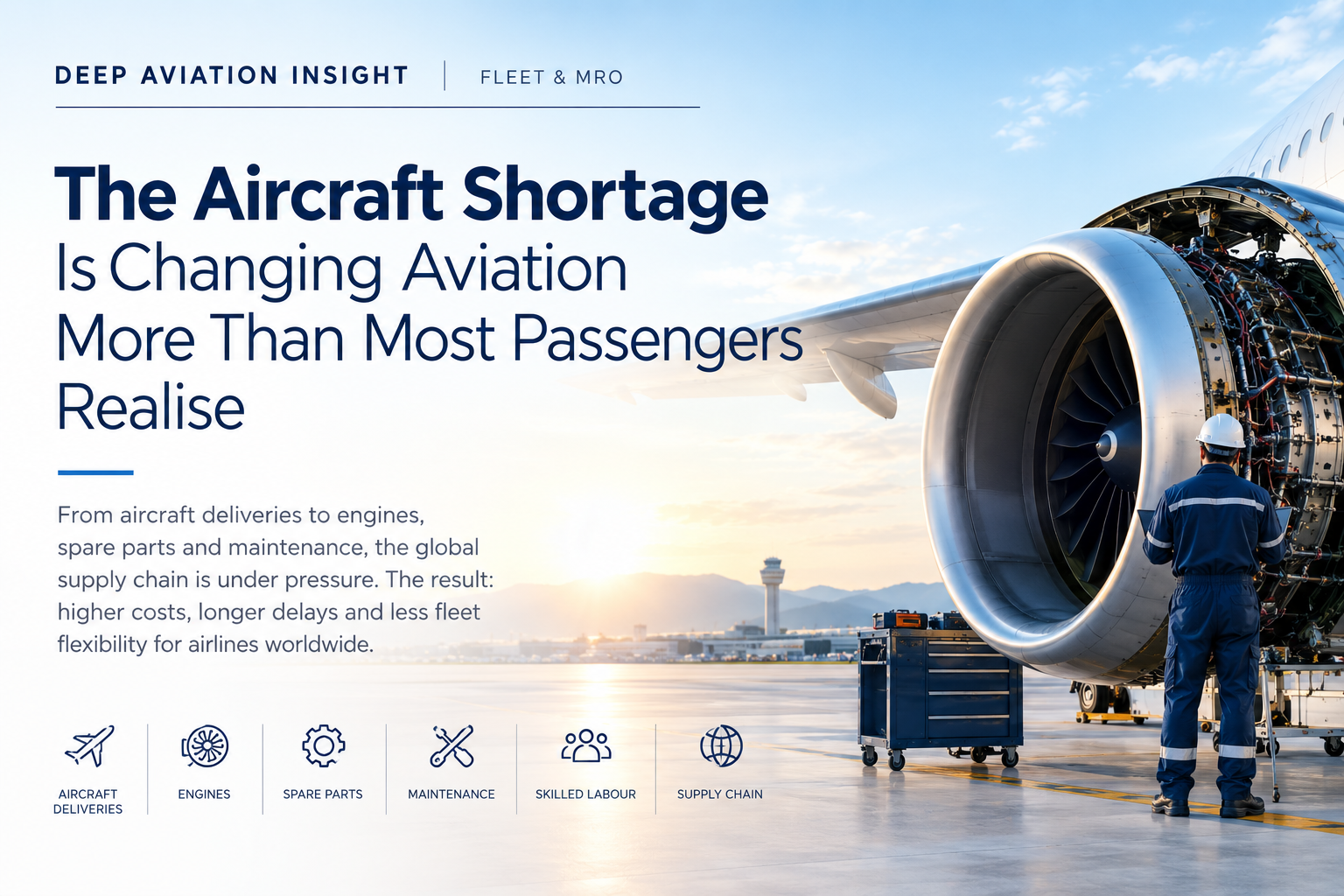
Behind the scenes, however, airlines are dealing with a problem that is becoming one of the defining issues of modern commercial aviation: there are simply not enough serviceable aircraft and engines available to meet everything airlines want to do.
The problem is no longer just delayed aircraft deliveries.
It stretches across aircraft manufacturing, engines, spare parts, maintenance capacity, skilled labour and the global aerospace supply chain.
IATA says the aircraft order backlog has now exceeded 18,000 aircraft, while delivery shortfalls exceed 5,000 aircraft. The average global fleet age has consequently risen above 15 years.
What appears to be a manufacturing problem is increasingly becoming an airline strategy problem.
Airlines Are Keeping Aircraft Longer
Airlines normally plan fleet replacement years in advance.
Older aircraft leave the fleet as newer, more fuel-efficient aircraft arrive. The process allows airlines to reduce fuel consumption, improve reliability and introduce newer cabin products.
But when replacement aircraft arrive late, retiring the existing fleet becomes difficult.
The old aircraft suddenly becomes valuable again.
Leases get extended. Retirement dates move. Aircraft that might previously have been sold or returned remain in service.
That creates another consequence.
Older aircraft generally require more maintenance.
IATA estimates aerospace supply-chain problems cost airlines at least $11 billion in 2025, including approximately $4.2 billion in delayed fuel savings and $3.1 billion in additional maintenance costs.
The aircraft shortage therefore creates a cycle.
New aircraft arrive late.
Older aircraft remain longer.
Older aircraft require additional maintenance.
Maintenance facilities become busier.
And airlines have less flexibility when something goes wrong.
The Engine Has Become Just as Important as the Aircraft
An aircraft sitting on the ground without a serviceable engine produces no revenue.
This simple fact explains why today’s engine situation has become such an important aviation story.
Modern engines deliver substantial improvements in fuel efficiency, but some newer engine programmes have experienced durability and maintenance challenges.
At the peak in March 2025, IATA says 648 Pratt & Whitney GTF-powered aircraft — approximately 28% of the GTF-powered fleet — were grounded while waiting for engine shop visits, replacement engines or parts.
The situation has begun improving, but the financial consequences remain.
Air New Zealand, for example, recently estimated that engine-availability problems cost it approximately NZ$190 million during its 2026 financial year.
This demonstrates something passengers rarely consider.
An airline can own an aircraft and have passengers ready to fly, yet still be unable to operate because one critical component is unavailable.
MRO Is Becoming Strategically Important
Maintenance, Repair and Overhaul was once viewed by many outside aviation simply as the technical function responsible for keeping aircraft operational.
Today, MRO capacity is becoming a strategic asset.
Engines require shop visits.
Aircraft require heavy maintenance.
Components require repair.
And all of those activities compete for limited engineering capacity, hangar space, spare parts and skilled technicians.
The challenge could become considerably larger.
IATA forecasts annual shop visits for CFM LEAP engines could increase from roughly 600–800 in 2025 to more than 5,000 by 2040. GTF shop visits could rise from around 1,000 to more than 2,000 annually over the same period.
The aviation industry therefore cannot simply manufacture more aircraft.
It must simultaneously expand the ecosystem capable of maintaining them.
A Missing Part Can Ground a Multi-Million-Dollar Aircraft
Aviation supply chains are unusually complex.
Thousands of components must meet strict certification and airworthiness requirements.
An airline cannot simply replace a delayed aviation component with something commercially available.
That is why relatively small supply-chain problems can have disproportionately large consequences.
IATA has highlighted shortages of materials and spare parts, limited maintenance capacity, engine durability problems and long repair turnaround times as continuing constraints on airline operations.
For airlines, this changes inventory strategy.
Keeping additional spare components costs money.
Not keeping them creates another risk: an aircraft worth tens or hundreds of millions of dollars could remain grounded while waiting for a comparatively small component.
The economics of aviation therefore increasingly depend on something passengers will never see — parts availability.
The Shortage Is Changing Airline Networks
Fleet shortages eventually reach the route-planning department.
Imagine an airline originally expecting 50 aircraft but receiving only 44.
Its network cannot operate exactly as originally planned.
Management must decide where those six missing aircraft matter most.
Some new routes may be postponed.
Existing frequencies may be reduced.
Marginal routes may disappear.
Aircraft may be shifted toward markets generating stronger returns.
Growth becomes more selective.
This helps explain why aircraft availability is not merely an engineering issue.
It can determine which cities receive connectivity.
Leasing Becomes More Valuable
When airlines cannot obtain new aircraft quickly enough, another part of the industry benefits: aircraft leasing.
An available aircraft becomes more valuable when supply is constrained.
Airlines requiring immediate capacity may extend existing leases or seek additional aircraft from lessors rather than waiting years for factory delivery positions.
Engine leasing has experienced similar pressure.
IATA estimated that supply-chain disruption generated approximately $2.6 billion in additional engine-leasing costs in 2025.
Aircraft and engines therefore increasingly need to be understood not simply as equipment, but as scarce productive assets.
Asia Has More at Stake
This matters particularly to Asia.
The region contains some of aviation’s strongest long-term growth markets.
Millions of additional passengers are expected to enter the air-travel market as economies develop and connectivity improves.
But demand alone cannot create aviation growth.
Airlines need aircraft.
Aircraft need engines.
Engines need maintenance.
Maintenance organisations need parts.
And the entire system needs engineers, technicians and other skilled aviation professionals.
That creates an important opportunity for Asian aviation economies.
Countries capable of developing strong MRO facilities, engineering talent, component repair capabilities, spare-parts logistics and technical training could become increasingly valuable within the global aviation ecosystem.
Malaysia should pay particular attention.
Its aviation future does not depend exclusively on carrying more passengers through airports.
There is also strategic value in strengthening the technical infrastructure that keeps Asia’s aircraft flying.
The Industry Is Learning a Bigger Lesson
For decades, aviation strategy often concentrated heavily on aircraft orders.
An announcement for 50 or 100 new aircraft naturally attracted attention.
But today’s supply-chain crisis is demonstrating that an aircraft order is only the beginning.
Aviation growth requires an entire industrial system behind it.
Manufacturing.
Engines.
Components.
MRO.
Logistics.
Training.
Engineering talent.
Data.
And supply-chain resilience.
Remove one critical element and the aircraft may remain on the ground.
That may ultimately be the deepest lesson from the current aviation supply-chain crisis.
The future of aviation will not be determined solely by how many aircraft airlines order.
It will increasingly be determined by how reliably the global aviation ecosystem can keep those aircraft flying.
My Aviation | Deep Aviation Insights | 28 August 2026