
ASIA AVIATION | MRO & AEROSPACE
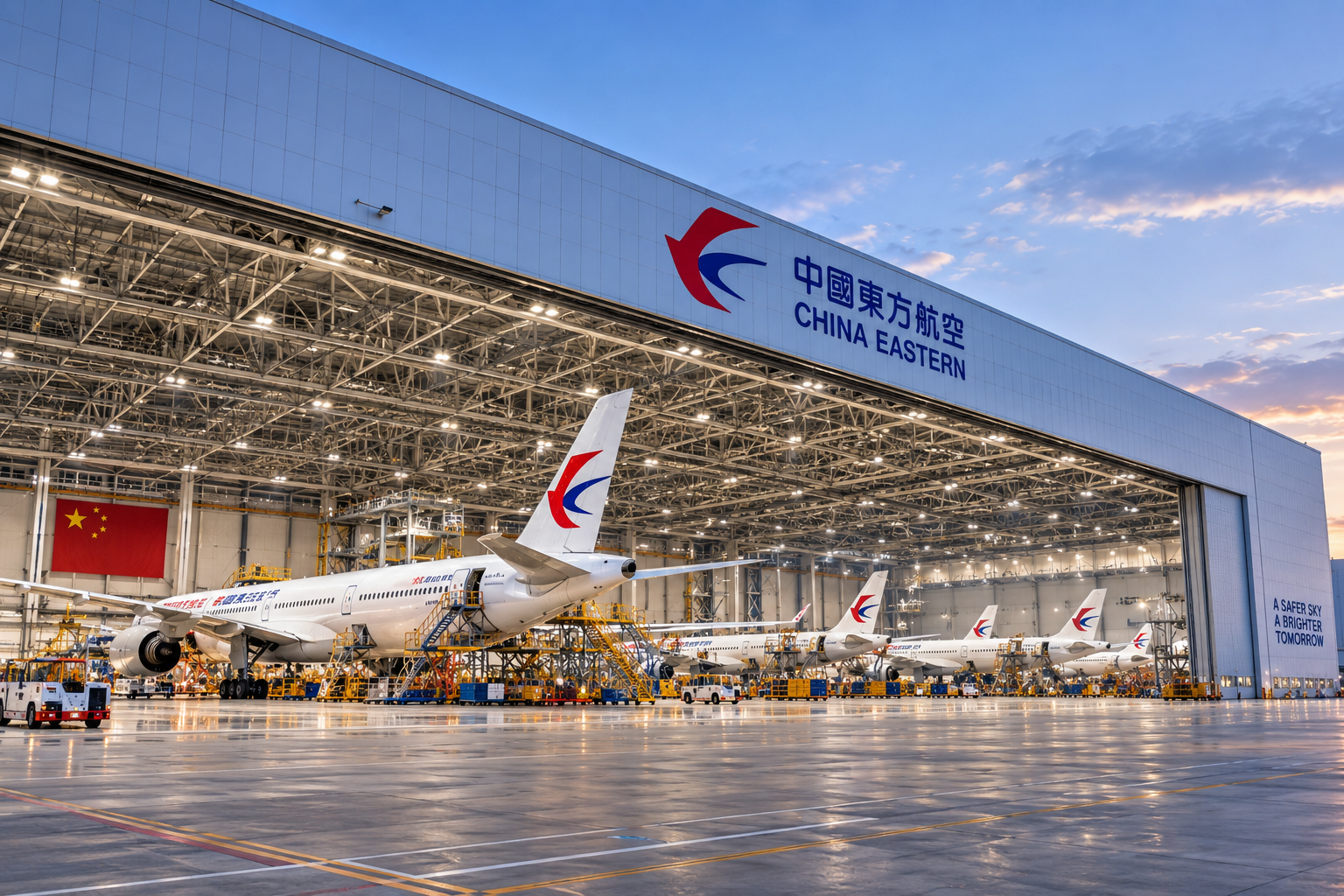
China’s aircraft maintenance sector has taken another significant step forward with the commissioning of what China Eastern Airlines describes as Asia’s largest widebody aircraft maintenance hangar, strengthening Shanghai’s position in the increasingly competitive Asia-Pacific maintenance, repair and overhaul market.
The new facility is operated by China Eastern Aircraft Maintenance Engineering (Shanghai) and located in Shanghai’s Lingang New Area, with direct access to Shanghai Pudong International Airport. Covering approximately 46,000 square metres, the hangar measures 313 metres across and 146 metres deep, with capacity to accommodate as many as nine widebody and two narrowbody aircraft simultaneously.
The significance of the development extends beyond the size of the building. It reflects a wider shift taking place across Asian aviation as maintenance capacity becomes an increasingly strategic component of airline operations.
With fleets expanding, aircraft remaining in service for longer and manufacturers continuing to work through substantial order backlogs, access to maintenance capacity can directly influence aircraft availability, operational reliability and network performance.
China Eastern’s maintenance organisation already provides heavy maintenance services for Boeing, Airbus and Comac aircraft. Its capabilities also extend to Airbus A330 passenger-to-freighter conversions and aircraft lease-return inspections.
The organisation has also developed an international customer base. Chinese reporting says it holds maintenance approvals from several major aviation authorities and has completed close to 1,900 aircraft maintenance events while serving more than 40 airlines and leasing companies.
For an MRO provider seeking international business, this regulatory reach is important. Aircraft may be registered in one jurisdiction, operated by an airline in another and maintained in a third. International approvals, technical capability and turnaround reliability therefore become as important as physical hangar capacity.
China Eastern is already looking beyond the facility’s initial configuration. The company plans to develop capacity for 10 widebody maintenance lines, two narrowbody lines and a dedicated aircraft painting line, while targeting annual productivity of approximately two million work hours within the next five years.
The facility is expected to support China Eastern’s own fleet while also competing for maintenance work from third-party airline customers.
That combination has strategic value. An airline-affiliated MRO organisation begins with a substantial internal maintenance requirement. Once sufficient technical expertise, certification and capacity have been established, those capabilities can be offered commercially to other operators.
Widebody maintenance is particularly significant because these aircraft represent some of the most technically demanding and commercially valuable assets within airline fleets. Aircraft such as the Airbus A330 and A350 and Boeing 777 commonly operate long-haul international services where aircraft availability has a direct effect on network capacity.
When a widebody aircraft enters heavy maintenance, an airline temporarily removes a considerable amount of passenger or cargo capacity from its operation. Maintenance planning and turnaround time therefore have consequences extending beyond the engineering department.
This is one reason MRO is becoming increasingly important to Asia’s wider aviation growth story.
Every new aircraft entering service creates decades of future demand for inspections, engine and component support, structural maintenance, cabin modifications and eventually aircraft transitions, conversions or retirement services.
The economic value of aviation consequently extends far beyond the initial aircraft purchase.
China’s investment also comes as its domestic aviation industry continues to develop. Chinese airlines are expanding and modernising their fleets while Comac gradually builds its presence in commercial aircraft manufacturing. The Shanghai maintenance facility’s proximity to the wider aerospace activities in the Lingang area creates opportunities for closer links between aircraft manufacturing and lifecycle support.
For Southeast Asia, the development should not necessarily be viewed as China taking business away from established regional MRO centres. Instead, it demonstrates the scale of the maintenance opportunity emerging across Asia.
Singapore already possesses one of the region’s most sophisticated aerospace and MRO ecosystems. Malaysia has established maintenance capabilities, technical expertise and aerospace manufacturing activities of its own, while other Southeast Asian markets continue developing their aviation support industries.
Asia’s commercial aircraft fleet is large and geographically dispersed. This provides room for multiple maintenance centres with different areas of specialisation.
Competition is therefore likely to increasingly revolve around technical expertise, certification, turnaround times, cost efficiency, engineering capacity and the ability to support particular aircraft, engines and components.
For Malaysia, the Shanghai development is worth observing from that perspective.
Malaysia already possesses many of the foundations required to participate more deeply in the Asian aerospace aftermarket, including international airports, established MRO organisations, technical training institutions, aerospace manufacturing activities and a strategic location within Southeast Asia.
Future competitiveness will depend not simply on constructing additional hangars but on developing specialised technical capabilities and the professionals required to support them.
Licensed aircraft engineers, technicians, inspectors, planners and specialised engineering personnel take years to develop. As MRO investment accelerates across Asia, experienced aviation talent could consequently become one of the region’s most valuable resources.
The opening of the Shanghai facility is ultimately a reminder that aviation growth cannot be measured solely through passenger numbers, airline routes or airport capacity.
Behind every aircraft operating those routes is an extensive technical industry responsible for maintaining its airworthiness and keeping it commercially productive.
As Asia’s aircraft fleet expands, that industry will expand with it.
China Eastern’s new facility provides a visible indication of the scale at which the region is preparing for that future.
The next phase of competition in Asian aviation may therefore take place not only across airline networks and airport terminals, but also inside the hangars and engineering facilities responsible for keeping Asia’s aircraft flying.
My Aviation | Asia Aviation |