
AVIATION DESK | AEROMEDICAL
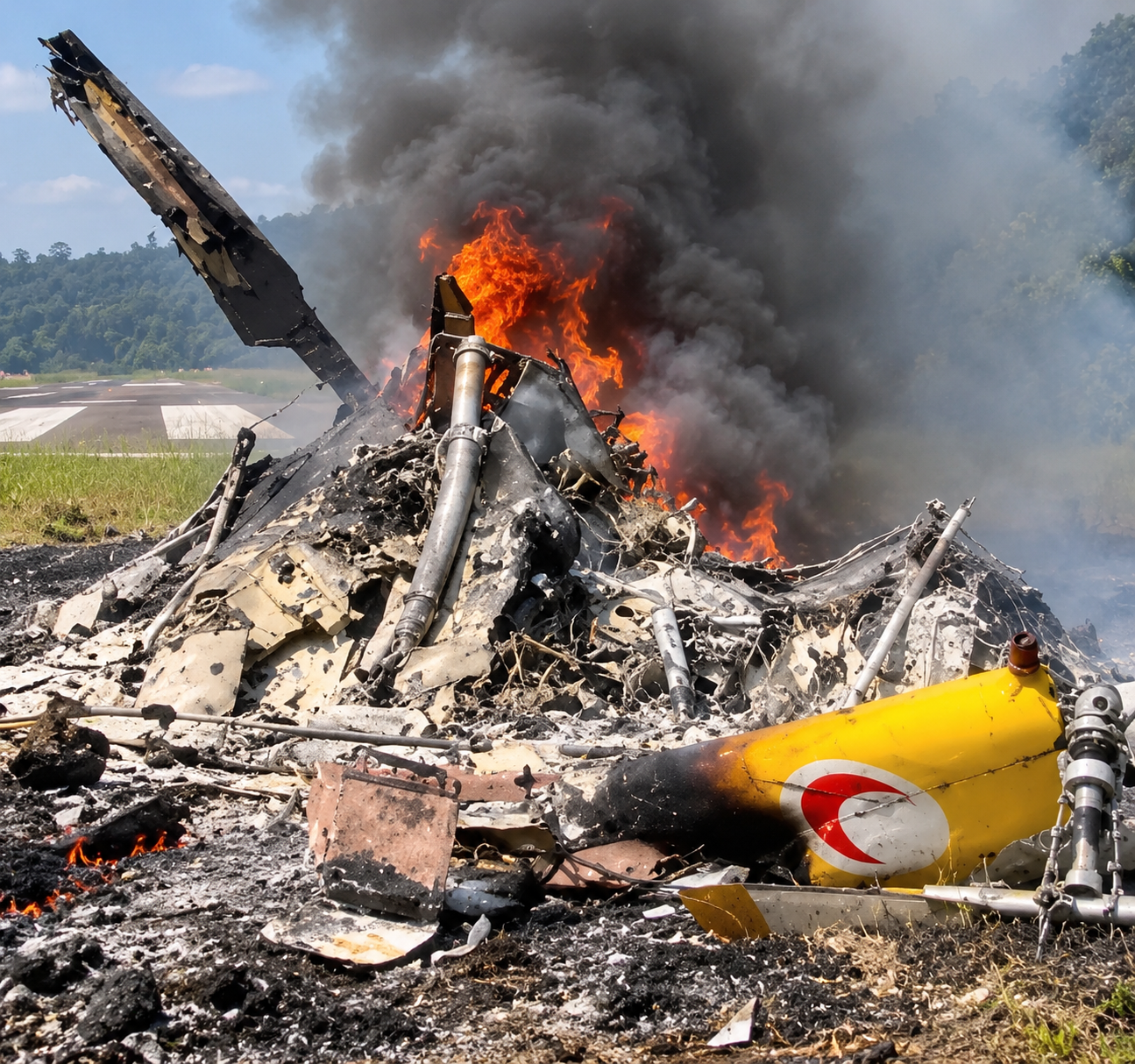
A mission carrying healthcare professionals into the remote interior of Sarawak ended in tragedy on Tuesday when a Flying Doctor Service helicopter crashed near Long Lellang STOLport, killing all five people on board.
The BO-105 helicopter, registered 9M-LLF, was operating an official Flying Doctor Service mission when it crashed at approximately 3.40pm on September 8. Those on board comprised the pilot and four Ministry of Health personnel, a medical officer, an assistant medical officer and two nurses. Authorities subsequently confirmed that all five had died.
The accident has struck at the heart of a service that has, for decades, connected some of Sarawak’s most isolated communities with essential healthcare.
For the people serving on board, this was not simply another helicopter flight. It was part of a healthcare mission into areas where geography can make access by conventional ground transportation difficult and time-consuming.
Sarawak’s Flying Doctor Service has operated since 1973, bringing healthcare professionals and medical services to communities across the state’s vast interior. According to information previously released by the Ministry of Health, the service covers dozens of remote localities, particularly across areas including Kapit, Miri and Limbang.
In these communities, aviation serves a purpose extending far beyond transportation. Helicopters provide the ability to move healthcare personnel and medical resources across terrain where distance, forests, rivers and limited road connectivity can otherwise become barriers to medical access.
The helicopter involved in Tuesday’s accident had departed Miri as part of a Flying Doctor Service operation covering Ba Lai, Long Siut and Long Lellang.
The Civil Aviation Authority of Malaysia said it was notified of the accident by the Flight Information Service at 3.58pm. The crash occurred near Long Lellang STOLport, in a remote part of Sarawak’s interior. Search-and-rescue efforts were subsequently mounted, although environmental conditions, including haze, affected some aspects of the response.
The tragedy inevitably raises questions about what happened during the final moments of the flight. Those questions, however, must be answered by investigators rather than speculation.
No official cause of the accident has been established.
The Air Accident Investigation Bureau under Malaysia’s Ministry of Transport will investigate the crash in accordance with the country’s civil aviation investigation framework.
That investigation will be essential in determining the sequence of events and examining any technical, operational, environmental or human factors relevant to the accident.
Until that work is completed, conclusions about the aircraft, pilot, weather or any other potential factor would be premature.
For Malaysia’s aeromedical community, the accident also carries a deeper significance.
Aeromedical operations exist at the intersection of two highly demanding environments: aviation and medicine. The aircraft must be operated safely while medical personnel, equipment and mission requirements are integrated into an aviation operation that may involve remote destinations and limited infrastructure.
Sarawak provides perhaps one of Malaysia’s clearest examples of why that capability matters.
The state’s geography means that healthcare cannot always depend entirely on roads and conventional ambulances. Aviation can provide the bridge between healthcare professionals and communities separated by considerable distances and difficult terrain.
That makes the Flying Doctor Service more than an aviation operation. It forms part of the healthcare access system serving rural communities.
Behind that system are people.
Pilots accept responsibility for operating aircraft into challenging environments. Doctors, nurses and medical assistants leave conventional clinical surroundings to deliver healthcare where it is needed. Engineers, operations personnel, dispatchers and other aviation professionals work behind the scenes to make those missions possible.
The five people aboard 9M-LLF were part of that system.
They went to work on September 8 with a mission centred on reaching communities that depend on aviation-supported healthcare.
They never returned.
There will be an appropriate time to study the accident in detail. When investigators publish their findings, Malaysia’s aviation and aeromedical communities will need to examine those findings carefully and apply any lessons that can strengthen future operations.
For now, however, the significance of the tragedy should not be lost beneath speculation over its cause.
A pilot and four healthcare professionals lost their lives while carrying out a Flying Doctor Service mission in the Sarawak interior.
Their deaths are a reminder that behind every aeromedical flight are professionals willing to take aviation and healthcare beyond the walls of airports and hospitals to reach people who need them.
For their families and colleagues, the loss is immeasurable.
For Malaysia’s aeromedical community, it is a deeply painful day.
And for the remote communities served by the Flying Doctor Service, the tragedy is a reminder of the people behind an aviation lifeline that has connected healthcare with rural Sarawak for more than half a century.
My Aviation extends its deepest condolences to the families, colleagues and communities affected by the loss of those aboard 9M-LLF.
My Aviation | Aviation Desk – Aeromedical |