

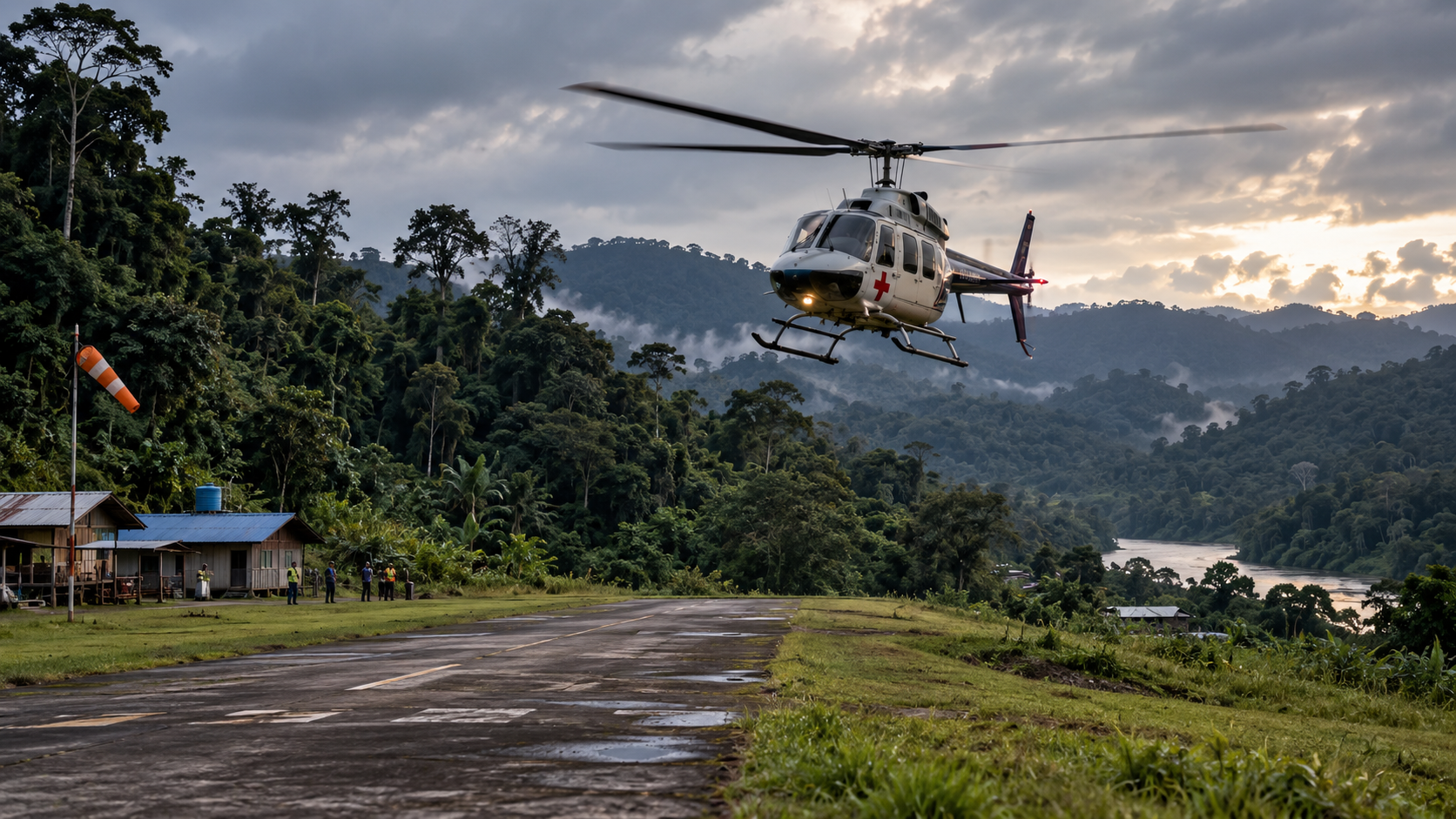
SPECIAL REPORT | AEROMEDICAL AVIATION
The fatal crash of a Flying Doctor Service helicopter near Long Lellang STOLport in Sarawak on September 8 has brought profound grief to Malaysia’s aviation and healthcare communities. It should also prompt a careful, evidence-based examination of the safety environment surrounding one of the country’s most important forms of public-service aviation.
The BO-105 helicopter, registration 9M-LLF, was operating a Flying Doctor Service mission when it crashed near Long Lellang STOLport on Tuesday afternoon. The helicopter had departed from Miri and was carrying five people , the pilot and four Ministry of Health personnel comprising a medical officer, an assistant medical officer and two nurses. All five were subsequently confirmed dead.
The Civil Aviation Authority of Malaysia said it received notification of the accident from the Flight Information Service at 3.58pm. The Air Accident Investigation Bureau under the Ministry of Transport will investigate the accident in accordance with Malaysia’s Civil Aviation Regulations 2016.
At this stage, the cause of the accident has not been established.
That distinction is fundamental. There is presently no factual basis for concluding that negligence, maintenance failure, pilot actions or organisational shortcomings caused the Long Lellang accident. Those conclusions must come from evidence gathered during the official investigation.
But aviation safety also requires the industry to examine its history.
The Long Lellang tragedy is not the first publicly documented occurrence involving a Layang Layang-operated helicopter conducting a Flying Doctor Service mission.
On October 26, 2022, Airbus AS355 9M-SSW lost control in flight and crashed into jungle terrain in Cameron Highlands, Pahang. Malaysia’s official AAIB accident records classify the occurrence as accident A 08/22 and record no fatalities.
The official final report contains a safety bulletin issued by Layang Layang Aerospace immediately following the accident. It identified risk management and weather vigilance as important considerations and listed follow-up areas including recurrent unusual-attitude recovery training, situational awareness, weather avoidance and proficiency in standard and non-normal procedures.
Those measures are important because they demonstrate that safety actions were initiated following the accident.
They do not, however, establish any connection between the Cameron Highlands accident in 2022 and what happened at Long Lellang almost four years later. Each aviation accident must be investigated on its own evidence.
Another Flying Doctor Service occurrence followed in September 2024.
A Bell 206B JetRanger belonging to Layang Layang Aerospace was conducting a routine Flying Doctor Service flight in Sabah on September 25 when it made an emergency landing near Kampung Buayan, Penampang.
The helicopter was carrying its pilot and four Ministry of Health personnel. All five were reported safe.
According to contemporary reporting, the pilot detected a warning indication in the aircraft system and made an emergency landing. The aircraft was subsequently attended by technical personnel.
That occurrence should not automatically be interpreted as evidence of unsafe operations.
In fact, based on the information available, the pilot recognised an abnormal indication, responded to it and successfully brought the aircraft down without injury to those aboard.
Publicly available records therefore identify three occurrences involving Layang Layang-operated helicopters conducting Flying Doctor Service missions between 2022 and 2026: the 2022 Cameron Highlands accident, the 2024 Sabah emergency landing and the 2026 fatal Long Lellang accident.
That history deserves examination.
But it is equally important to state clearly that three occurrences do not, by themselves, prove systemic failure or negligence by the operator.
What they do provide is a legitimate reason for Malaysia’s aviation and aeromedical communities to examine the wider safety environment surrounding these highly specialised operations.
Flying Doctor Service operations sit at a demanding intersection between aviation and healthcare.
Aircraft may operate into remote areas where terrain, changing weather, communications and limited infrastructure can present challenges very different from conventional airline operations.
The people travelling aboard these aircraft are also not simply passengers. They are doctors, nurses, medical assistants and other healthcare professionals being transported to communities where aviation can provide one of the few practical means of delivering essential healthcare.
Sarawak demonstrates why this capability matters.
The Flying Doctor Service was introduced in the state in 1973. According to the Ministry of Health, 97 remote localities across Kapit, Miri and Limbang require the service, with many located far from adequate road networks. The FDS delivers medicines and vaccines and supports medical evacuation for critically ill patients.
The importance of that mission makes aviation safety oversight even more significant.
Malaysia should eventually examine how risks are assessed before Flying Doctor missions into remote areas, how changing weather is incorporated into operational decision-making, what recurrent training standards apply to pilots regularly conducting such missions and how aircraft reliability and maintenance trends are monitored.
Aircraft suitability, utilisation, crew experience, operational decision-making and the effectiveness of safety-management systems are equally legitimate areas for examination.
Previous occurrences should also form part of that conversation.
When an aviation organisation experiences an accident or significant operational event, the objective should not simply be to close the investigation and move forward. The aviation safety system must ensure that lessons identified from previous occurrences remain embedded within training, procedures, maintenance practices and operational culture.
That does not mean assuming an earlier accident caused a later one.
It means asking whether the aviation system continuously learns from what has happened before.
Regulatory approval is fundamental, but public-service aviation safety can also be considered through factors such as crew training, aircraft suitability, maintenance reliability, the maturity of an operator’s safety-management system and its response to previous safety occurrences.
None of this means that Layang Layang Aerospace failed those standards, nor does the existence of previous occurrences establish that any organisational, maintenance or operational factor contributed to the Long Lellang accident.
Only evidence can establish that.
Malaysia’s AAIB is the independent entity responsible for investigating civil aviation accidents and incidents. Its functions include collecting and analysing evidence, determining underlying factors and issuing investigation reports and safety recommendations intended to prevent future occurrences.
The investigation into 9M-LLF must therefore be allowed to proceed independently and without premature conclusions.
What happened during the final moments of the Long Lellang flight remains to be established. The eventual evidence may identify technical, operational, environmental or human factors, a combination of circumstances, or factors entirely different from what outside observers currently imagine.
The aviation community should wait for those findings.
But waiting for an investigation does not mean avoiding a wider conversation about safety.
Aviation has become safer precisely because accidents and incidents are examined rather than forgotten. Investigations identify lessons. Procedures evolve. Training changes. Engineering improves. Future crews benefit from knowledge gained through previous occurrences.
Five people went to work on September 8 as part of a mission bringing healthcare to remote communities in Sarawak.
Tragically, they did not return.
The tragedy should first and foremost be remembered for those who lost their lives, their families and colleagues, and the communities they were serving.
In time, however, respecting those involved must also mean understanding exactly what happened and determining whether there are lessons that could make future Flying Doctor missions safer.
The question should therefore not be:
Who should we blame?
The more important question is:
What can Malaysian aeromedical aviation learn?
My Aviation | Special Report – Aeromedical Aviation | 9 September 2026
*Editorial Note: This article examines publicly documented Flying Doctor Service aviation occurrences for the purpose of aviation-safety discussion. It does not attribute responsibility for the Long Lellang accident to Layang Layang Aerospace, its crew or any other party. The cause of the accident has not been established, and conclusions regarding causation or responsibility should await the official investigation.*