
Malaysia’s preliminary investigation into the fatal Flying Doctor Service helicopter crash in Sarawak has identified evidence of smoke and apparent flames before impact, alongside shortcomings in emergency response arrangements at a remote airstrip.
The accident occurred on 8 September 2026 near Long Lellang STOLport in Ulu Baram, claiming the lives of a pilot and four Ministry of Health personnel.
The Air Accident Investigation Bureau (AAIB), under the Ministry of Transport, released its preliminary report on 16 October. The cause and contributing factors remain under investigation.
Smoke and Flames Captured Before the Crash
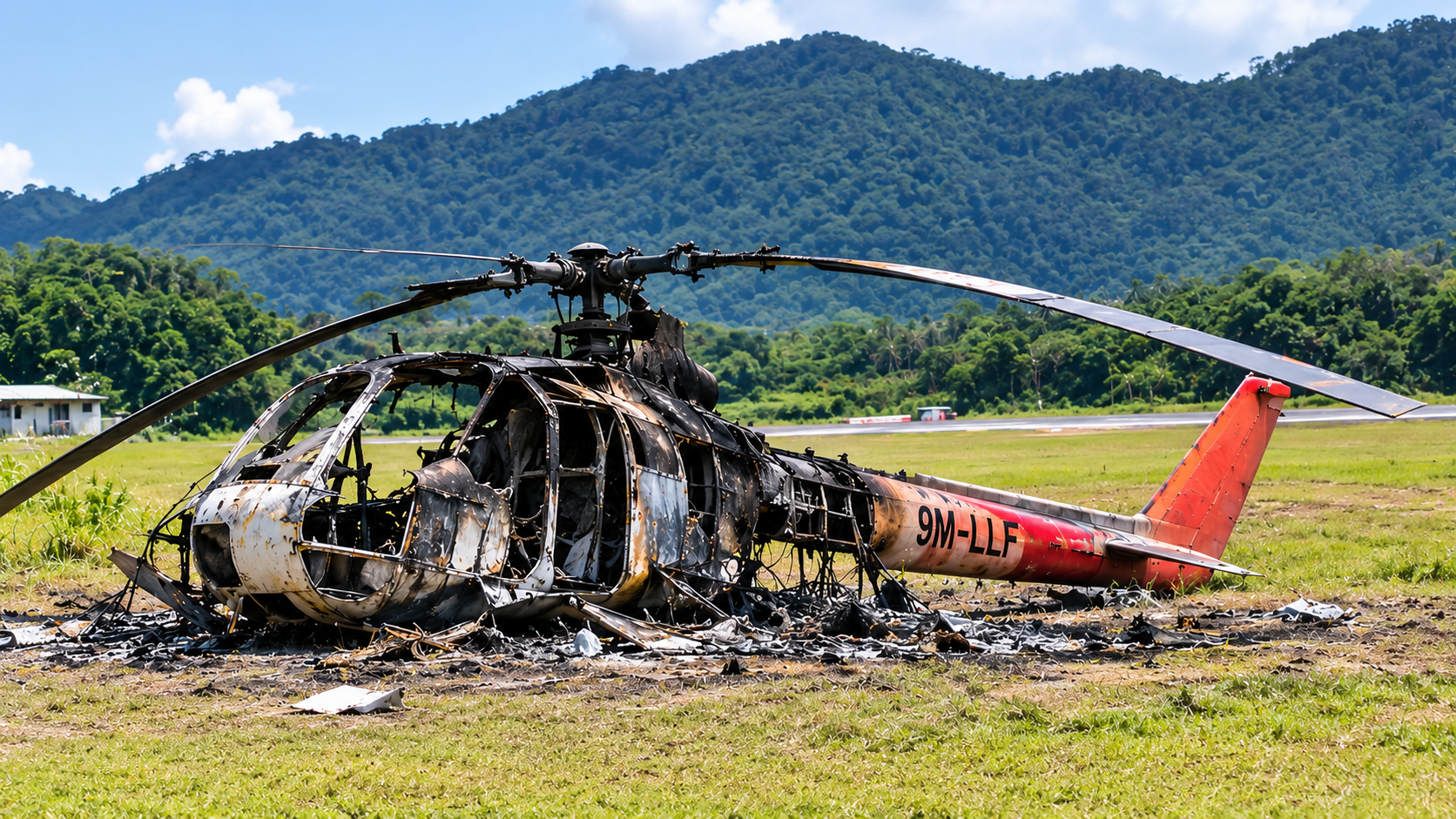
The Messerschmitt-Bölkow-Blohm BO105 S helicopter, registered 9M-LLF and operated by Layang-Layang Aerospace Sdn Bhd, was conducting a scheduled Flying Doctor Service mission under the callsign MEDIC3.
The helicopter had departed Selungo for Long Lellang when the accident occurred.
According to the preliminary report, a 37-second ground video captured a visible smoke trail and apparent flames in the area behind the helicopter’s main gearbox as it approached Runway 04.
The aircraft subsequently crashed approximately 25 metres from the runway threshold and was destroyed by fire.
Investigators have not established the origin or significance of the smoke and flames.
Aircraft and Weather Conditions
The preliminary investigation established that the pilot held the required licence, qualifications and medical certification.
The helicopter possessed valid registration and airworthiness certificates and was considered airworthy at the time of dispatch.
Weather conditions near Long Lellang were generally favourable, with horizontal visibility exceeding 10 kilometres.
Investigators also reported that no emergency or distress transmission was recorded during the final flight sector.
These findings provide an initial account of the circumstances surrounding the accident but do not establish its cause.
Emergency Response at Long Lellang
The investigation identified shortcomings in rescue and firefighting preparedness at the remote STOLport.
Personnel from the Malaysia Volunteers Corps Department (RELA), together with local responders, attempted to control the fire using 12 dry-powder extinguishers available at the facility.
Despite their efforts, the fire continued for several hours.
The AAIB reported that some auxiliary responders lacked appropriate firefighting personal protective equipment. Certain equipment also showed signs of deterioration and damage.
Post-mortem examinations determined that all five occupants died from severe burn injuries.
The AAIB recommended that Malaysia Airports Sdn Bhd review rescue and firefighting arrangements across its STOLports, including personnel training, equipment readiness and protective equipment maintenance.
The preliminary findings do not establish whether different emergency response arrangements would have changed the outcome.
Safety Oversight and Operational Measures
Following the accident, Layang-Layang Aerospace temporarily suspended operations involving aircraft fitted with the same engine type pending airworthiness verification.
The Civil Aviation Authority of Malaysia (CAAM) subsequently cleared the affected aircraft to resume operations on 13 September after the necessary technical reviews.
Separately, Transport Minister Anthony Loke disclosed that a CAAM surveillance audit conducted shortly before the accident had identified administrative and organisational findings involving the operator’s maintenance organisation.
The minister stated that the outstanding finding concerned workforce planning and had no direct bearing on the helicopter’s technical condition. Whether any broader circumstances contributed to the accident remains a matter for investigation.
Implications for Aeromedical Aviation
Flying Doctor Services play an important role in providing healthcare access to communities in remote parts of Malaysia.
The Long Lellang accident highlights the importance of examining aviation safety beyond the aircraft and its crew.
For medical aviation operations serving isolated communities, emergency communications, rescue coordination, firefighting equipment and trained response personnel are essential considerations.
The AAIB’s recommendations provide an opportunity to review how these arrangements are maintained at remote aviation facilities.
Investigation Continues
The AAIB is continuing its examination of the wreckage, operational records, maintenance history and circumstances surrounding the flight.
Further technical analysis is expected to help investigators establish the sequence of events, including the development of the fire.
The final investigation report is required within one year of the accident.
Until the investigation is completed, the preliminary findings should not be interpreted as determining the cause of the crash or assigning responsibility.
For Malaysia’s aeromedical aviation sector, the investigation underscores the importance of maintaining safety standards across both flight operations and the facilities supporting essential medical services.