
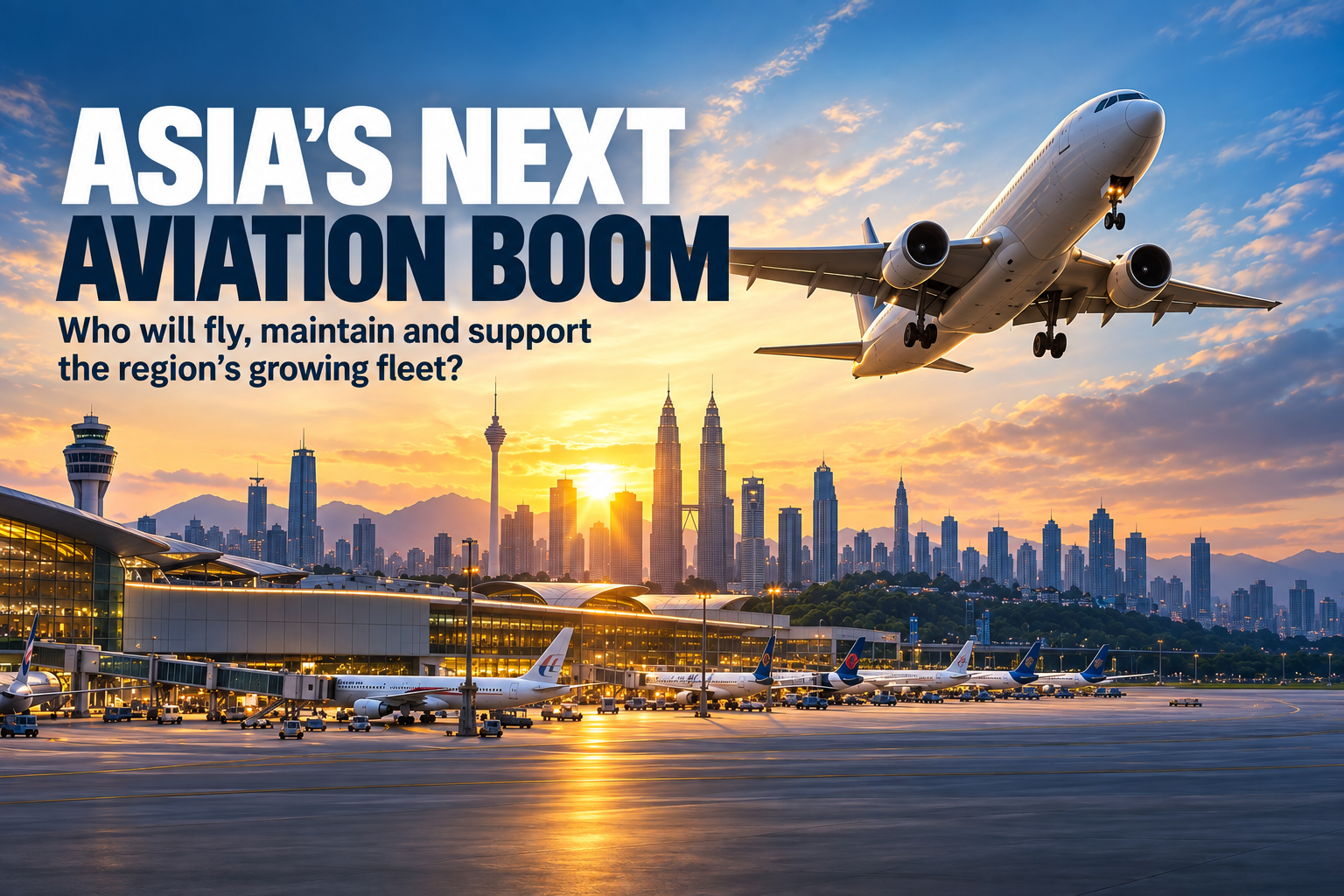
Asia-Pacific is entering another major period of aviation expansion. Behind the aircraft orders lies an equally significant requirement for people, maintenance, training, technology and infrastructure.
MY AVIATION | INDUSTRY ANALYSIS
Asia-Pacific aviation is preparing for growth on a scale that could reshape the global industry.
Airbus forecasts that the region, including China and India, will require 19,560 new passenger aircraft over the 20 years to 2044, representing approximately 46 per cent of global demand over that forecast period. Passenger traffic across the region is projected to increase by an average 4.4 per cent annually, compared with a global average of 3.6 per cent in the same Airbus services outlook.
The numbers are substantial. But aircraft themselves tell only part of the story.
Every additional aircraft requires pilots to fly it, engineers and technicians to maintain it, cabin crew to operate it, airports to accommodate it and an increasingly sophisticated network of training, maintenance, ground operations, digital systems and professional services behind it.
The defining question for Asia’s next phase of aviation growth may therefore not simply be how many aircraft will arrive.
It is how the aviation ecosystem surrounding those aircraft will develop alongside them.
Growth Beyond the Aircraft
The latest Airbus outlook points towards a broader transformation of aviation across Asia-Pacific.
Rising passenger demand, expanding economies and changing demographics are expected to continue influencing where and how people travel. Airbus’s separate 2026 Global Market Forecast identifies developing economies including India, Vietnam, Indonesia and Malaysia among those contributing to evolving traffic patterns across the region.
At the same time, urbanisation is increasingly extending beyond the largest metropolitan areas.
This has implications for airline networks.
For decades, much of Asian aviation growth has centred around major hubs. New generations of efficient aircraft are increasingly capable of serving lower density and longer routes directly, potentially allowing airlines to connect smaller and medium sized cities without always relying on traditional hub connections.
Airbus describes this broader development as a decentralisation of aviation networks, supported by aircraft efficiency, greater range and changing passenger demand.
If that trend continues, the aviation map of Asia in the 2040s could look considerably different from today’s.
More Than One Million Aviation Professionals
Fleet growth creates another requirement that receives considerably less public attention.
People.
Airbus estimates that Asia-Pacific will require more than 1.06 million new aviation professionals by 2044. Its current regional services forecast breaks that requirement down into approximately 282,000 pilots, 302,000 technicians and 473,000 cabin crew.
Those figures illustrate the scale of the human capital requirement accompanying aviation expansion.
Aircraft can be ordered years before delivery. Developing an experienced captain, licensed aircraft engineer, instructor or specialised technical professional requires training, experience and time.
Training capacity therefore becomes part of aviation infrastructure.
Flight schools, airline academies, universities, technical institutions and maintenance training organisations will increasingly sit alongside airports, aircraft manufacturers and MRO providers as important components of the region’s aviation ecosystem.
The opportunity is not simply about producing greater numbers of personnel.
Aviation depends upon competent professionals operating within rigorous regulatory and technical standards. As aircraft and supporting systems become increasingly sophisticated, professional development will need to evolve with them.
The Business Behind Keeping Aircraft Flying
Some of the largest opportunities may develop away from the passenger terminal.
Airbus forecasts that the Asia-Pacific aviation services market could reach approximately US$138.7 billion by 2044, growing at a compound annual rate of 5.2 per cent.
Maintenance forms a major part of that picture.
The manufacturer says investment is already flowing into new base maintenance infrastructure in markets including India, Indonesia, Malaysia and the Philippines.
But tomorrow’s aviation services industry will extend considerably beyond conventional maintenance.
Aircraft are becoming increasingly connected. Airlines and MRO organisations are adopting artificial intelligence and data analytics to support predictive maintenance, operational efficiency and automation. Airbus forecasts the region’s digital and connectivity services market to grow from approximately US$2.9 billion in 2025 to US$11.2 billion by 2044.
This changes the skills required behind the aircraft.
Mechanical and engineering expertise will remain fundamental, but increasingly it will operate alongside aircraft health monitoring, software, diagnostics, data analysis and digitally connected maintenance systems.
The hangar of the future will remain an engineering environment.
It will also increasingly become a data environment.
Malaysia’s Place in the Regional Opportunity
For Malaysia, Asia’s aviation expansion presents an opportunity extending well beyond airline operations.
The country already has an established aviation and aerospace ecosystem encompassing airline operations, airports, engineering, maintenance, manufacturing and professional training.
Airbus describes Malaysia as its third largest market in Asia-Pacific after China and India, while also identifying the country as its largest supplier base in Southeast Asia. Malaysian aerospace companies manufacture aerostructures and components used across Airbus programmes.
Malaysia also has established maintenance capability. Airbus subsidiary Sepang Aircraft Engineering operates two hangars with approximately 50,000 square metres of combined floor space and capacity for up to eight aircraft undergoing major maintenance checks at one time. Airbus has separately identified Malaysia among regional markets where additional base maintenance infrastructure is being developed.
These capabilities provide a foundation from which Malaysia can participate in wider regional aviation growth.
The opportunity includes engineering, maintenance, training, aerospace manufacturing, airport services, digital aviation and specialised professional services.
An aircraft operated elsewhere in Asia can still create economic activity in Malaysia if components are manufactured here, maintenance is performed here, professionals are trained here or specialist aviation services are provided from here.
That is what makes the regional forecast relevant beyond aircraft orders.
A Changing Aviation Map
The development of more efficient aircraft could also change the geography of air travel.
Airbus expects urbanisation to increasingly favour smaller cities, while new generation aircraft make additional city pairs economically viable. Longer range single aisle aircraft and increasingly efficient widebody platforms allow airlines to consider direct connections that would previously have required passengers to transit through major hubs.
For passengers, this could mean greater choice and more direct travel.
For airlines, it creates potential new markets.
For secondary airports and regional cities, greater connectivity can create opportunities extending beyond aviation itself.
And for the aviation services industry, a more geographically distributed fleet means technical and operational support will also need to develop across a wider network.
The Opportunity Behind the Forecast
Aircraft orders naturally attract attention. They involve recognisable airlines, enormous investments and machines that will remain in service for decades.
Yet the deeper aviation opportunity may develop behind those orders.
It will emerge inside maintenance hangars, engineering centres, training academies, airports, manufacturing facilities and operations centres throughout the region.
It will depend upon pilots, engineers, technicians, instructors, cabin crew, ground personnel and thousands of other aviation professionals whose work rarely appears in an aircraft delivery photograph.
Airbus’s forecast of 19,560 new passenger aircraft for Asia-Pacific therefore represents considerably more than future fleet growth.
It represents demand for an entire ecosystem capable of supporting those aircraft safely and efficiently throughout their operational lives.
For Malaysia and the wider region, the opportunity is not simply to watch Asia’s aviation industry expand.
It is to participate in building the infrastructure, capability and expertise that will support that expansion.
The next chapter of Asian aviation may be measured in aircraft, but it will ultimately be built by people.
My Aviation | Industry Analysis | 20 September 2026