

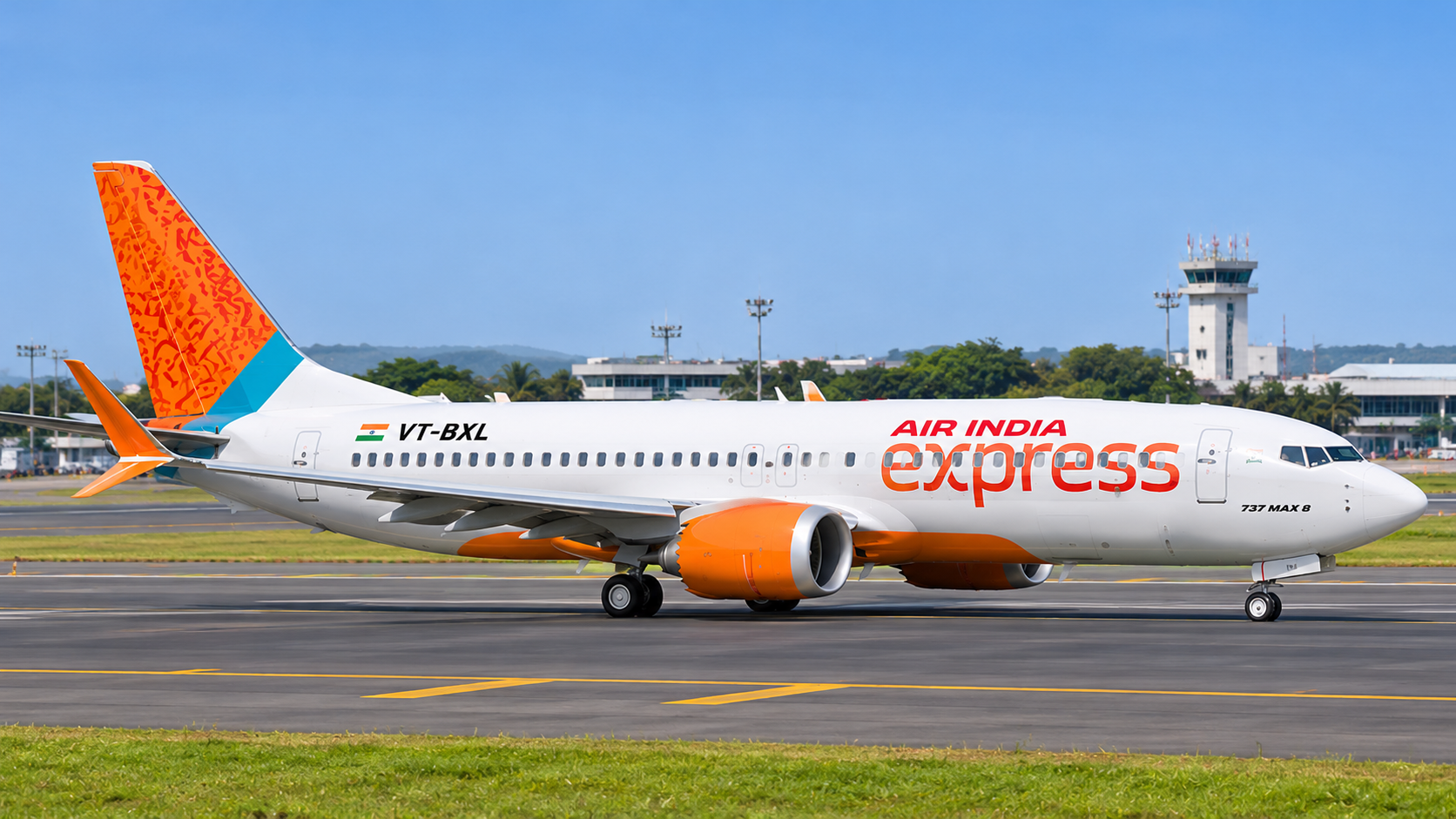
India’s Aircraft Accident Investigation Bureau (AAIB) has identified the misinterpretation of air traffic control instructions and failure to comply with taxi procedures as the probable causes of a serious runway incursion involving an Air India Express passenger aircraft and an Indian Navy fighter jet at Goa’s Dabolim Airport.
The incident occurred on 3 April 2026, with the investigation findings reported on 31 October.
The Air India Express Boeing 737, registered VT-BXL, was preparing to operate flight AXB1109 to Delhi with 165 passengers and six crew members on board. No injuries or aircraft damage were reported.
How the Incident Unfolded
The aircraft initially received departure instructions for Runway 26 before being informed that Runway 08 was in use.
The surface movement controller instructed the crew to taxi via Taxiway N2 and hold at the runway holding point before contacting Navy air traffic control.
However, the crew misunderstood an instruction to expect a runway backtrack as permission to enter the active runway.
After briefly stopping at the holding point, the aircraft proceeded onto Runway 08 without explicit clearance or establishing the required radio communication with Navy air traffic control.
Meanwhile, an Indian Navy fighter aircraft was accelerating for take-off on the same runway.
The Navy tower controller detected the unauthorised entry and warned the fighter pilot, who continued the departure and became airborne.
The aircraft did not collide, and the Air India Express flight subsequently departed safely for Delhi.
Investigation Findings
The AAIB identified two probable causes: the captain’s misinterpretation of the anticipated backtrack instruction as runway-entry clearance and the crew’s failure to comply with the requirement to hold and establish communication with Navy air traffic control.
Investigators also identified contributing factors involving cockpit monitoring and air traffic control communication.
The trainee first officer became occupied with verifying take-off performance calculations following the runway change, reducing his ability to monitor radio communications effectively.
The surface movement controller also failed to ensure that the crew correctly acknowledged the holding instruction.
These failures contributed to the aircraft entering an active runway without the necessary clearance.
Safety Recommendations
The AAIB recommended additional training and counselling for the flight crew, alongside wider communication of the investigation’s safety lessons within Air India Express.
The Airports Authority of India was advised to reinforce standard radio phraseology, correct inaccurate readbacks and review instructions that could be misunderstood.
Investigators also recommended considering Taxiway N2 a runway-incursion hotspot because of its proximity to the civilian apron.
Further recommendations addressed coordination between civilian and military air traffic services, including clearer frequency-change procedures and improved arrangements for sharing investigation evidence.
Following the incident, airport and Navy authorities revised certain coordination and shift handover procedures.
Lessons for Joint-Use Airports
Dabolim Airport operates as a civilian enclave within the Indian Navy’s INS Hansa airbase.
The Airports Authority of India provides surface movement control, while Navy personnel manage tower and approach services.
The arrangement requires effective coordination, particularly during runway changes and departures involving both civilian and military aircraft.
Although no injuries occurred, the investigation illustrates how misunderstood instructions, incomplete readbacks and ineffective cockpit monitoring can create serious runway safety risks.
The findings reinforce the importance of explicit runway-entry clearance, disciplined radio communication and coordinated procedures at joint-use airports.