
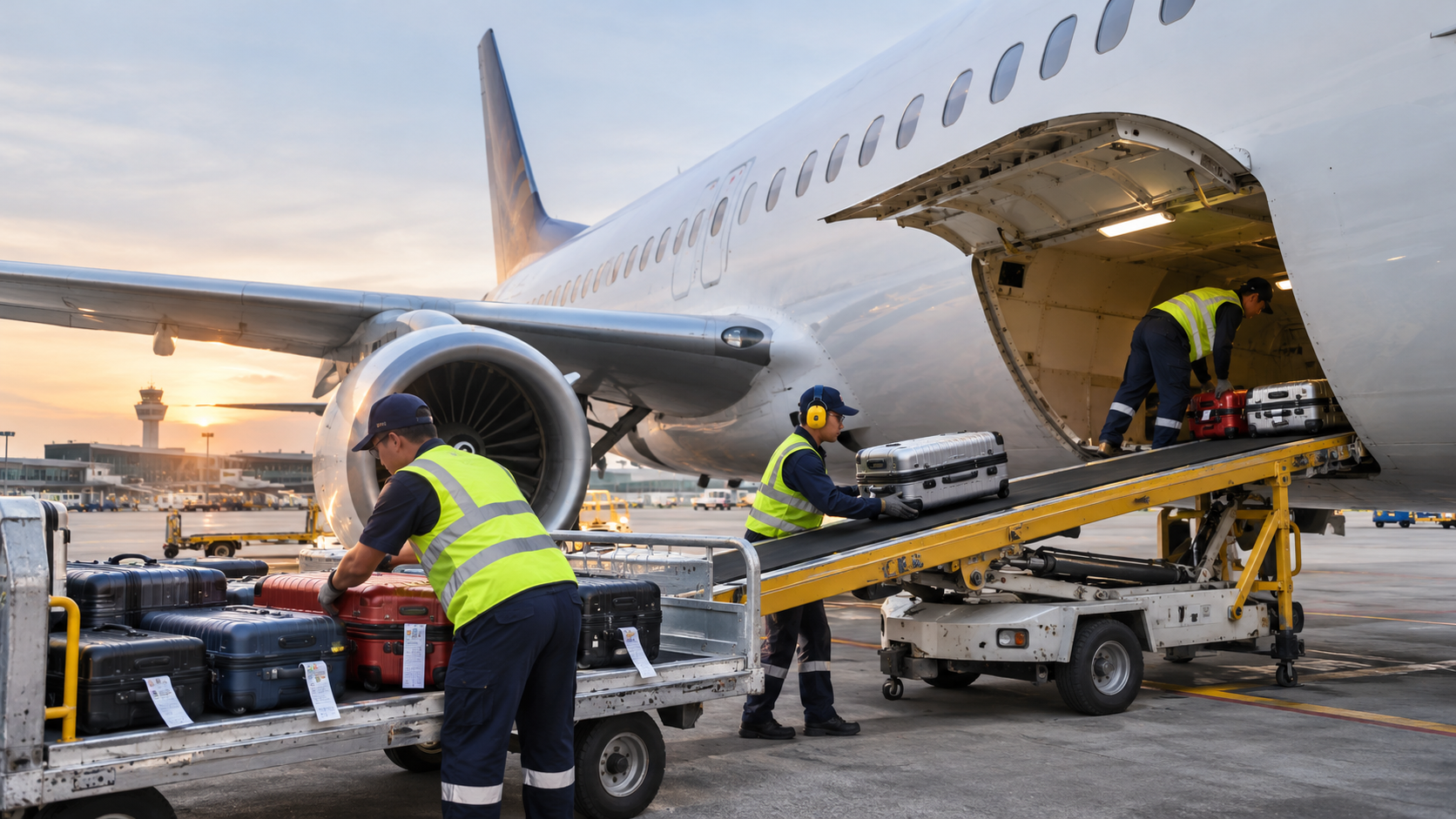
For most passengers, the journey of a checked bag ends at the airport counter or automated bag drop. The suitcase disappears onto a conveyor belt while its owner continues through security towards the departure gate.
Behind the scenes, however, that bag becomes part of a coordinated process involving identification, screening, sorting, aircraft loading and flight documentation.
Before departure, ground handling teams must ensure that baggage and other loads are processed according to the airline’s procedures and applicable safety requirements.
From Check-In to the Aircraft
Once accepted, checked baggage receives an identification tag linking it to the passenger’s journey.
Depending on the airport, bags pass through security screening, automated sorting systems and designated handling areas before reaching the aircraft.
Ground handlers prepare baggage for loading according to the aircraft type and the airline’s instructions.
The process involves more than placing suitcases into available compartments.
Bags may require separation according to destination, connecting flights or special handling requirements. Where aircraft also carry cargo and mail, loading arrangements must accommodate these additional items.
Why Weight and Balance Matter
Every aircraft has operating limitations governing its weight and centre of gravity.
Before departure, the operator must establish that the aircraft is loaded within the applicable limits.
Passenger numbers, baggage, cargo, fuel and other relevant weights form part of this assessment.
Load distribution matters because the position of baggage and cargo affects aircraft balance.
Ground handling and load control personnel must therefore coordinate to ensure that loading instructions are followed and changes are accurately recorded.
A late baggage addition or removal may require an update to the aircraft’s load information.
The Importance of Accurate Information
At its Ground Handling Conference in May 2026, the International Air Transport Association (IATA) highlighted aircraft loading errors as an operational concern.
According to IATA, contributing members reported 37,953 aircraft loading errors in 2025.
These reports concerned aircraft loading operations more broadly and should not be interpreted as baggage-only errors or a worldwide total.
IATA also reported that airlines adopting digital load-control and reconciliation systems had achieved reductions in loading errors exceeding 90%.
The findings demonstrate how reliable information exchange and digital processes can improve loading accuracy.
When a Bag Does Not Make the Flight
Not every checked bag reaches its intended aircraft.
Late connections, sorting problems, handling disruptions and operational restrictions can prevent baggage from being loaded as planned.
When this happens, airline personnel must follow the applicable baggage reconciliation and security procedures.
Depending on the circumstances, a missing or unaccounted for bag may require additional checks before departure.
These procedures help ensure that the aircraft’s actual load is properly accounted for.
The Final Coordination
As departure approaches, ground handlers complete loading tasks and communicate the necessary information to operational personnel.
The final sequence may include closing cargo compartments, removing ground equipment, confirming load documentation and completing departure checks.
Specific procedures vary according to aircraft type, operator and airport.
The aircraft can proceed towards departure only after the applicable operational requirements have been satisfied.
The Work Passengers Rarely See
A passenger may notice a delay at the gate without realising that ground teams are resolving a baggage discrepancy or updating loading information.
These activities are essential to normal airline operations.
Baggage handlers, load controllers and ground operations personnel rarely attract public attention when everything proceeds smoothly.
Yet their work helps ensure that aircraft depart with their loads correctly accounted for.
The next time a suitcase disappears behind the check-in counter, its journey will involve far more than a conveyor belt. It becomes part of an operational system in which accuracy matters as much as speed.