
LEADER FLAGSHIP | AEROMEDICAL LEADERSHIP
Malaysia has spent years strengthening its position in aviation and healthcare.
It has internationally connected airports, established airlines, a growing aerospace ecosystem, internationally recognised private hospitals and an increasingly important healthcare-travel industry.
But between aviation and healthcare sits another specialised capability that remains comparatively underdeveloped as an integrated national ecosystem:
Aeromedical transport.
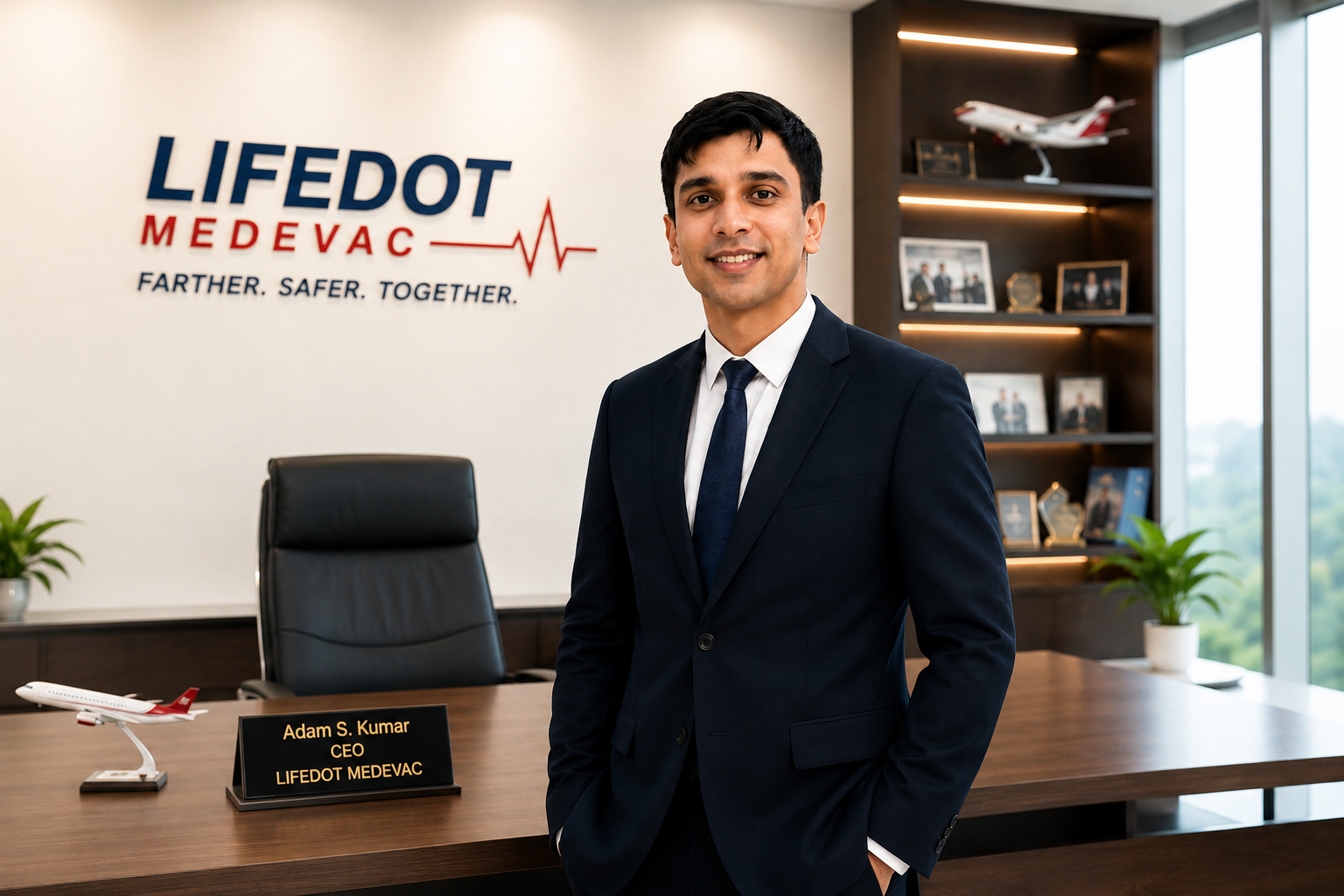
For Adam S. Kumar, CEO of Lifedot Medevac, this represents both a gap and an opportunity.
His ambition is not simply to operate medical flights. It is considerably broader: to contribute towards developing Malaysia into a credible aeromedical hub for Asia, connecting aviation, critical-care transport, hospitals, specialist training and cross-border patient movement within one coordinated ecosystem.
It is an ambitious proposition.
But Malaysia may be entering the right period to explore it.
From Medical Tourism to Medical Mobility
Malaysia’s healthcare travel sector has already achieved significant scale.
The Malaysia Healthcare Travel Council reports that the country generated RM3.35 billion in healthcare-traveller revenue in 2025, with approximately 1.8 million healthcare travellers annually.
Malaysia Year of Medical Tourism 2026 is pushing that ambition further, while Tourism Malaysia and MHTC are expanding collaboration and international outreach across ASEAN, South Asia, East Asia, the Middle East, Africa and Central Asia.
The opportunity identified by Kumar sits alongside this growth.
International patients must first reach Malaysia.
Most will travel conventionally.
Some cannot.
Critically ill patients, ICU patients, patients requiring continuous monitoring and individuals needing urgent specialist treatment may require a completely different transportation pathway.
That is where healthcare travel becomes medical mobility.
And where aviation becomes part of the healthcare continuum.
The Aircraft Is Only One Part of the Mission
The public perception of an air ambulance often begins and ends with an aircraft.
Kumar’s approach challenges that assumption.
An aeromedical mission can involve considerably more than flying a patient between two airports.
It can begin at a hospital bedside.
The patient may require a ground ambulance, clinical stabilisation, specialist medical equipment, medical escorts, airport coordination, flight operations, receiving-hospital acceptance and another medically supported transfer after landing.
Lifedot itself describes cross-border medevac as a structured clinical and operational process requiring medical oversight, particularly for patients requiring continuous monitoring, advanced life support or urgent access to specialised treatment.
The objective, therefore, is not simply transportation.
It is continuity of care during transportation.
That distinction is central to Kumar’s vision.
Building an Ecosystem, Not Simply a Company
Malaysia becoming an Asian aeromedical hub cannot be achieved by one operator.
Kumar’s larger proposition depends upon an ecosystem.
Hospitals.
Air operators.
Ground ambulance providers.
Doctors.
Flight nurses.
Paramedics.
Airports.
Insurers and assistance companies.
Training institutions.
Regulators.
And international medical partners.
Each organisation controls a different part of the patient journey.
The opportunity is to connect those capabilities more effectively.
Malaysia is already seeing aviation and healthcare become more closely linked commercially. In July 2026, Batik Air, Institut Jantung Negara and Tourism Malaysia announced a collaboration intended to improve access to specialised cardiac services while strengthening Malaysia’s medical-tourism ecosystem.
That collaboration is not an aeromedical programme, but it illustrates a larger principle:
Healthcare connectivity increasingly extends beyond the hospital.
Why Malaysia?
Geography gives Malaysia an interesting strategic position.
It sits within one of the world’s most dynamic aviation regions and is connected to major population centres across Southeast Asia.
Malaysia also possesses another critical component: healthcare capability.
MIDA describes the country as strategically positioned in the growing medical-tourism landscape, supported by internationally accredited hospitals, skilled medical professionals, competitive treatment costs and regulatory governance.
This creates the foundation for a broader proposition.
A patient requiring specialist treatment in Malaysia should ideally be able to access not only the hospital but, when clinically necessary, a coordinated pathway capable of bringing that patient safely from another country into the Malaysian healthcare system.
That is the bridge Kumar wants aeromedical capability to provide.
Training May Be the Most Important Investment
Aircraft can be acquired.
Equipment can be purchased.
Facilities can be built.
Experienced aeromedical professionals cannot be created overnight.
That makes human-capital development one of the most important components of Kumar’s strategy.
Lifedot Aeromedical Academy has consequently become part of the broader vision, with specialised programmes addressing aeromedical and critical-care transport. Its Advanced Aeromedical & Critical Care Transport programme, for example, focuses on managing critically ill patients in aeromedical environments and complex transport scenarios.
The long-term objective is larger than running individual courses.
Malaysia needs professionals who understand both sides of the mission.
Aviation personnel must appreciate the operational consequences of transporting critically ill patients.
Healthcare professionals entering the aeromedical environment must understand altitude physiology, cabin limitations, aircraft operations, communication, human factors and decision-making outside a conventional hospital environment.
That intersection creates a specialist profession.
Building an aeromedical hub therefore begins with building aeromedical people.
Standards Before Recognition
There is an important distinction in Kumar’s ambition.
Malaysia should not simply declare itself Asia’s aeromedical hub.
Such recognition has to be earned.
Infrastructure must exist.
Professionals must be trained.
Operational standards must mature.
Partnerships must become credible.
Patient pathways must demonstrate reliability.
International confidence must follow.
The objective should therefore be capability before branding.
Malaysia’s wider healthcare strategy provides a useful parallel. The country’s healthcare-travel development has been supported by collaboration between government agencies, healthcare providers and industry partners rather than depending on a single institution.
Aeromedical development would require the same ecosystem mentality.
Beyond Emergency Evacuation
Aeromedical capability also needs to be understood more broadly than emergency rescue.
There are several forms of medical aviation.
Dedicated ICU air ambulance missions represent one.
Commercial airline medical escorts represent another.
International repatriation, specialist medical transfers and coordinated hospital-to-hospital movements create additional requirements.
Each patient requires a different solution.
The future of aeromedical services may therefore be less about owning one particular type of aircraft and more about creating a system capable of selecting and coordinating the appropriate transportation pathway for each patient’s clinical condition.
That requires clinical judgement alongside aviation expertise.
Malaysia’s Healthcare Ambition Creates an Opening
The timing of Kumar’s proposition is significant.
Malaysia is actively positioning healthcare as a strategic international sector.
Tourism Malaysia describes medical tourism as a key pillar of its 2026 agenda, while recent initiatives have sought to strengthen international healthcare partnerships and referral opportunities.
Malaysia is therefore already asking international patients to consider the country for treatment.
The next question is:
How comprehensive can that patient journey become?
For the majority, commercial aviation will remain sufficient.
For the small but highly complex group requiring medical transportation, a mature aeromedical ecosystem could become another component of Malaysia’s healthcare proposition.
A Regional Vision
Kumar’s ambition ultimately extends beyond Malaysia.
Southeast Asia’s geography makes cross-border medical transportation particularly relevant.
The region consists of large archipelagos, rapidly growing cities, remote communities and healthcare systems with different specialist capabilities.
No single country needs to provide every treatment.
But patients need safe pathways to reach the treatment they require.
An effective regional aeromedical network could connect those capabilities.
Kuala Lumpur and Malaysia could potentially become one important node within that network.
Not because Malaysia declares itself the centre of Asian aeromedical services, but because it develops the clinical, operational, educational and partnership infrastructure required to earn that position.
Leadership Is About Building Before Recognition Arrives
Kumar’s aeromedical ambition remains a journey rather than a completed achievement.
And perhaps that is precisely what makes it a leadership story.
Leadership is not only about managing what already exists.
Sometimes it is about recognising what does not yet exist — and beginning to assemble the pieces required to create it.
Malaysia already possesses aviation connectivity.
It possesses internationally recognised healthcare capabilities.
It possesses airports, medical specialists and an established healthcare-travel ecosystem.
The opportunity now is to explore what happens when those strengths are connected through specialised medical aviation.
For Adam S. Kumar, the destination is clear:
Build the capability. Develop the people. Establish the standards. Create the partnerships.
Then allow recognition to follow.
Malaysia does not need to announce that it is Asia’s aeromedical hub today.
It needs to build something strong enough that, one day, Asia recognises it for itself.
My Aviation | Leader Flagship | 28 August 2026
Editorial Note: Adam S. Kumar is the publisher of My Aviation Magazine and CEO of Lifedot Medevac. This Leader Flagship feature discusses his vision for the development of Malaysia’s aeromedical ecosystem.