

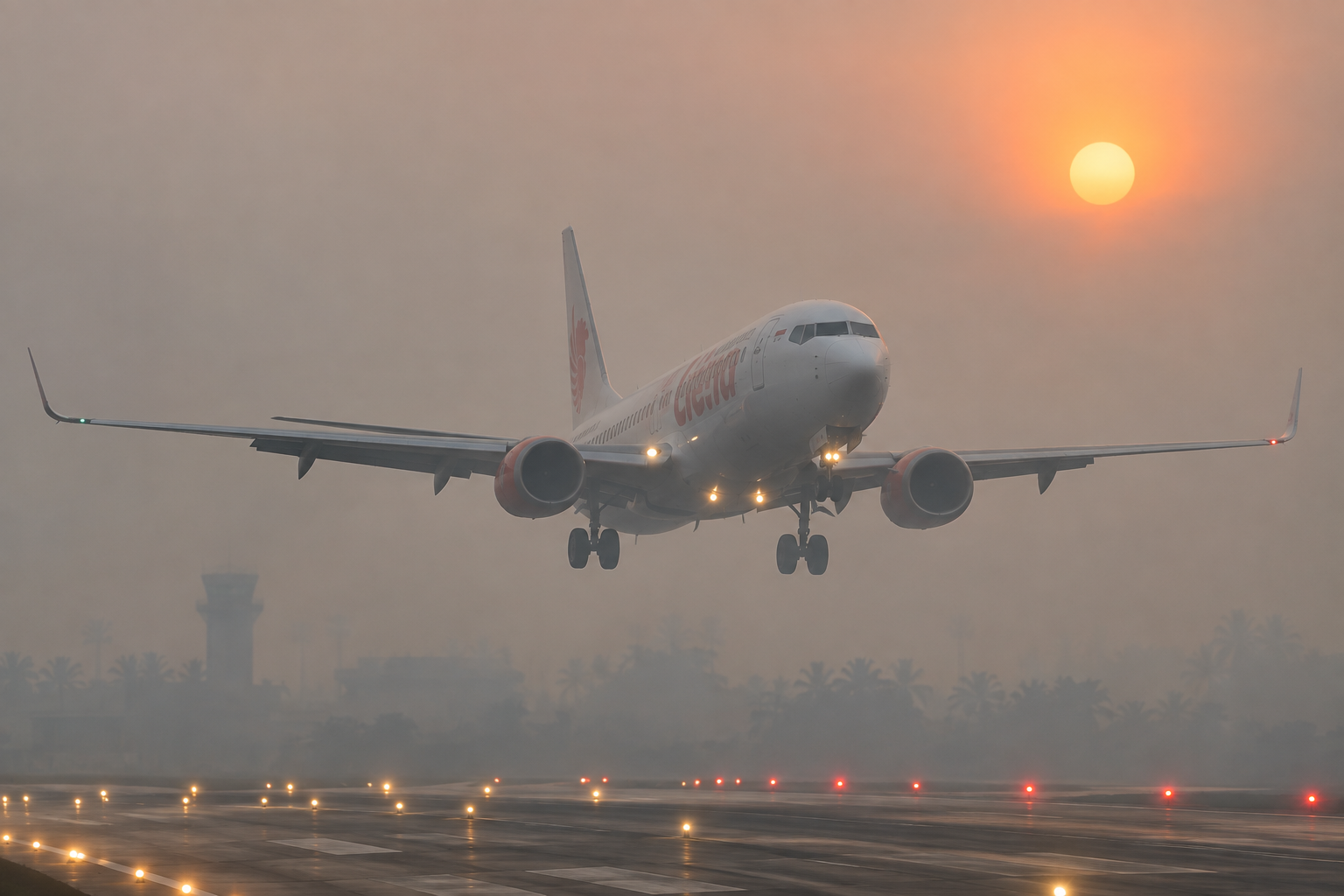
Two passenger flights were unable to land at Pekanbaru in Indonesia on Wednesday as thick haze reduced visibility to around 600 metres, while deteriorating air quality also affected large parts of neighbouring Malaysia.
Haze has begun affecting aviation operations in Indonesia, forcing one passenger flight to return to Jakarta and another to divert after visibility deteriorated sharply at Sultan Syarif Kasim II Airport in Pekanbaru, Riau.
Airport authorities confirmed that Lion Air flight JT292, operating from Jakarta to Pekanbaru, returned to Soekarno-Hatta International Airport on Wednesday morning after conditions at Pekanbaru reduced visibility to approximately 600 metres.
The aircraft returned to Jakarta at around 6.44am local time.
Shortly afterwards, Citilink flight QG936, also operating from Jakarta to Pekanbaru, was unable to complete its approach and was diverted to Hang Nadim International Airport in Batam at approximately 8.04am.
The Citilink aircraft had held near Pekanbaru before the decision was made to divert.
Visibility Falls to Around 600 Metres
The disruption occurred as haze affected Pekanbaru and other parts of Sumatra.
According to airport authorities, visibility at Sultan Syarif Kasim II Airport was approximately 600 metres when the Lion Air flight returned to Jakarta.
By 8.20am, visibility had improved to around 800 metres.
Despite the disruption, the airport did not close.
Other flights continued operating, and Pelita Air flight IP320 from Jakarta successfully landed in Pekanbaru at approximately 8.40am.
Airport management said operations were continuing to be monitored and evaluated, with aviation safety remaining the priority in operational decisions.
The events demonstrate how quickly reduced visibility can affect airline operations even when an airport itself remains open.
Haze Also Affecting Batam
Haze was also reported over Batam, an important Indonesian aviation and industrial centre close to Singapore and southern Malaysia.
Indonesia’s Meteorology, Climatology and Geophysics Agency reported reduced visibility in the area as smoke from forest and land fires affected parts of the region.
The conditions are being closely watched because prolonged haze can have consequences extending beyond air quality.
For aviation, significantly reduced visibility can affect approaches and departures, potentially resulting in holding, diversions, return-to-base decisions and wider network disruption.
Malaysia Records Widespread Unhealthy Air
Across the Strait of Malacca, air quality also deteriorated significantly in Malaysia on Wednesday.
By late afternoon, Department of Environment monitoring data showed 37 stations recording Air Pollutant Index readings in the unhealthy category.
Johan Setia in Selangor recorded an API of 190, while Cheras registered 187, Nilai 185 and Putrajaya 183.
Several other locations across the Klang Valley, Johor, Negeri Sembilan, Melaka, Pahang, Terengganu and Perak were also recording unhealthy conditions.
Malaysia classifies API readings between 101 and 200 as unhealthy, while readings between 201 and 300 are considered very unhealthy.
The deterioration has already prompted authorities to take precautionary measures outside aviation. Malaysia’s Ministry of Education instructed educational institutions to suspend outdoor activities in areas where API readings exceed 100, while educational institutions in Batu Pahat were temporarily closed.
Aviation Impact Requires Continued Monitoring
There has not, however, been confirmation of widespread disruption to Malaysian commercial flight operations comparable with the two Pekanbaru flights.
That distinction is important.
Poor air quality at ground level does not automatically mean commercial flights will be disrupted. Aviation decisions depend on operational conditions including airport visibility, meteorological information, aircraft and crew limitations, and the requirements governing individual approaches.
The situation nevertheless warrants monitoring if haze persists or visibility deteriorates further around major airports.
Malaysia and Indonesia sit within one of Southeast Asia’s busiest aviation regions, with dense networks connecting Kuala Lumpur, Singapore, Jakarta and numerous secondary cities across Sumatra and the Malay Peninsula.
Even localised periods of severely reduced visibility can therefore have consequences beyond a single airport if aircraft are required to divert, return to their departure points or operate with extended delays.
Safety Before Schedule
The decisions involving Lion Air JT292 and Citilink QG936 also underline a fundamental principle of airline operations: completing a scheduled landing is secondary to meeting the conditions required for a safe approach.
Returning to the departure airport or diverting to an alternate airport under deteriorating conditions is a normal safety measure rather than evidence of an unsafe flight.
For passengers travelling through affected areas, changing haze conditions mean flight status and airline notifications should be monitored closely.
For the wider aviation industry, the immediate question is whether today’s disruption at Pekanbaru remains localised or develops into a broader operational issue across parts of Southeast Asia.
MyAviation Magazine will continue monitoring aviation operations in Malaysia and Indonesia as haze conditions develop.
MyAviation Magazine | Aviation Safety & Asia-Pacific