
Malaysia is strengthening the way future air traffic controllers are identified, using a more structured and evidence-based assessment system before candidates enter formal training.
MY AVIATION | AIR TRAFFIC MANAGEMENT
Malaysia is introducing a new approach to selecting future air traffic controllers as the Civil Aviation Authority of Malaysia moves to strengthen the pipeline of people responsible for managing the country’s airspace.
CAAM has signed a five-year agreement with Airways International to use the company’s SureSelect air traffic control candidate selection and assessment platform for future recruitment. The agreement gives CAAM access to a suite of ATC-specific assessments designed to evaluate the aptitude and competencies of candidates before they progress further into the training process.
The development places greater emphasis on identifying whether candidates possess the cognitive, behavioural and ATC-specific abilities associated with successful controller performance.
Air traffic control is one of aviation’s most specialised professions. Controllers are responsible for maintaining the safe, orderly and efficient movement of aircraft within controlled airspace, issuing instructions to pilots, managing traffic flows and ensuring appropriate separation between aircraft. CAAM describes the profession as safety-critical and requires prospective controllers to meet academic, competency and medical requirements before qualifying.
Under the SureSelect system, candidates can be assessed through cognitive ability testing, ATC skills simulation and behavioural-trait evaluation. The system is intended to help organisations identify candidates with stronger potential before substantial investment is made in formal controller training.
For CAAM, the objective is not simply to increase recruitment numbers.
Dato’ Captain Norazman Mahmud, Chief Executive Officer of CAAM, said air traffic controllers perform a highly specialised and safety-critical role, adding that the authority intends to use a structured and evidence-based approach to identify candidates with the aptitude and competencies needed to succeed in ATC training and support Malaysia’s future operational requirements.
The agreement also reflects the increasingly important role of selection science in aviation training.
Training an air traffic controller requires considerable time and resources. CAAM notes that candidates may undergo formal training at the Academy of Civil Aviation Malaysia for up to 66 weeks, followed by on-the-job training before receiving a live rating. Training covers subjects including meteorology, aircraft operations, navigation, communications, aviation law and practical air traffic control.
Selecting candidates who demonstrate the required aptitude at an earlier stage can therefore help training organisations use resources more efficiently while improving the likelihood that candidates progress successfully through the demanding training pathway.
SureSelect is already used by air navigation service providers across the Asia-Pacific, Middle East and Africa, according to Airways International. The system combines automated assessment with ATC-specific testing and candidate performance reporting.
For Malaysia, the significance goes beyond recruitment software.
Air traffic management is an essential part of national aviation infrastructure. As aircraft movements, airport capacity and regional connectivity continue to develop, the effectiveness of the people managing the airspace remains as important as the technology supporting them.
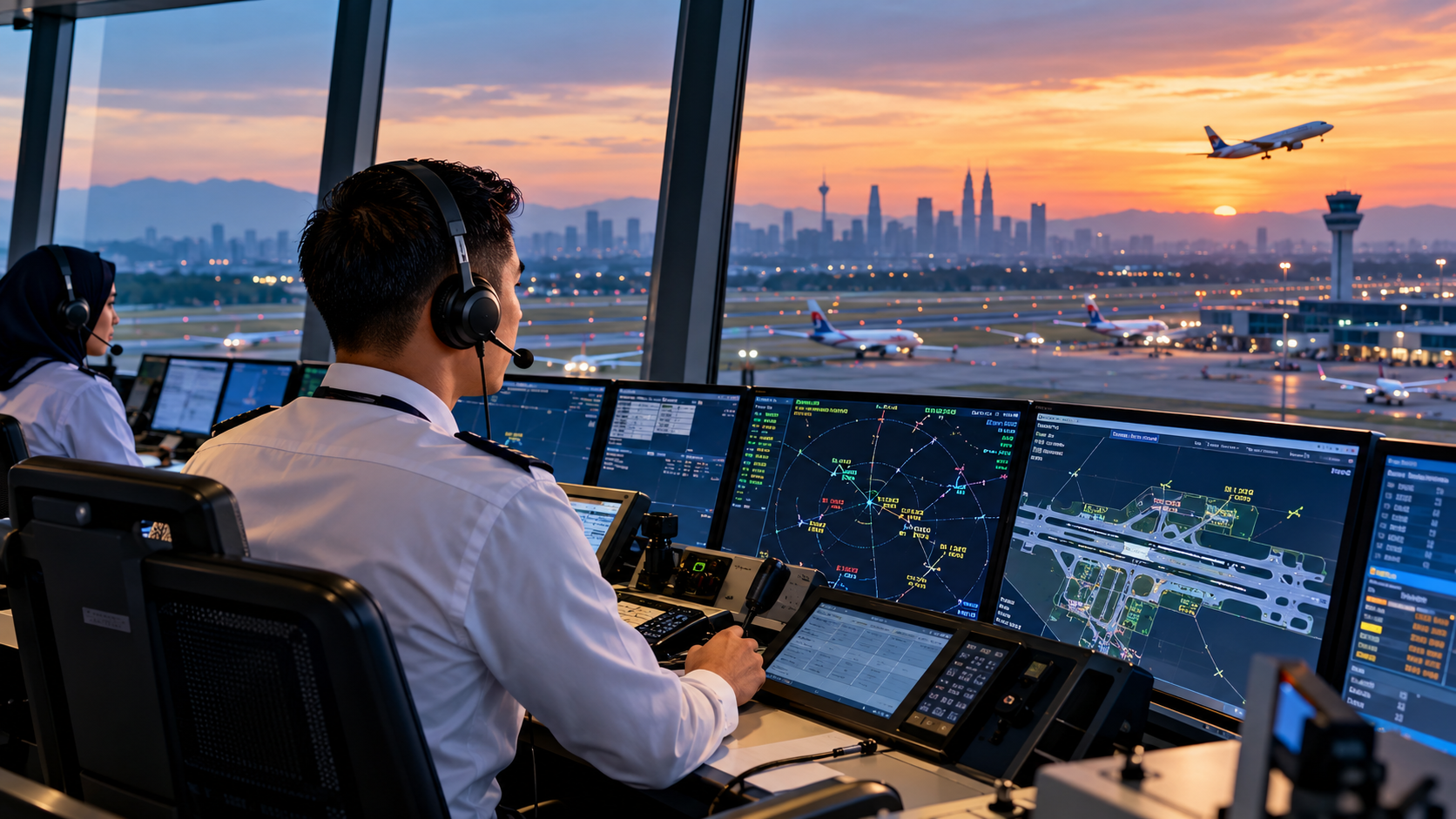
Modern control centres may increasingly rely on advanced surveillance, communications and digital systems, but the controller remains at the centre of operational decision-making.
That makes the selection process particularly important.
A future controller must be able to process information quickly, maintain situational awareness, communicate clearly, manage workload and make decisions in an environment where accuracy and discipline are critical.
Malaysia’s adoption of a dedicated ATC selection platform therefore represents an investment not only in recruitment, but also in the human element of aviation safety.
The next generation of Malaysian air traffic controllers will eventually guide aircraft through some of the country’s busiest and most complex airspace.
The process of preparing them begins long before they sit behind a radar display.
It begins with selecting the right people.
My Aviation | Air Traffic Management | 30 September 2026