
My Aviation | Advanced Air Mobility & Aeromedical | 7 October 2026
India’s emerging advanced air mobility sector is beginning to intersect with emergency healthcare, with a new partnership exploring whether electric vertical take-off and landing aircraft could eventually support time-critical patient transfers.
Manipal Hospitals, Sarla Aviation and Aeromed International Rescue Services have entered into a tripartite memorandum of understanding to work toward a next-generation air ambulance model using Sarla Aviation’s Shunya eVTOL platform.
The partnership brings together three different areas of expertise.
Sarla Aviation is developing the aircraft platform, Manipal Hospitals contributes clinical expertise and hospital infrastructure, while Aeromed International Rescue Services brings experience in air ambulance and medical evacuation operations.
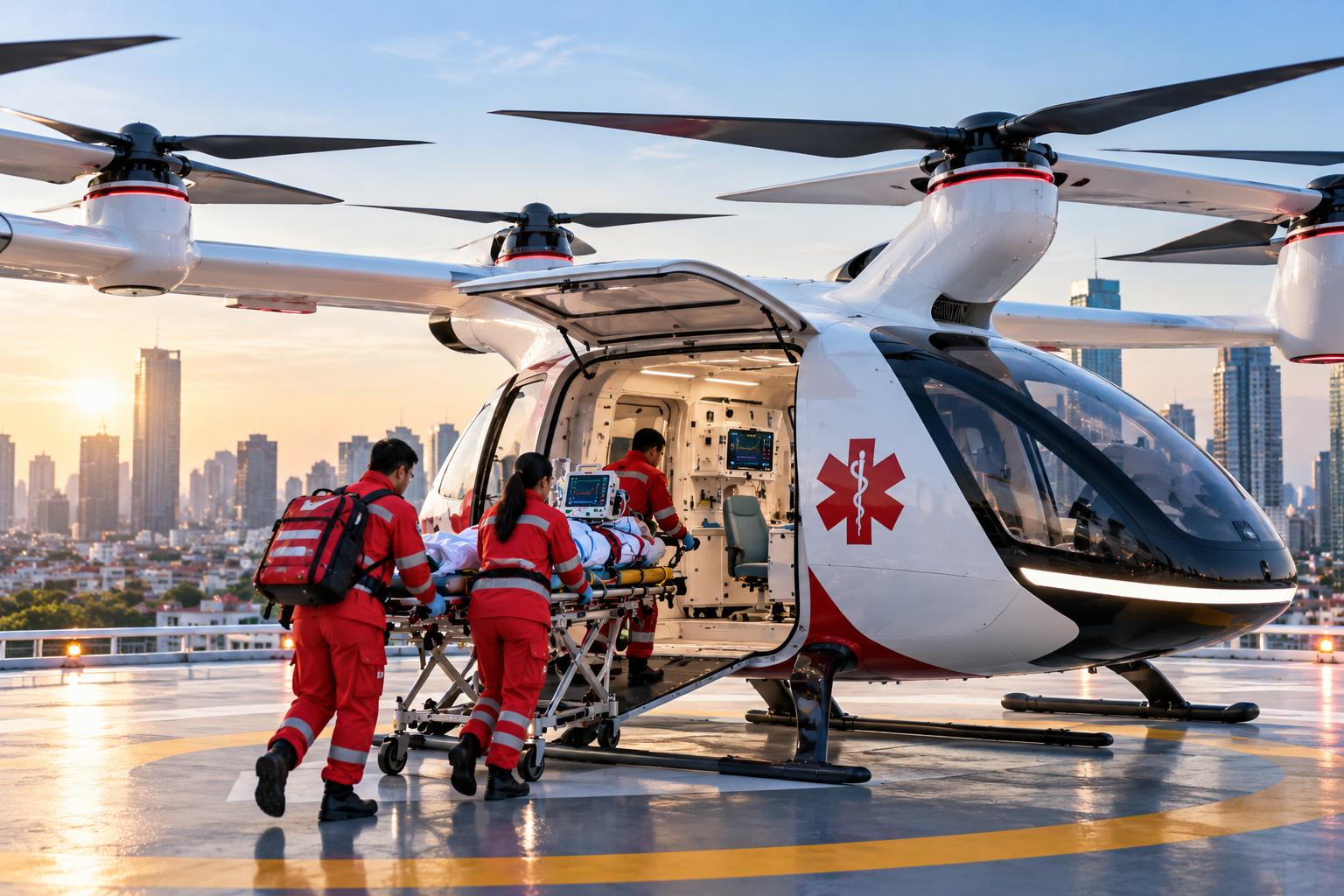
Under the collaboration, the organisations plan to examine medical cabin design, equipment integration and standard operating procedures for transferring patients between ground ambulances, eVTOL aircraft and hospitals.
The partners are also expected to identify medical transfer corridors where faster transport could have the greatest clinical impact.
Potential applications being considered include trauma, heart attacks, stroke, neonatal transfers and organ transportation.
Training, insurance arrangements, safety frameworks and research into patient outcomes are also expected to form part of the programme.
The concept is particularly relevant in India’s major cities.
Severe road congestion can make relatively short hospital-to-hospital transfers time-consuming, particularly during peak periods. For some patients, delays in reaching specialist care can become an important part of the clinical challenge.
An aircraft capable of vertical take-off and landing could potentially bypass road congestion and connect hospitals or designated landing sites without requiring conventional airport infrastructure.
But the idea remains technically and operationally complex.
An eVTOL designed for passenger transport does not automatically become a critical-care aircraft.
Medical teams need enough space to reach and treat the patient safely. Aircraft must be capable of carrying stretchers, monitoring equipment, oxygen, medication and potentially ventilators while remaining within strict weight and power limitations.
Battery reserves, operating range, weather limitations, noise, landing-site design, patient loading and regulatory certification will also influence whether the aircraft can perform real-world medical missions.
The partners have also indicated that they intend to engage with Indian aviation and health authorities as the concept develops.
This regulatory element will be critical.
Aeromedical operations sit at the intersection of aviation and healthcare. An aircraft may satisfy aviation requirements while still needing additional consideration before it can safely function as a clinical environment.
The same applies to ground integration.
A five or ten-minute airborne journey delivers little benefit if the patient then faces a lengthy transfer between the ambulance, landing site and receiving hospital.
That is why the proposed model includes procedures for the entire patient journey rather than focusing solely on the aircraft.
At this stage, the initiative should be viewed as an exploratory development programme, not as an operational nationwide eVTOL air ambulance service.
The technology still needs to pass through design, regulatory, certification and operational stages before routine medical missions become possible.
Nevertheless, the partnership illustrates an important change in the advanced air mobility conversation.
eVTOL aircraft have often been associated with future urban passenger transport and air taxi services.
Healthcare may prove to be one of the areas where the technology offers a more clearly defined operational purpose.
If the aircraft, clinical system and regulatory framework can be successfully integrated, India could become an important test market for the use of advanced air mobility in emergency healthcare.
The real question is not simply whether an eVTOL can fly over traffic.
It is whether it can safely move the right patient, with the right medical team and equipment, at the moment when time matters most.
My Aviation will continue to follow the programme as the partners move from concept development toward certification and operational testing.