
My Aviation | HEMS & Regulation | 7 October 2026
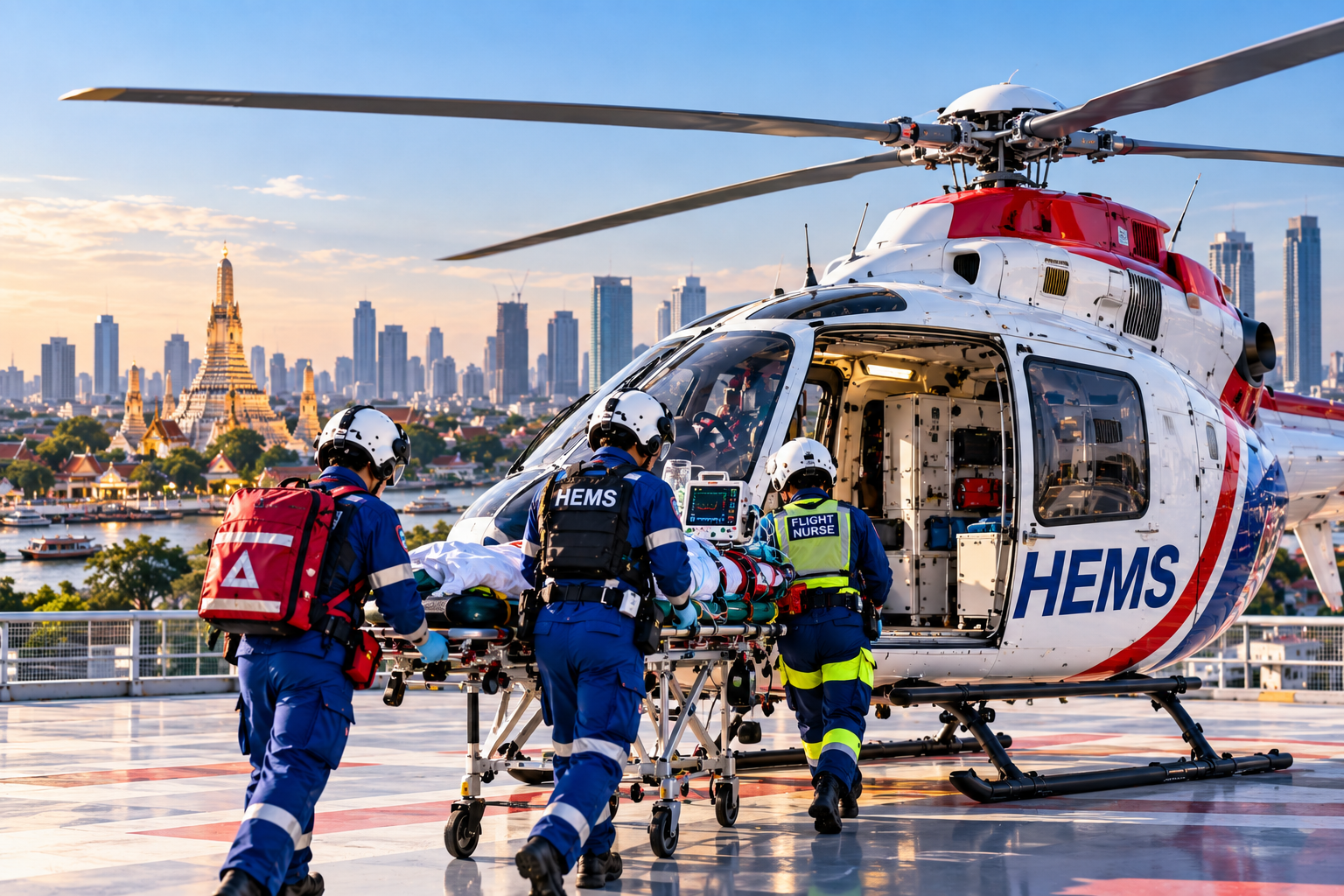
Thailand is exploring closer cooperation with the European Union Aviation Safety Agency (EASA) as the country looks at the future development of Helicopter Emergency Medical Services and the standards needed to support safe operations.
The Civil Aviation Authority of Thailand confirmed that HEMS formed part of bilateral discussions with EASA on 8 September 2026 during the 61st Conference of Directors General of Civil Aviation for the Asia-Pacific region in Malaysia.
According to CAAT, the two sides exchanged views on the development of HEMS safety standards, regulatory approaches and the sharing of operational knowledge and experience. The stated aim is to support the development of HEMS in Thailand in a way that is safe, efficient and aligned with international practice.
The discussions are particularly relevant because Thailand already has a regulatory framework covering helicopter emergency medical service operations.
Under Thailand’s civil aviation rules, helicopters may only be used for HEMS if the operator has approval from CAAT. The rules also include requirements concerning medical equipment installations, communications capability and operational weather minima.
This means the current engagement with EASA should not be understood as Thailand starting from zero.
Rather, it reflects an effort to strengthen technical cooperation, refine standards and learn from mature international HEMS systems as Thailand considers how its own aeromedical aviation capability should evolve.
The distinction is important.
A successful HEMS system depends on much more than the availability of helicopters.
Aircraft must be operated within a clear regulatory structure. Pilots and medical crews require specialised training. Medical equipment must be safely installed and approved. Communications between the aircraft, dispatch centres, hospitals and ground emergency services must remain reliable.
Weather limitations, landing sites, maintenance standards and mission-selection criteria also influence whether an emergency helicopter operation can be conducted safely.
Europe has decades of experience operating sophisticated HEMS networks, and EASA standards have influenced aeromedical helicopter regulation in many jurisdictions.
Thailand, however, will still need to adapt international experience to its own environment.
The country faces a combination of dense urban centres, mountainous regions, islands, tourism destinations and areas where rapid road access to specialist hospitals can be difficult.
A HEMS model that works in Europe cannot simply be transferred directly into Southeast Asia without considering local weather, geography, healthcare resources, aviation infrastructure and emergency-response arrangements.
CAAT itself has emphasised the importance of applying international standards in a manner appropriate to Thailand’s operating context.
The country is also exploring other forms of aviation technology for medical missions.
In September, CAAT said it was working with Thailand’s Ministry of Public Health and True Corporation on the SkyBridge initiative, involving unmanned aircraft for medical transport in remote areas. More recent CAAT discussions have also examined the potential use of unmanned aircraft and advanced air mobility in locations such as Phuket and northern Thailand.
Taken together, these developments suggest that Thailand is looking at aeromedical access as part of a wider aviation ecosystem rather than relying on a single type of aircraft.
For Southeast Asia, that approach is significant.
The future of aeromedical aviation in the region is likely to involve a combination of helicopters, fixed-wing aircraft, ground ambulances and, eventually, new technologies such as unmanned aircraft and advanced air mobility platforms.
But regardless of the aircraft used, the foundation remains the same: strong regulation, trained crews, clinical governance and effective integration between aviation and healthcare.
The CAAT-EASA discussions therefore represent more than a technical exchange.
They are another indication that aeromedical aviation is becoming part of the wider conversation about how Asian countries can build safer and more resilient emergency medical transport systems.
My Aviation will continue to follow Thailand’s HEMS development as regulatory cooperation and operational planning progress.