
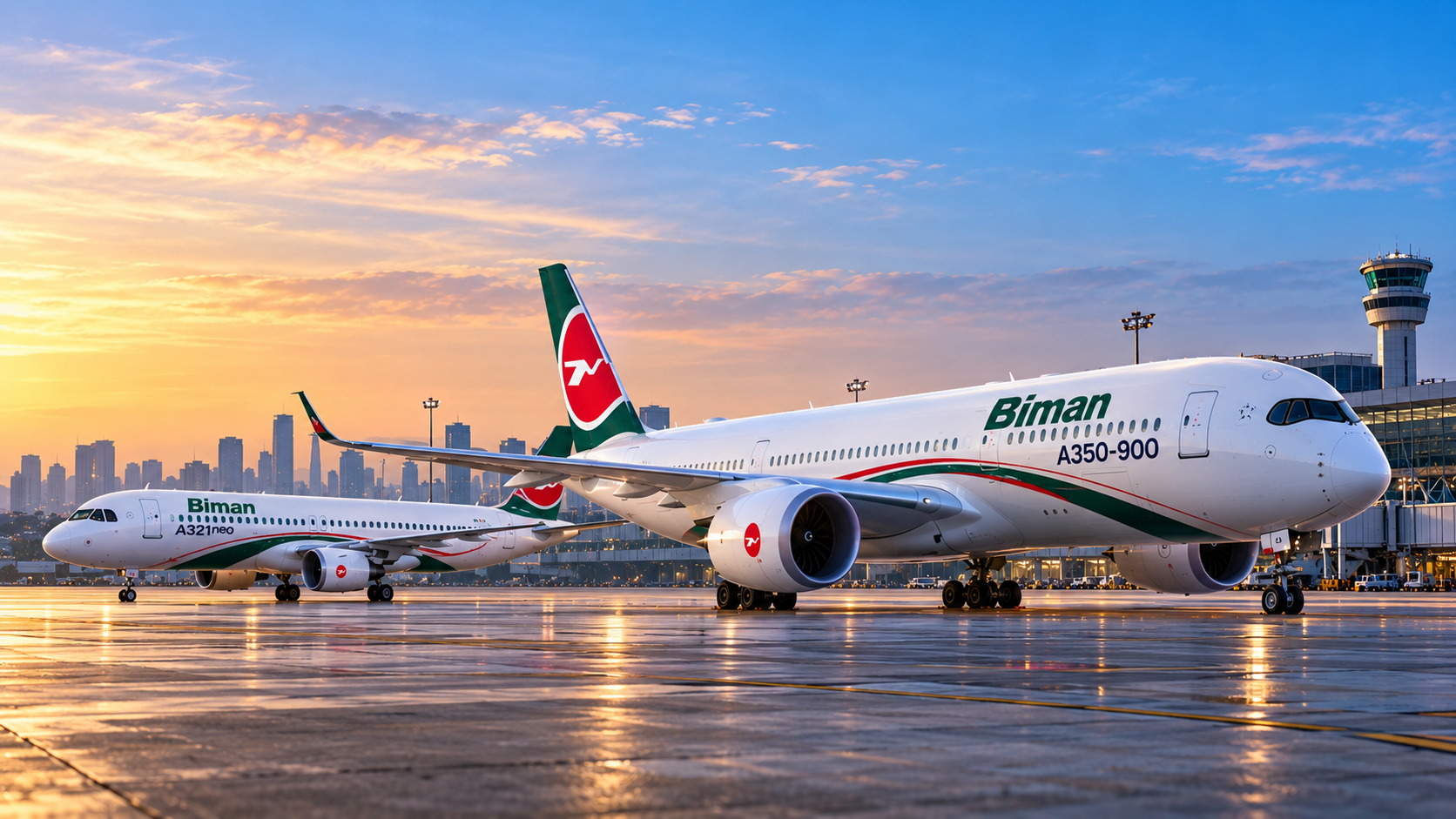
Bangladesh’s national carrier has signed a firm order for four Airbus A350-900 widebody aircraft and six A321neo jets, marking a significant shift towards a mixed Airbus–Boeing fleet as it prepares for international expansion
Biman Bangladesh Airlines has signed a firm agreement with European aircraft manufacturer Airbus for 10 new aircraft, marking a major milestone in the national carrier’s fleet modernisation and international growth strategy.
The agreement, signed in Dhaka on 7 October, comprises four Airbus A350-900 widebody aircraft and six A321neo single-aisle jets.
The acquisition represents a significant development for Biman, which has traditionally operated a predominantly Boeing jet fleet.
It also comes shortly after the airline expanded its Boeing acquisition programme, bringing its planned long-term aircraft procurement pipeline to 35 aircraft.
A New Chapter for Bangladesh Aviation
The signing ceremony, held at the Radisson Blu Dhaka Water Garden, brought together senior representatives from Airbus, Biman Bangladesh Airlines and the Bangladeshi government.
Biman Chairman Rumee A. Hossain and Airbus India and South Asia President and Managing Director Jürgen Westermeier signed the agreement.
The ceremony was attended by senior government officials, including Civil Aviation and Tourism Minister M. Rashiduzzaman Millat.
The agreement reflects Bangladesh’s ambition to strengthen its national carrier as demand for international travel continues to grow.
Biman currently operates a fleet of approximately 19 aircraft, including Boeing 737-800s, 777-300ERs, 787 Dreamliners and Dash 8 turboprops.
The new Airbus aircraft will introduce additional fleet capabilities while supporting the airline’s longer-term network development.
Airbus A350 to Support Long-Haul Expansion
The four Airbus A350-900 aircraft are expected to form an important part of Biman’s future long-haul strategy.
The A350 is designed for intercontinental operations, offering the range and operating efficiency required to connect Dhaka with distant international markets.
Airbus says the aircraft will support Biman’s ambitions to expand connectivity to North America, Europe and the Middle East.
For Bangladesh, long-haul connectivity is particularly important because of its substantial overseas population and growing international trade relationships.
The airline’s expansion plans could strengthen direct links between Bangladesh and major international destinations while reducing dependence on connecting services through foreign aviation hubs.
However, specific new routes have not yet been formally confirmed as part of the aircraft order.
A321neo Strengthens Regional Connectivity
The six Airbus A321neo aircraft will support Biman’s regional and medium-haul operations.
The aircraft offers greater flexibility for services connecting Bangladesh with destinations across Asia and the Middle East.
The A321neo is also designed to provide improved fuel efficiency compared with previous-generation single-aisle aircraft.
Its introduction could allow Biman to strengthen existing routes while exploring additional markets where widebody aircraft may not be commercially suitable.
For Southeast Asian aviation, the development is particularly relevant because Bangladesh maintains important economic and passenger connections with Malaysia, Singapore, Thailand and other regional markets.
A 35-Aircraft Expansion Programme
The Airbus agreement forms part of a much larger aircraft procurement strategy.
Biman has also agreed to acquire 25 Boeing aircraft, comprising 15 Boeing 787 Dreamliners and 10 Boeing 737 MAX 8 aircraft.
Combined with the latest Airbus agreement, the airline’s planned acquisition pipeline now stands at 35 aircraft.
The programme includes 19 widebody and 16 narrowbody jets.
The scale of the expansion is substantial when compared with Biman’s existing fleet.
However, the 35 aircraft should not be interpreted as an immediate increase in the airline’s operational fleet.
Deliveries will take place over several years, and some aircraft may replace older equipment as part of the carrier’s fleet renewal programme.
Mixed Fleet Brings New Opportunities and Challenges
The decision to introduce Airbus aircraft alongside Boeing models represents a major strategic change.
A mixed fleet can provide airlines with greater flexibility in aircraft selection, network planning and future procurement.
Different aircraft types can be deployed according to route distance, passenger demand and operating requirements.
However, introducing a new aircraft manufacturer also creates additional operational considerations.
Airlines must develop the necessary pilot training, engineering expertise, maintenance support, spare-parts arrangements and technical infrastructure to operate new aircraft types safely and efficiently.
For Biman, these requirements will form an important part of the transition towards a larger and more diversified fleet.
The airline has indicated that its modernisation programme will include investment in engineering capabilities and personnel training.
Bangladesh Seeks a Stronger Position in International Aviation
The expansion comes as Bangladesh seeks to strengthen the competitiveness of its national airline.
The country’s large population, growing economy and substantial overseas workforce provide an important foundation for international passenger demand.
Biman Chairman Rumee A. Hossain has highlighted the country’s population of approximately 200 million and a global Bangladeshi diaspora estimated at 15 million.
These factors create opportunities for international air connectivity, particularly across the Middle East, Europe and Asia.
The airline’s long-term challenge will be translating that demand into commercially sustainable routes while maintaining operational reliability and competitive service standards.
Aircraft investment alone will not determine the success of the programme.
Fleet utilisation, maintenance capability, route economics, workforce development and customer experience will remain critical.
Airbus Strengthens Its Position in South Asia
The agreement also represents a commercial milestone for Airbus.
South Asia continues to emerge as an important market for commercial aircraft manufacturers, supported by rising passenger demand, airline expansion and the need to replace ageing fleets.
Biman’s decision to introduce both the A350 and A321neo broadens Airbus’s presence in Bangladesh while establishing a new long-term relationship with the country’s national carrier.
For Airbus, the agreement provides an opportunity to support Biman across long-haul and regional operations.
For Biman, it creates a platform for a more diversified fleet strategy.
Looking Ahead
The financial value of the Airbus agreement has not been officially disclosed.
Detailed delivery arrangements are also expected to become clearer as the airline advances its fleet modernisation programme.
The agreement nevertheless represents one of the most significant developments in Bangladesh’s recent commercial aviation history.
With 35 aircraft now included in its long-term acquisition pipeline, Biman Bangladesh Airlines is preparing for a substantial transformation of its fleet and international network.
The next challenge will be converting those aircraft commitments into stronger operational capabilities, sustainable growth and greater competitiveness in the international aviation market.
For Bangladesh, the agreement represents more than an aircraft purchase.
It is an investment in the future direction of the country’s national airline and its ambitions within the global aviation industry.
MyAviation Magazine | Aircraft & Asia-Pacific Aviation