EVERETT, UNITED STATES | 21 October 2026
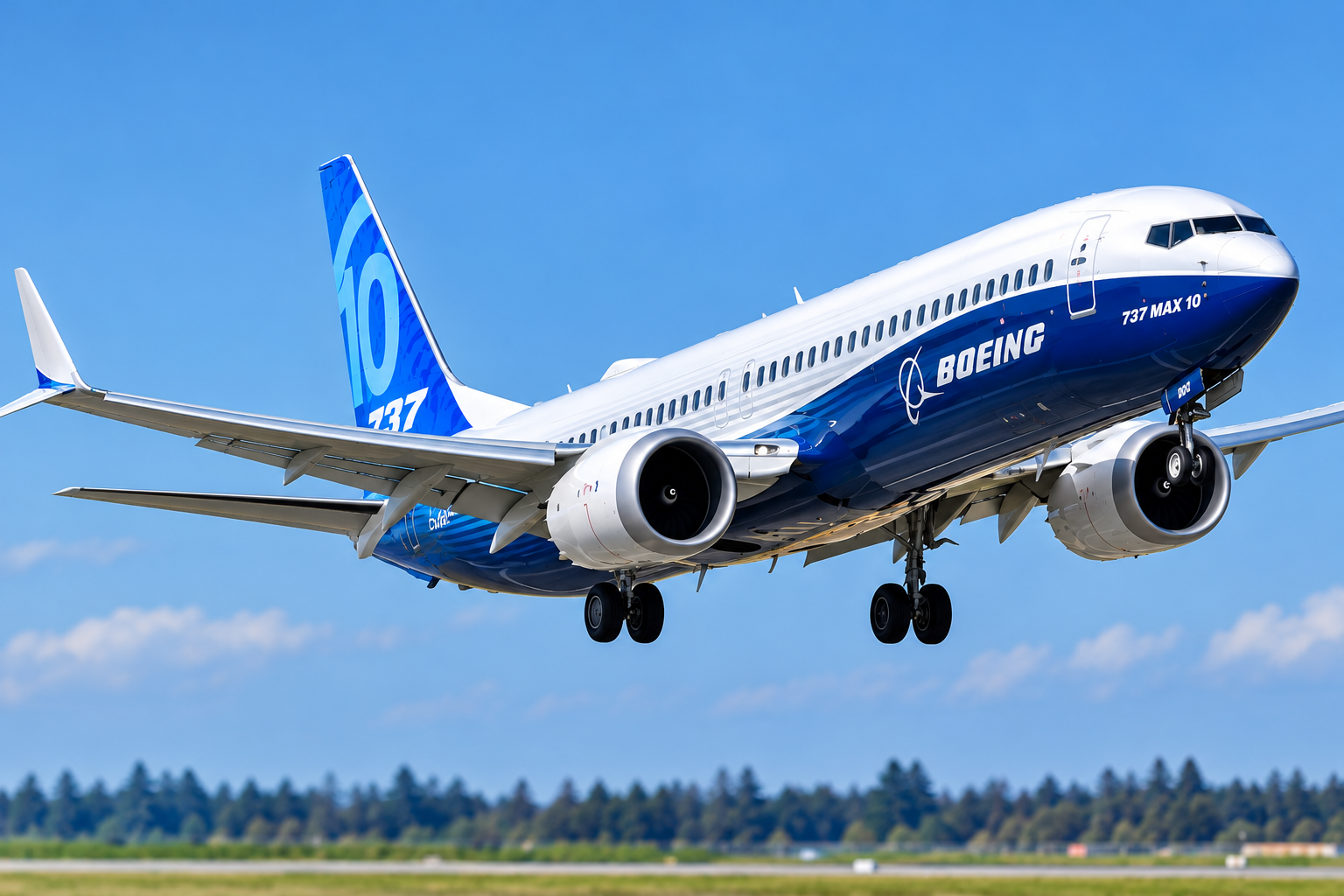
The United States Federal Aviation Administration (FAA) has certified the Boeing 737 MAX 10, clearing a major regulatory hurdle ahead of customer deliveries of the largest aircraft in the 737 MAX family.
The approval, announced on 20 October 2026, follows an extensive programme of flight testing, technical assessments and regulatory scrutiny. The FAA issued an amended type certificate confirming compliance with applicable design and safety requirements, together with an updated Production Limitation Record.
The development is significant for Boeing and its airline customers following delays to the programme. The MAX 10 is designed for carriers seeking greater passenger capacity within their single-aisle fleets.
Extensive Testing and Safety Reviews
Boeing conducted nearly 1,000 test flights, accumulating more than 2,000 flight hours, alongside approximately 1,000 hours of ground testing.
The certification assessments covered flight-control systems, human factors, design assurance and aircraft safety documentation.
Among the improvements is an enhanced angle-of-attack system intended to provide additional safeguards against erroneous sensor information. Boeing has indicated that the system will subsequently be introduced across other 737 MAX variants.
The FAA’s review incorporated requirements under the Aircraft Certification, Safety, and Accountability Act of 2020, together with relevant recommendations from the National Transportation Safety Board.
Aircraft Capacity and Airline Demand
The 737 MAX 10 accommodates approximately 185 to 210 passengers in a typical two-class configuration, with a maximum capacity of 230 passengers.
Its published range of approximately 3,100 nautical miles makes it suitable for short- and medium-haul routes requiring higher seating capacity.
According to Boeing, more than 30 customers have placed orders for 1,555 MAX 10 aircraft, representing over 30% of the outstanding 737 MAX order book.
The aircraft competes with the Airbus A321neo in the higher-capacity single-aisle market, where airlines consider seating capacity, operating economics and compatibility with existing fleets.
Deliveries and International Approval
Although FAA certification establishes the aircraft’s regulatory approval in the United States, deliveries and entry into commercial service remain subject to production schedules, operator preparations and any additional approvals required by other aviation authorities.
Reuters reported that Canada’s WestJet is expected to be among the first recipients in 2027, with further certification processes anticipated in Canada and Europe.
The MAX 10 approval follows the earlier certification of the MAX 7, completing FAA certification of the principal passenger variants in Boeing’s 737 MAX family.
Attention now turns to customer deliveries, airline preparations and the aircraft’s introduction into commercial service.