

My Aviation | Aeromedical Asia | 7 October 2026
Indonesia has begun trialling an air ambulance programme aimed at improving emergency medical access for communities in isolated and difficult-to-reach parts of the country.
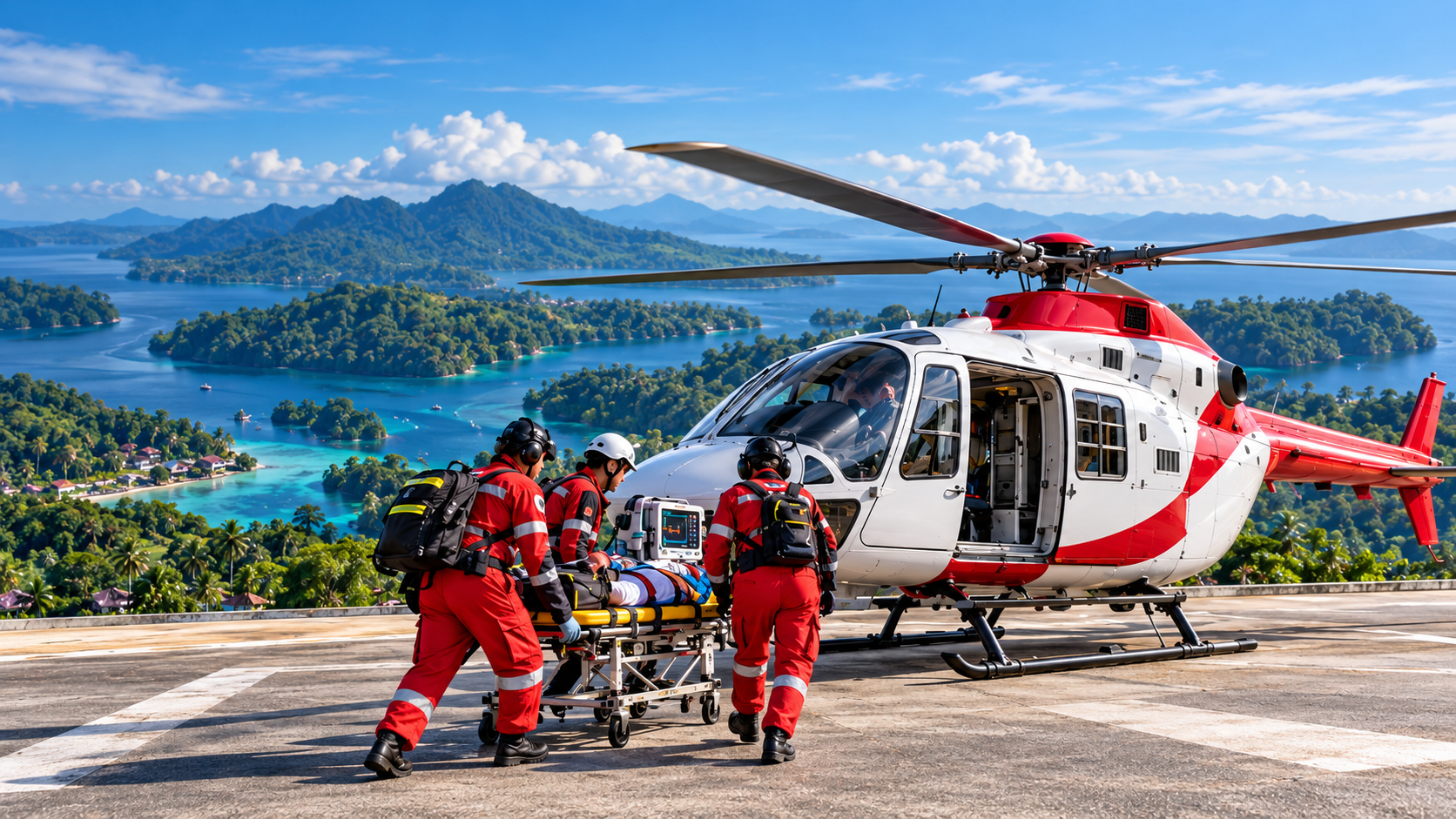
The first reported medical evacuation exercise was carried out in Pesisir Barat Regency, Lampung, using a helicopter. The Indonesian government said the initiative is intended to shorten the time required to move patients from areas where road access is limited or where long journeys can delay treatment.
President Prabowo Subianto had earlier announced plans for an air ambulance capability using helicopters and small aircraft, particularly for areas where conventional transport infrastructure is inadequate. The initiative forms part of a broader effort to improve access to healthcare in remote regions.
For a country as geographically complex as Indonesia, the case for aeromedical transport is clear. Indonesia spans thousands of islands, with many communities separated from major hospitals by mountains, sea crossings or lengthy road journeys. In some locations, patients requiring specialist care may face several hours of travel before reaching an appropriate facility.
Air ambulances can potentially reduce that delay, particularly in cases involving trauma, cardiac emergencies, stroke, obstetric complications and other time-critical conditions.
But the aircraft itself is only one part of the system.
A reliable aeromedical service requires trained medical crews, aircraft operators, maintenance support, suitable landing locations, hospital coordination, communications systems, oxygen and medical equipment, patient-selection criteria and clearly defined clinical responsibilities.
This is why the current trial should be viewed as the beginning of a wider operational development rather than a fully established nationwide air ambulance network.
Indonesia will eventually need to determine how aircraft are deployed, who operates them, how missions are activated, how patients are selected and how the service integrates with existing hospitals and ambulance networks.
The programme nevertheless represents an important development for aeromedical care in Southeast Asia.
For years, air ambulance services in the region have often been associated with private medical evacuation or international repatriation. Indonesia’s initiative points toward a broader model in which aviation becomes part of the public healthcare-access system.
If the programme develops successfully, it could provide valuable lessons for other Asian countries facing similar challenges involving remote geography and uneven access to specialist care.
The key measure of success will not simply be the number of aircraft available.
It will be whether the system can safely deliver the right patient to the right hospital, with the right medical team, at the right time.
My Aviation will continue to follow the development of Indonesia’s air ambulance programme as further operational details are announced.