
A Malaysian aerospace researcher is playing a direct role in one of NASA’s key programmes aimed at shaping the future of electric vertical take-off and landing (eVTOL) aircraft, reinforcing the country’s growing presence in advanced aviation research on the global stage.
Dr Raja Akif Raja Zahirudin, 33, a Postdoctoral Fellow at the Daniel Guggenheim School of Aerospace Engineering at the Georgia Institute of Technology (Georgia Tech), is directly involved in the NASA RAVEN GT programme. RAVEN, which stands for Research Aircraft for eVTOL Enabling Technologies, is a collaboration between NASA and Georgia Tech to design, build and fly a 1,000 lb class unmanned eVTOL research aircraft intended to serve as a flying laboratory for advanced air mobility (AAM) technologies.
Speaking to Bernama, the Kerteh born scientist said his research, titled ‘Proprotor Hover Performance and Wing Download for the RAVEN eVTOL Aircraft,’ focuses on rotor performance and the interaction of aircraft components that affect thrust during vertical take off and landing phases. The work aims to improve eVTOL design efficiency and operational suitability for future deployment.
The RAVEN programme, which commenced in 2020, involves four researchers, four academic faculty members and seven students at Georgia Tech, supported by industry partners and external collaborators. The aircraft is based on the airframe of a Bede BD 6 experimental fixed wing kit plane, modified to incorporate a distributed electric propulsion system with tilting rotors, a battery system, fly by wire flight controls and avionics enabling remotely piloted operation. Initial research applications span flight dynamics, controls, acoustics and automation.
Dr Raja Akif noted that eVTOL technology has significant potential as an alternative to conventional surface transportation, offering faster, quieter and more environmentally sustainable short distance air travel, particularly in congested urban environments. However, he acknowledged that achieving low noise levels and energy efficiency remains among the principal challenges, as public acceptance in densely populated areas depends heavily on these factors.
The eVTOL sector is of particular relevance to the Asia Pacific region, where rapid urbanisation and traffic congestion in megacities across Southeast Asia, China and India are driving growing interest in urban air mobility solutions. Several countries in the region, including Singapore, Japan and South Korea, are actively developing regulatory frameworks and infrastructure for AAM operations, making the research conducted under programmes such as RAVEN directly applicable to future aviation ecosystems in the region.
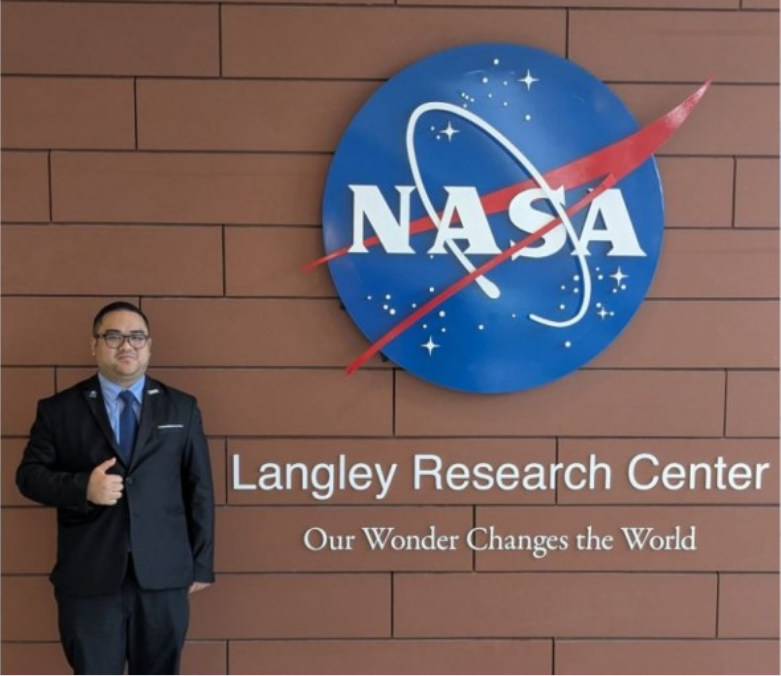
Dr Raja Akif’s involvement in NASA funded research traces back to his PhD studies at Pennsylvania State University, where he was mentored by Prof Eric Greenwood, a former researcher at NASA’s Langley Research Centre. Greenwood brought with him a NASA Langley grant for research on overlapping rotor aerodynamics and acoustics, which became the foundation of Dr Raja Akif’s doctoral thesis. He has since maintained a working relationship with the aeroacoustics team at NASA Langley, contributing research methodologies and experimental findings.
Describing his involvement in international research as a responsibility to represent the nation and demonstrate the capabilities of Malaysian scientists, Dr Raja Akif expressed hope that his work would open further opportunities for Malaysian scientists and engineers on the international stage.
A major goal of the RAVEN programme is to make its aircraft design geometry and flight test data publicly available, accelerating the development of the broader AAM market and supporting the next generation of aerospace engineers worldwide.