
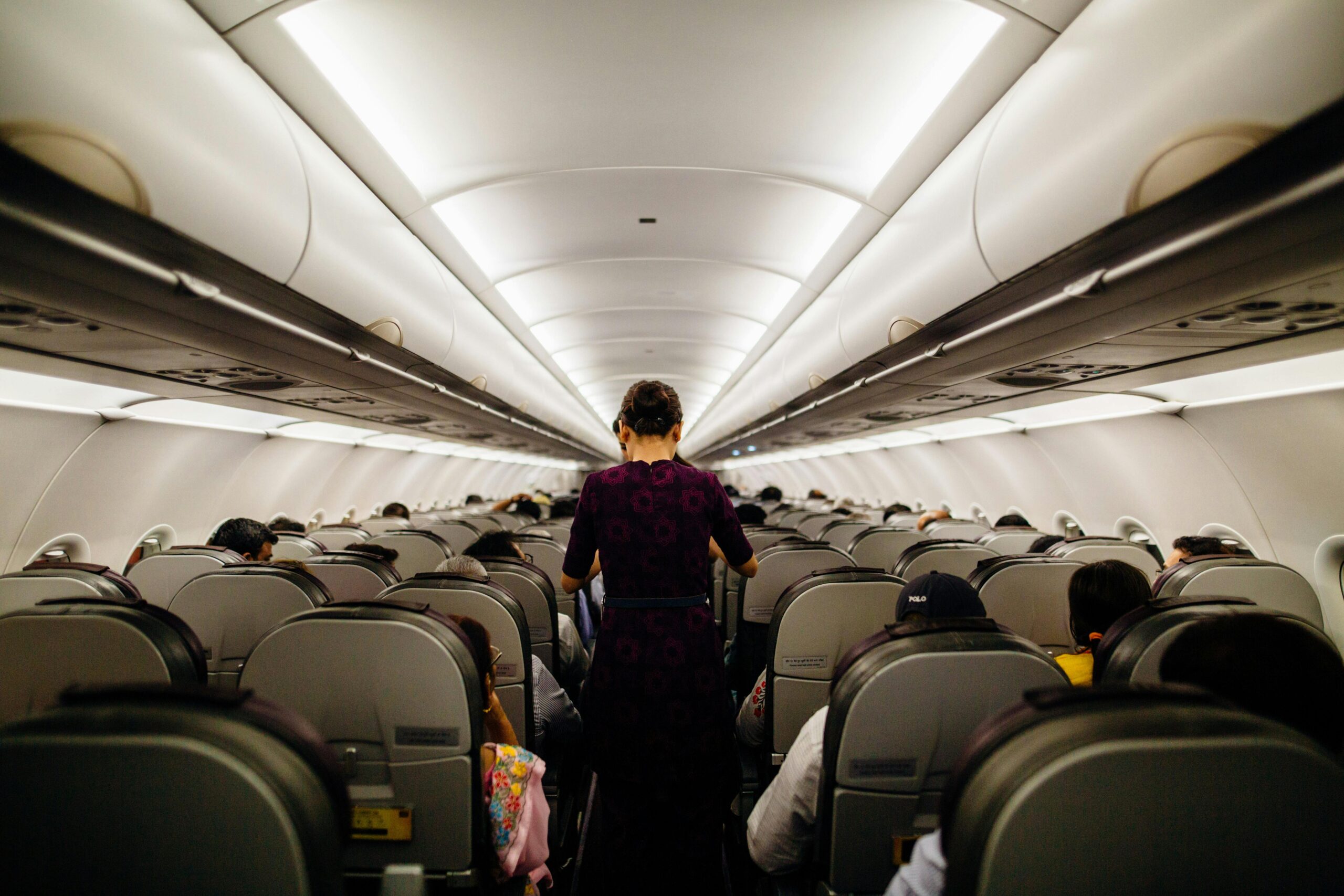
A passenger raises his voice. Another refuses to follow a simple instruction. Someone laughs when a crew member tries to defuse a tense exchange. For most on board, it is just a difficult flight. For cabin crew, it is often dismissed as part of the job. That dismissal is exactly where the problem begins.
Behind the polished image of warm service is a less visible reality. Cabin crew are not hospitality staff. They are trained safety professionals responsible for evacuation, first aid, fire response, and de-escalation in a confined environment at altitude. Yet in moments of misconduct, their authority is regularly tested, dismissed, or ignored. The numbers suggest this is not anecdotal.
The data behind the lived experience
The International Air Transport Association recorded one unruly passenger incident for every 480 flights in 2023, drawing on more than 24,500 reports from over 50 operators. By 2024, that rate had worsened to one incident per 395 flights. Within those incidents, non compliance with crew instruction is the single most common category. Verbal abuse appears in roughly 14 per cent of cases. Physical abuse, while rarer, rose 61 per cent between 2021 and 2022 alone.
Regulators report similar trends. The United States Federal Aviation Administration logged a peak of 5,973 cases in 2021, prompting its Zero Tolerance policy and civil fines of up to USD 37,000 per violation. Europe’s aviation safety regulator estimates disruptive events now affect at least one flight in every three hundred. These are not isolated outbursts. They are a structural feature of contemporary commercial aviation.
Why prosecution rarely follows
The legal architecture compounds the problem. The Tokyo Convention of 1963, which still governs offences committed on aircraft, ties jurisdiction to the state of aircraft registration rather than the state of landing. The result is that a passenger who assaults a crew member on a foreign carrier often cannot be prosecuted by the country where the aircraft lands. IATA estimates this jurisdictional gap is the reason roughly 60 per cent of unruly passenger prosecutions do not proceed.
The Montreal Protocol of 2014 was designed to fix this by extending jurisdiction to the state of landing. More than a decade later, only around 45 states, representing about a third of international passenger traffic, have ratified it. Malaysia and most of its ASEAN neighbours have not. The practical consequence is that crew across this region absorb misconduct knowing the legal recourse is limited at best.
Emotional labour, not just stress
The framework for understanding what this does to crew is not new. The sociologist Arlie Hochschild’s 1983 study of flight attendants introduced the concept of emotional labour, the work of managing one’s own feelings to produce a particular emotional state in others. Hochschild’s findings, replicated across decades of subsequent research, show that sustained emotional labour produces a specific form of exhaustion distinct from physical fatigue, characterised by emotional dissonance, depersonalisation, and elevated risk of depression.
Recent peer reviewed research confirms what crew already know. A 2023 scoping review in the International Journal of Environmental Research and Public Health found cabin crew face elevated rates of depression and anxiety compared to the general population. A 2021 international survey of active flight attendants found four in ten screened positive for depression. Repeated exposure to passenger hostility, combined with the requirement to remain composed, is part of why these numbers are what they are.
The safety case
This is not only a wellbeing issue. Aviation safety depends on crew authority being respected. When passengers ignore seatbelt instructions, refuse to stow baggage, or argue during taxi, they are not merely being rude. They are degrading a safety system designed around the assumption that crew commands will be followed without negotiation. The sterile cockpit rule, fastened seatbelts during turbulence, and orderly evacuation procedures all rest on the same foundation. That foundation is weakened every time misconduct is treated as ordinary.
Many airlines have wellbeing frameworks, peer support programmes, and incident reporting channels. The gap between policy and practice is where the issue lives. Reporting systems exist, but the prevailing culture often discourages their use. When something is repeatedly described as routine, it stops being reported as a problem.
What needs to change
Three things would meaningfully shift the picture. First, more states ratifying the Montreal Protocol 2014, closing the jurisdictional gap that lets misconduct go unpunished. Second, airlines treating crew incident reports as safety data rather than complaints, with the same seriousness applied to flight deck reports under just culture frameworks. Third, a public conversation that stops describing crew as service staff and starts describing them as what they are, the safety personnel standing between an ordinary flight and a serious one.
None of this requires sympathy. It requires recognition. The glamorised image of the job, all uniforms and destinations, has done crew a disservice by hiding the other half of the work, the irregular sleep, the time zone disruption, the constant management of unpredictable behaviour in a space no one can leave.
Most flights are uneventful. Most passengers are courteous. But the cumulative effect of even a small share of difficult interactions, repeated across thousands of duty hours, is enough to shape an entire workforce’s mental health. Being mistreated should never be considered part of the job. The sooner that idea is challenged, in policy and in public attitude, the safer the cabin becomes for everyone in it.