
LEADERSHIP SPOTLIGHT | AIRPORT LEADERSHIP
Some aviation leaders inherit an airport.
Others inherit the responsibility of preparing an entire aviation hub for what comes next.
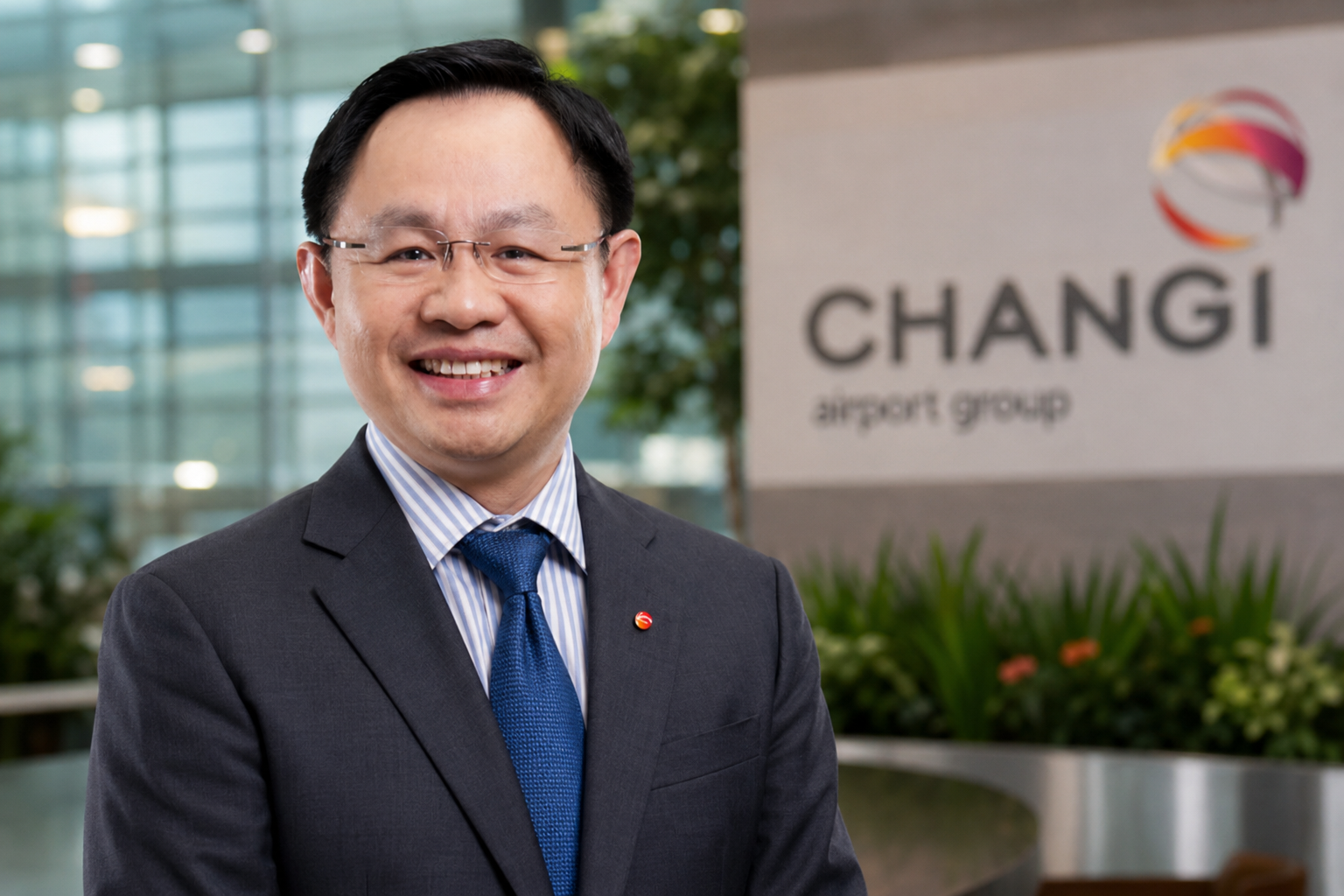
For Yam Kum Weng, Chief Executive Officer of , that responsibility comes at an important moment for Asian aviation.
Passenger demand across the region continues to grow. Airlines are rebuilding and expanding networks. Technology is changing airport operations. Sustainability expectations are increasing. At the same time, geopolitical uncertainty is demonstrating how quickly global traffic patterns can change.
Leading an airport in this environment requires considerably more than managing terminals and runways.
It requires thinking decades ahead.
And Yam’s career has positioned him unusually close to that challenge.
More Than Three Decades in Aviation
Yam brings more than 30 years of aviation experience spanning airport management, commercial development, aviation policy, traffic-rights negotiations, air-hub development and airport infrastructure.
He began his career with the Civil Aviation Authority of Singapore before taking on increasingly senior responsibilities within Singapore’s aviation ecosystem.
Before becoming CEO of Changi Airport Group, Yam served as Executive Vice President for Airport Development.
That part of his career is particularly significant.
He led the development of Changi’s Terminal 4 and subsequently spearheaded the wider Changi East Development — an enormous programme encompassing Terminal 5, Runway 3, cargo and logistics facilities and underground infrastructure connecting the future terminal with Changi’s existing facilities.
He therefore entered the CEO position not simply as an airport administrator, but as someone who had already been deeply involved in designing Changi’s future.
Building for a Future That Has Not Arrived Yet
Airport infrastructure presents an unusual leadership challenge.
Decisions made today may determine how an airport performs 20 or 30 years from now.
Terminal 5 demonstrates the scale of that responsibility.
Located within the 1,080-hectare Changi East development, the first phase of T5 is designed to accommodate approximately 50 million passenger movements annually and is expected to become operational around the mid-2030s.
But capacity alone is not what makes the project strategically important.
T5 is being designed to function as part of a single integrated Changi Airport rather than as an isolated terminal.
Automation, digitalisation, artificial intelligence, robotics and video analytics are among the technologies being considered or trialled to support future operations. The terminal is also being designed with lessons from the COVID-19 pandemic incorporated into its infrastructure and operational flexibility.
This represents a broader shift in airport thinking.
The airport of the future cannot simply be bigger.
It must be more adaptable.
Changi’s Leadership Challenge Is Changing
Changi has spent decades building an international reputation around passenger experience, operational standards and connectivity.
Maintaining that position may prove harder than achieving it.
Asian aviation is becoming increasingly competitive.
Airports across Southeast Asia, India, China and the Middle East are expanding. Governments are investing heavily in aviation infrastructure. Airlines have more choices about where they deploy aircraft and establish connections.
Changi therefore cannot depend entirely on its historical reputation.
It must continuously earn its position as a hub.
The scale of that responsibility is already visible.
In the first quarter of 2026, Changi handled 17.6 million passenger movements, an increase of 2.3% year-on-year. Over the 12 months ending March 2026, traffic reached 70.4 million passengers — Changi’s highest recorded passenger volume over a 12-month period.
The airport was connected to approximately 170 cities through close to 100 airlines operating more than 7,300 weekly flights.
Those numbers make Changi powerful.
They also make the consequences of strategic decisions much larger.
Connectivity Is the Real Product
Airports are often measured by passenger numbers.
But the deeper value of an international hub is connectivity.
A successful hub allows passengers from multiple origins to connect efficiently to multiple destinations. Every additional viable connection can strengthen the attractiveness of the entire network.
Yam understands this dimension from direct experience.
Alongside his airport-development responsibilities, he previously served as Advisor for Air Hub Development, working on strengthening Singapore’s air network and growing Changi’s traffic.
That combination of infrastructure and network experience matters.
Building an impressive terminal without sufficient airline connectivity does not create a successful hub.
Likewise, attracting airlines without sufficient infrastructure eventually creates congestion.
The two strategies must evolve together.
Leadership Beyond Singapore
Yam’s role also extends beyond Changi.
He is Chairman of Changi Airports International and the Jewel Changi Airport companies, and currently serves as a director on the ACI Asia-Pacific & Middle East Regional Board. His present ACI board term runs from January 2025 through December 2027.
That regional dimension is increasingly important.
Asia-Pacific aviation cannot develop entirely through individual airports competing independently.
Airports share many of the same challenges: infrastructure capacity, workforce development, sustainability, technology adoption, safety, security and increasingly complex passenger expectations.
The strongest aviation systems will likely be those capable of competing commercially while cooperating on standards, resilience and connectivity.
Technology Without Losing the Passenger
One of the most interesting questions facing airport leaders is how far automation should go.
Airports increasingly use biometric processing, automated baggage systems, self-service technology, artificial intelligence and robotics.
The economic logic is compelling.
Automation can improve productivity, reduce repetitive work and allow airports to process larger numbers of passengers without increasing manpower at the same rate.
Changi’s future Terminal 5 is being developed with extensive automation and digitalisation in mind.
But Changi’s reputation was not built on technology alone.
It was built around the passenger experience.
The leadership challenge will therefore be finding the correct balance.
Technology should make the airport feel easier — not more complicated.
The best airport technology may ultimately be technology passengers barely notice.
Resilience Has Become Part of Airport Leadership
Another lesson of recent years is that aviation leaders must prepare for disruption that cannot always be predicted.
Pandemics.
Airspace closures.
Wars.
Supply-chain interruptions.
Extreme weather.
Economic shocks.
The first quarter of 2026 provided another example. Changi reported that passenger traffic between Singapore and the Middle East fell 80% year-on-year in March amid geopolitical disruption, while airlines added around 90 flights between Singapore and alternative destinations including Frankfurt, London, Munich, Muscat, Paris, Perth and Sydney.
That is modern aviation leadership in practice.
The question is no longer simply how efficiently an airport operates when everything is normal.
It is how quickly the aviation ecosystem responds when normality disappears.
What Other Asian Airports Can Learn
Changi’s model cannot simply be copied.
Every country has different geography, traffic patterns, airlines, economic conditions and infrastructure requirements.
But there is a lesson in the way Singapore approaches aviation development.
It treats aviation infrastructure as something that must be planned far ahead of immediate demand.
That principle is relevant throughout Asia.
Airport development cannot begin only when terminals become overcrowded.
Workforce development cannot begin only when shortages appear.
Digital transformation cannot begin only when existing systems become obsolete.
And connectivity cannot be built overnight.
The decisions that determine an airport’s competitiveness in the 2030s are increasingly being made today.
Leadership Is Ultimately About What Comes Next
Yam Kum Weng’s leadership story is therefore larger than one executive appointment.
It reflects the changing role of the modern airport CEO.
The job is simultaneously about infrastructure, airlines, passengers, technology, commercial performance, national connectivity and long-term economic strategy.
Changi already has an extraordinary aviation legacy.
Yam’s challenge is different.
He must help ensure that the airport’s future becomes as significant as its past.
Terminal 5 will eventually open.
New technologies will become normal.
Passenger numbers will rise and fall.
New competitors will emerge across Asia.
Through all of that, Changi will need to continue answering one fundamental question:
What must an airport become today to remain relevant tomorrow?
For Yam Kum Weng and Changi Airport Group, the answer is already being built.
My Aviation | Leadership Spotlight
*Editorial note: This is an independent My Aviation editorial profile prepared from publicly available information. It is not an interview with, or endorsement by, Mr Yam Kum Weng or Changi Airport Group.*